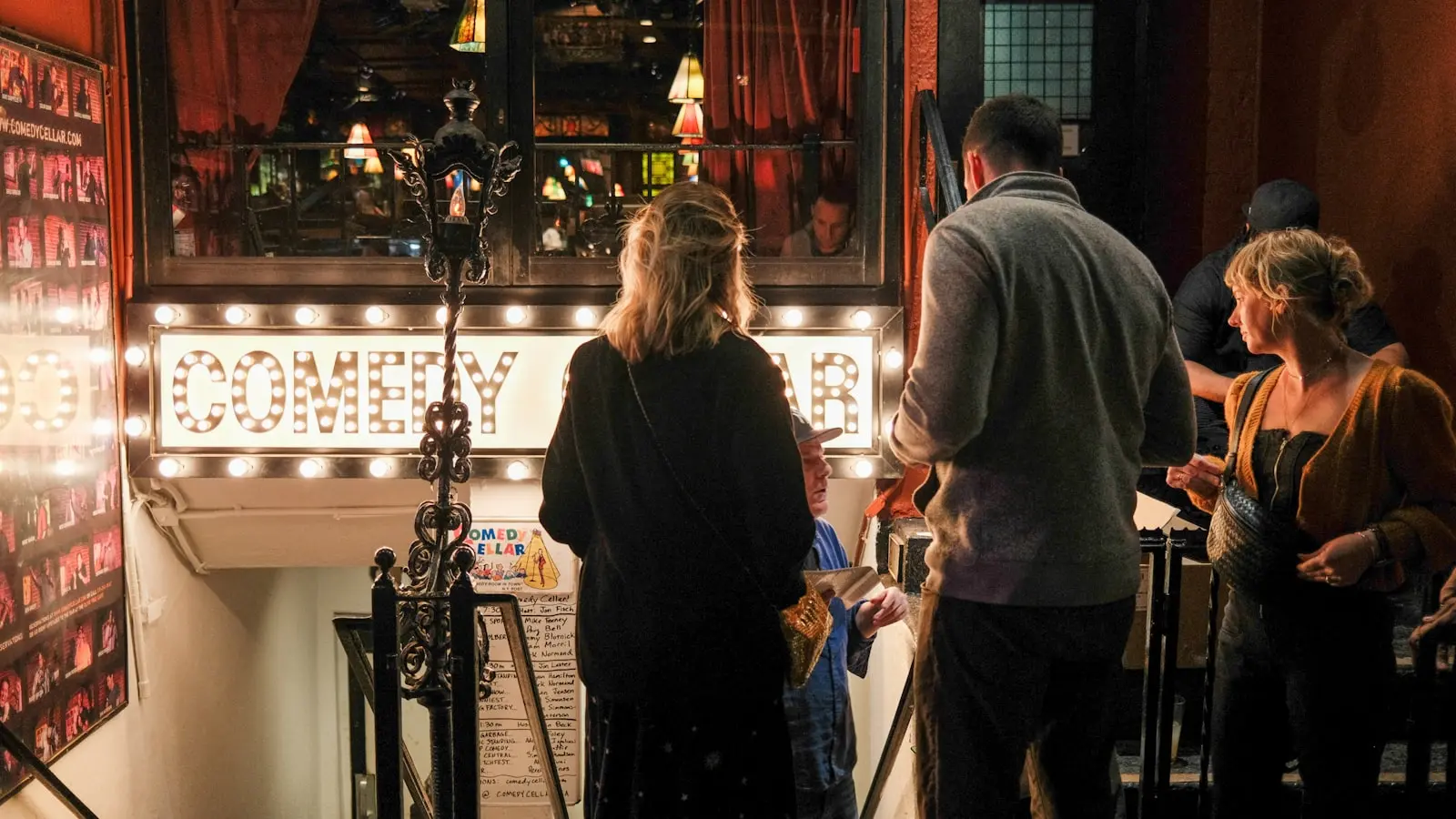
The Void Left by Unscripted Spontaneity
A recent Reddit post lamented the absence of a modern equivalent to Whose Line Is It Anyway. The thread erupted. Hundreds of commenters pointed to the same truth: improv comedy, in its purest form, resists digital capture. The show that defined a generation of spontaneous humor — a bare stage, four chairs, a host whose only prop was a ring binder — now feels like a relic from a different cultural climate. Yet the appetite for that exact energy has not faded. If anything, it has intensified. Why does live improv still command a loyalty that streaming content, for all its convenience, cannot replicate?
The answer is not about nostalgia. It is about architecture. The physical space of a live improv show — the black box theater, the worn wooden floor, the soft glow of practical lights — creates a contract between performer and audience that no screen can honor. When a comedian steps onto that stage without a script, the audience becomes a co-conspirator. Every pause, every breath, every misfire lands in real time. That vulnerability generates a specific physiological response. Analysts who study audience behavior note that shared laughter in a room triggers mirror neurons at a rate three times higher than solitary viewing. The body knows the difference. Streaming platforms, no matter how sophisticated, cannot engineer that collective pulse.
The Room as a Character
Improv is not merely a performance style; it is a spatial practice. The living room of a club, the low ceiling, the smell of spilled beer and old carpet — these details shape the humor. In Chicago, at iO Theater, the seats face a stage that sits barely a foot above the audience. The proximity eliminates the fourth wall. A performer makes eye contact with a woman in the front row, and that glance becomes a scene. The audience member is implicated. She cannot hide behind a screen. This intimacy is deliberate. The design of a black box theater — bare walls, movable seats, limited sightlines — forces attention inward. There is no distraction. The laughter reverberates. (Frankly, recording setups like this belong in the past only if you believe artifacts have no value.)
Streaming, by contrast, is a medium of elimination. Algorithms scrub pause, remove dead air, compress dynamic range. The laugh track replaces the real laugh. Even a live-streamed improv show, when watched at home, is filtered through a 16:9 frame and compressed audio. The environment of the viewer — a couch, a phone, a coffee shop — is not designed for communal vulnerability. The result is a sanitized version of spontaneity. The risk is gone. And risk is the engine of improv. Commenters in the Reddit thread noted this explicitly: improv works because it can fail. A show that cannot fail cannot thrill.
The Ritual of Departure
Attending a live improv show is not a passive act. It requires movement. You leave your house, navigate transit, find the venue, buy a drink, settle into a seat. This ritual of departure primes the brain for an experience. The walk from the train to the theater is part of the show. The cold air, the neon sign, the murmur of the crowd outside — these sensory inputs build anticipation. Once inside, the audience has invested time and money. That investment sharpens attention. In behavioral economics terms, the sunk cost increases the emotional stake. The viewer who paid $20 and traveled thirty minutes is more likely to engage deeply than someone who clicked a thumbnail while waiting for a download.
Streaming removes all friction. That is its genius. But friction is not always the enemy. The effort to attend a live show filters out passive consumption. You cannot multitask during an improv set. You cannot pause, rewind, or skip. The performance unfolds in irreversible real time. That irreversibility creates tension. And tension, in comedy, is the seed of laughter. A joke that lands after a long silence feels earned. Silence cannot exist on a platform that measures attention in seconds.
Who Makes Up the Audience
The Reddit thread also revealed a demographic pattern. Younger users expressed curiosity about improv but had never seen it live. Older users recalled the heyday of Whose Line and lamented the lack of a broadcast successor. The generational gap is not about taste; it is about access. Improv troupes exist in every major city, but they do not market aggressively. The venues are often hidden — above a bar, in a converted warehouse, behind an unmarked door. This obscurity is both a curse and a charm. It creates a sense of discovery. (Is this actually working? For those who find it, yes.) For those who do not, the experience remains abstract.
Meanwhile, streaming services pour billions into polished scripted content. A single season of a comedy series can cost $100 million. An improv show costs chairs and lights. The economic disparity is staggering. But the cultural return on live improv — measured in community cohesion, emotional resonance, and shared memory — cannot be captured by a balance sheet. When a theater runs an improv night, the bar next door fills. The local economy benefits. People talk to strangers. That social fabric is exactly what streaming platforms, in their drive for global scale, systematically erodes. The trade-off is real.
The Emotional Architecture of Laughter
Improv is a design problem. The stage must allow for movement. The lights must shift instantly. The sound system must pick up every whisper. But the most important design element is invisible: the expectation of imperfection. In a scripted show, the audience judges the artifact. In an improv show, the audience judges the process. They watch the performer’s brain work in real time. That transparency creates a bond. Studies in cognitive psychology suggest that witnessing someone think under pressure triggers empathy and admiration. We root for the performer. We forgive the stumble. That forgiveness is a gift the audience gives, and it is returned in the form of authentic laughter.
Streaming cannot replicate that gift because the viewer does not hold the power to forgive. The viewer can only consume or discard. The algorithm offers infinite alternatives. If a scene drags, the viewer swipes. That control kills the patience required for improv. A slow build — the hallmark of a great improv set — becomes impossible on a platform optimized for retention. The medium dictates the content. And the medium of streaming dictates speed, safety, and polish. The result is a diet of manufactured spontaneity, scripted within an inch of its life.
What the Reddit Thread Revealed
The original Reddit post asked for a modern Whose Line. Commenters nominated dozens of shows and YouTube channels, but none satisfied. The reason is structural. A weekly broadcast show with a fixed cast cannot capture the energy of a rotating group of performers who feed off a live crowd. Whose Line worked because it was filmed in front of a studio audience. The laughter was real. The performers were in a room with people. The camera was a witness, not a director. Modern attempts to recreate that format often overproduce. They add celebrity judges, pre-taped segments, and digital effects. They mistake chaos for spontaneity. Chaos is easy. Spontaneity requires trust.
Trust is built over time, in a space. The improv community in any city is a network of trust. Performers learn each other’s patterns. They learn the audience’s rhythms. A venue that hosts improv four nights a week creates a feedback loop. Regulars return. Jokes evolve. References compound. This cumulative culture is impossible to replicate in a streaming library. You cannot binge a relationship with a room. You can only be in the room.
The Lifestyle of Attendance
To attend an improv show regularly is to adopt a lifestyle. It means choosing a neighborhood, a bar, a weeknight. It means knowing the doorman and the bartender. It means accepting that some nights will be mediocre and that that mediocrity is part of the deal. The lifestyle is not for everyone. But for those it fits, it offers something rare: uncurated human encounter. In an age where every interaction is mediated by a screen, the physical presence of a comedy show becomes an act of resistance. The audience is not a market segment. They are witnesses.
Design shapes behavior. The layout of a theater — the sightlines, the acoustics, the comfort of the seats — either invites or discourages participation. A good improv space is designed for participation. The seats are close. The lights are warm. The bar is at the back, so movement during the show is minimized but not forbidden. The stage is low. The exits are visible. Every detail says: this is a place where things can happen. Compare that to the design of a streaming UI — rows of thumbnails, autoplay, infinite scroll. The UI says: never settle. Keep moving. That frictionless flow is the enemy of immersion.
The Cost of Convenience
Streaming has trained us to expect entertainment on demand. That expectation has eroded our tolerance for the unpredictable. But the unpredictable is where life happens. Improv is a microcosm of social reality. You cannot control the person next to you. You cannot control the performer’s mood. You cannot control the timing. You can only surrender to the moment. That surrender is terrifying and exhilarating. It is a skill we are losing. The Reddit thread was a symptom of a deeper hunger: a desire to feel something unscripted, something that has not been optimized by an algorithm.
Live improv will never become a mass market product. It cannot scale. That is its strength. It remains a niche, resilient because of its limitations. The venues that host it are often struggling. The performers are often unpaid. But the experience persists. Because there is no substitute for being in a room with strangers, laughing together at something that just happened. The design of that moment cannot be replicated by a platform. It can only be lived.
The Future of Spontaneity
Will there ever be a modern Whose Line Is It Anyway? Probably not in the same format. The television landscape has shifted. But the desire that powered that show — the desire for real-time, unscripted human connection — is stronger than ever. The challenge for content creators is not to replicate the format but to honor the principle. That means building spaces, both physical and digital, that allow for risk, imperfection, and collective experience. It means designing for vulnerability rather than polish.
Until then, the best place to find that energy is in a black box theater, on a Tuesday night, with twenty other people and a stage that holds everything. The lights go down. The host says a word. And something begins that no one has seen before. That is the gift. That is what streaming can never sanitize.