Recent shifts in online travel discourse reveal a quiet rebellion against the long-held consensus that Brussels operates merely as a bureaucratic transit lounge. Travel forum analysts note a rising tide of contrarian trip reports defending the Belgian capital. The data points toward a specific, highly functional utility. Brussels performs perfectly as a low-stress entry point for first-time European travelers. A standard three-night deployment allows tourists to absorb transatlantic time shifts, master regional transit systems, and engage with high-level culinary craftsmanship without confronting the aggressive spatial overwhelm of Paris or Rome.
When digital itineraries circulate across prominent platforms, the standard advice demands skipping the capital entirely. Commentators routinely label Brussels a sterile staging ground for European Union administrators. The city suffers from an image problem rooted in its institutional architecture rather than its lived reality. (Tourists consistently mistake political infrastructure for cultural emptiness). However, travelers ignoring this digital pessimism frequently encounter a structurally sound urban environment. The layout naturally guides disoriented arrivals through manageable districts anchored by centuries of unbroken architectural intent.
Rain slicks the cobblestones outside the Gare du Midi as high-speed rail lines discharge passengers into the terminal. Commuters bypass neon waffle stands, navigating toward localized tram networks while the smell of oxidized copper and roasted malt lingers in the humid air. This environment lacks the manufactured charm of a theme park. This functional European hub moves capital and humans with quiet efficiency. The machine hums.
The Architecture of Decompression
Design shapes behavior. The physical layout of Brussels contrasts sharply with the sprawling, concentric rings of major megacities. The central core remains tightly wound, allowing first-time visitors to build an internal map within forty-eight hours.
Long-haul flights sever the human body from its natural environment. Arriving in Europe from North America induces profound chronological disorientation. When travelers immediately transfer into the subterranean tunnels of the Paris Métro or the London Underground, artificial lighting and massive crowds spike cortisol levels. Brussels counters this physiological shock through surface-level walkability. The urban density remains low enough to encourage continuous outdoor movement. Sunlight exposure resets circadian rhythms. First-time visitors navigate the relatively flat terrain of the lower city, letting natural light and fresh air flush out transatlantic fatigue.
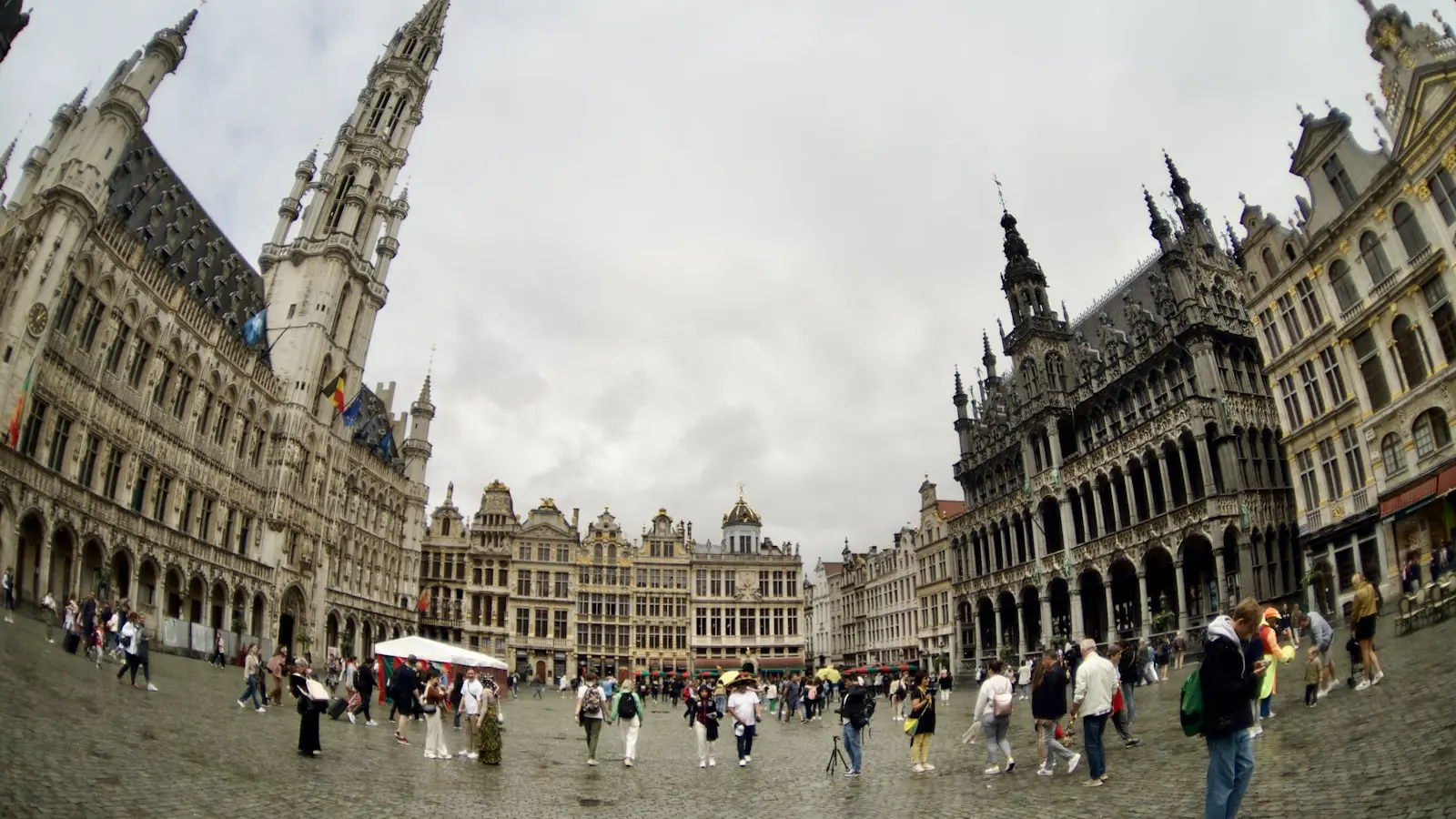
At the center sits the Grand-Place, an architectural footprint demanding immediate sensory engagement. Gothic facades and guildhalls lined with gold leaf reflect centuries of mercantile wealth. Unlike the vast, exhausting stretches of the Louvre or the fractured zones of Berlin, the historic center of Brussels provides an immediate aesthetic return on investment. Visitors step out of their hotels and instantly interact with world-class design. (This immediate gratification proves vital when fighting a six-hour timezone deficit). Pedestrians trace the perimeter of the square, funneling down narrow side streets radiating outward like spokes on a wheel. Urban planners engineered these arteries for commerce, not cars. Walkability lowers heart rates. First-time tourists map their routes between boutiques and taprooms without battling six lanes of aggressive traffic. The city scales down to the human eye.
Navigating the Aesthetic Divide
Beyond the golden trim of the central square, the broader city reveals competing aesthetic movements. Late nineteenth-century wealth fueled radical architectural experimentation. Architects warped industrial materials into organic shapes, bending iron and glass into sweeping, botanical staircases. These Art Nouveau townhouses dominate specific neighborhoods, forcing pedestrians to continually look upward. This design philosophy directly opposes the rigid geometry of modern institutional buildings.
Further down the socioeconomic ladder, the Marolles district provides necessary grit. Here, the daily flea market at Place du Jeu de Balle spreads across cracked paving stones. Vendors unbox brass lamps, faded oil paintings, and discarded industrial tools. The atmosphere feels distinctly unpolished. Diners consume bruised snails in dark broth at corner cafes while locals negotiate prices in heavy, guttural dialects. This rough texture shatters the illusion of Brussels as a sterile administrative waiting room. (Authenticity rarely looks pristine).
Culinary Craftsmanship as Lived Culture
Culture shapes taste. Tourism often flattens local food into transactional souvenirs. Brussels resists this commodification through an overwhelming density of craftsmanship. The twin pillars of Belgian culinary identity function not as tourist traps, but as foundational elements of daily life.
Consider the mechanics of the chocolate trade within the Sablon district. Master chocolatiers do not merely temper cocoa. They engineer flavor delivery systems. Sourcing single-origin beans from equatorial regions, artisans calculate fat-to-sugar ratios to manipulate melting points on the palate. Travelers stepping into these boutiques encounter clinical precision wrapped in velvet aesthetics. Ambient temperatures drop. Glass display cases highlight pralines like cut jewels. The environment elevates consumer expectation.
Similarly, the local brewing culture relies on atmospheric biology. Traditional lambic beers depend entirely on spontaneous fermentation fueled by wild airborne yeasts unique to the Zenne valley. Brewers leave massive copper vats open to the night air, inviting the local environment to literally infect the wort. (A beautiful, controlled decay). When a patron orders a complex geuze in a dark, wood-paneled estaminet, they consume the literal microclimate of the city. This level of terroir forces newcomers to slow down and analyze the liquid sitting in their glass.
The Economics of the Hub-and-Spoke Strategy
Beyond aesthetics and taste, Brussels provides structural leverage for extended European itineraries. The economic and geographic advantages of the city make it a highly rational basecamp. Positioning matters.
Look at the transit topology. Brussels anchors the western European high-speed rail corridor. International networks converge here, linking the city to major capitals within two hours. Rather than unpacking luggage in a new hotel every second night, travelers secure a central headquarters. From this hub, day trips to heavily promoted regional cities require minimal transit time. The financial arbitrage becomes immediately clear. Visitors capture the medieval aesthetics of Flanders during the day while retreating to the superior dining infrastructure of the capital at night.
Regional transit efficiency from Brussels Central Station:
- Ghent: 35 minutes via standard intercity rail
- Antwerp: 45 minutes via standard intercity rail
- Bruges: 60 minutes via standard intercity rail
- Paris: 85 minutes via high-speed rail
This hub-and-spoke model eliminates the friction of continuous movement. Luggage remains stationary. Hotel checkout lines vanish. The traveler maximizes time on the ground rather than losing hours staring at departure boards in crowded transit lounges. (Friction destroys itineraries).
The Value of Quiet Competence
Why does the negative online consensus persist despite these structural advantages? The mismatch lies entirely in expectation. Algorithmic platforms prioritize extreme visual distinctiveness. They reward the whitewashed domes of Santorini or the perilous cliffs of the Amalfi Coast. Brussels offers functional mastery over chaotic spectacle.
The European Quarter undeniably projects a sterile corporate energy. Men in tailored navy suits clutching leather briefcases march toward secure subterranean parking garages. Wind whips through brutal corridors created by severe modernist architecture. Yet, limiting an assessment of Brussels to this single administrative district represents a critical analytical failure. It ignores the vibrant immigrant neighborhoods of Ixelles, the antique markets of the Marolles, and the architectural heritage curving gracefully through Schaerbeek.
Brussels demands a specific type of traveler. It rewards those seeking the quiet mastery of an artisan over the loud clamor of a tourist trap. The city refuses to perform for its visitors. It simply exists, highly functional and deeply rooted in its own traditions, waiting for newcomers to adjust their internal clocks and recognize the value of a well-engineered space.
By embracing the very qualities travel forums deride, first-time arrivals gift themselves the most valuable resource in international travel. They secure a soft landing. They buy time to breathe.