The Silk Road Squeeze
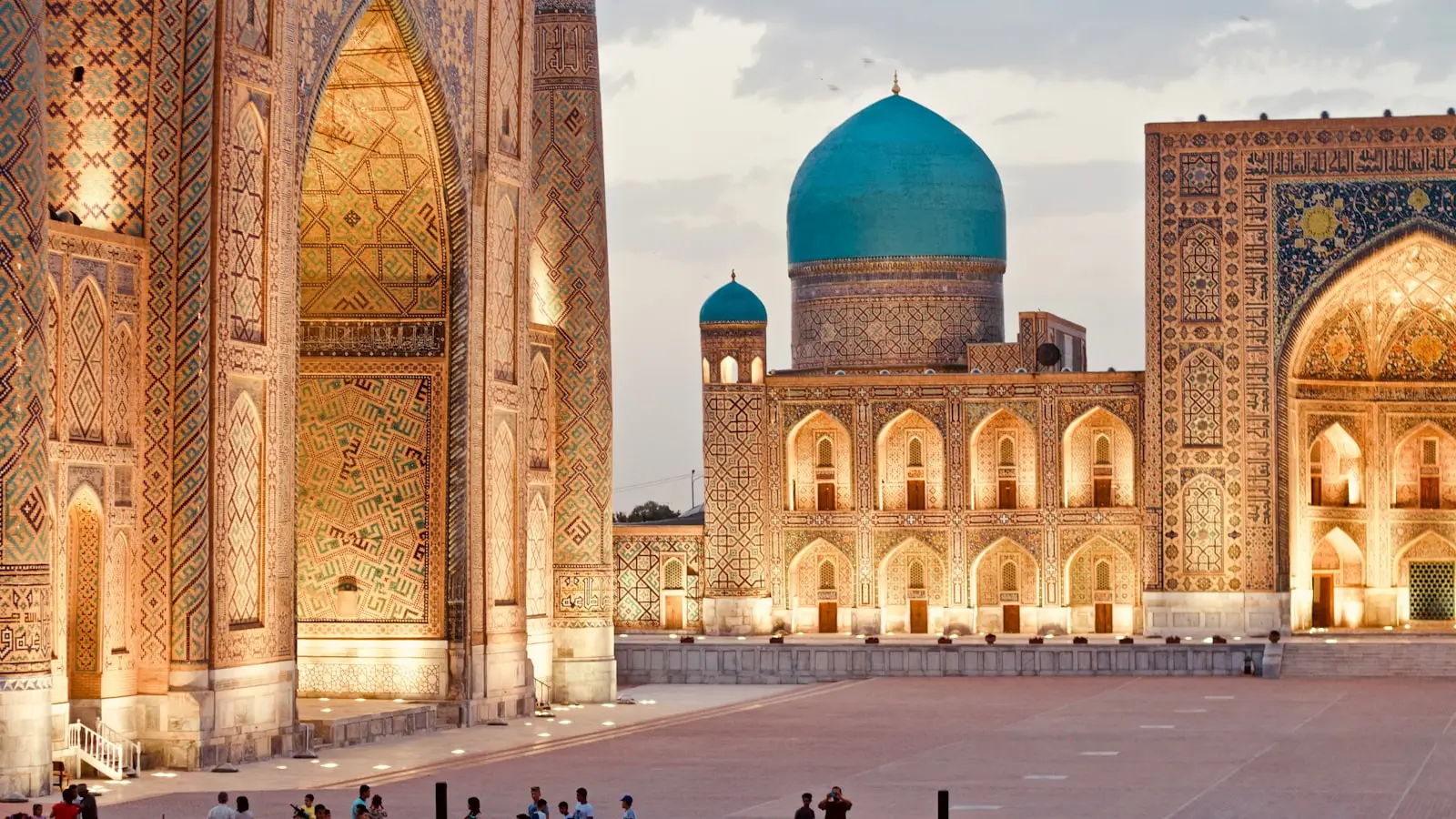
When a Reddit user posted a 13-day itinerary threading through Uzbekistan’s four major Silk Road cities with a single-day detour into Tajikistan’s 7 Lakes, the travel community reacted not with skepticism but with a quiet, envious curiosity. The post described a route that compressed centuries of history into less than two weeks: 1.5 days in Tashkent’s Soviet metro labyrinths, then a high-speed lurch to Samarkand for its turquoise domes, followed by Bukhara and Khiva. The outlier was the day-long side quest to the 7 Lakes of Tajikistan, launched from Samarkand — a logistical pivot that made commenters lean in. The question on everyone’s lips: is this packed itinerary a masterclass in efficiency or a recipe for exhaustion?
The numbers tell one story. Tashkent to Samarkand: two hours by Afrosiyob train. Samarkand to Bukhara: under three hours. Bukhara to Khiva: a longer eight-hour road haul across the Kyzylkum Desert. The Tajikistan side trip — crossing the border at Sarazm into Penjikent, then driving an hour into the Fann Mountains — demands a dawn start and a late return. Travelers who attempt this must sacrifice something: a slower meal, a deeper conversation, the random courtyard discovery that defines real exploration. Yet the allure is undeniable. The 7 Lakes (Haft Kul) are a chain of alpine pools cascading through rock, each a different shade of jade and cobalt. To see them in a single day from Samarkand is to treat them as a trophy, not an experience.
The Reddit Blueprint: What the Post Actually Said
The original post, buried in a travel subreddit, offered a tight outline. Day one in Tashkent: the blue-domed Minor Mosque, then a descent into the metro stations built during Stalin’s era (each station a marble-and-mosaic time capsule). Day two: a morning at Khast Imam complex before the train to Samarkand. Three days in Samarkand: Registan at sunset, Shah-i-Zinda’s avenue of tombs, Gur-e-Amir’s ribbed dome, the Bibi-Khanym Mosque. Day six: the side trip to the 7 Lakes — a taxi ride to the border, a guide on the Tajik side, a loop around the lakes, and a return by dusk. Then a train to Bukhara for two days, focusing on the Ark fortress, the Kalyan Minaret, and the trading domes. Finally, a long transit to Khiva for a day and a half inside the mud-walled Itchan Kala. Total: thirteen nights.
The comments flooded in with pragmatic doubts. How long does the border crossing actually take? (Answer: usually 30-60 minutes if paperwork is ready, but can balloon to two hours during peak season.) Is the 7 Lakes worth a full day when Samarkand itself demands more time? (Depends on a traveler’s tolerance for being in a car for six hours to get nine hours of lake-side wandering.) The broader pattern reveals a common tension in modern Silk Road travel: the desire to check off every UNESCO site versus the need to let a place settle into your bloodstream.
Logistics of the Tajikistan Side Quest
Crossing from Uzbekistan into Tajikistan from Samarkand is not a spontaneous hop. The nearest border post is Sarazm, a dusty checkpoint about 50 kilometers west of Samarkand. Travelers need a valid Tajik visa (e-visa available for most nationalities, processed in 3-5 days) and must ensure their Uzbekistan visa allows re-entry if they didn’t opt for double-entry. The Reddit user likely arranged a driver in Samarkand who handled the border formalities — a common workaround, though it adds cost. Once across, the journey to the 7 Lakes takes about an hour by four-wheel drive along unpaved mountain roads. The lakes themselves sit at altitudes from 1,600 to 2,500 meters, and the temperature drops sharply even in summer.
The side trip consumes an entire day. A typical schedule: leave Samarkand at 6 a.m., cross the border by 8 a.m., arrive at Lake 1 by 9 a.m., hike or drive through the seven lakes (with stops for photos and a picnic), then begin the return by 4 p.m. to reach Samarkand by 8 p.m. That leaves zero margin for delays. (One commenter noted that a flat tire could derail the entire itinerary.) Yet the payoff is visceral: standing at Lake 4, where the water is so clear you can count pebbles at three meters depth, while the only sound is wind scraping against scree slopes. The contrast with the mausoleums and minarets of Samarkand is stark — a switch from human-made geometry to geologic chaos.
Time Management: What Gets Sacrificed
A 13-day itinerary covering five distinct locations demands ruthless prioritization. In Samarkand, the standard three-day allocation allows for Registan at dawn, noon, and dusk — each light cast differently on the tilework. But the side trip to the lakes cuts that down to two full days plus a morning and evening. The Reddit user likely skipped the Afrosiab Museum or the Mausoleum of Saint Daniel to accommodate the lakes. Similarly, Bukhara’s labyrinth of medressas and the ancient trading domes could consume four days; here they get two. Khiva, the smallest city on the route, suffers the least compression because it’s confined within the city walls — but even there, a single day only scratches the surface of its thirty-six mosques and twenty-nine madrasas.
Data from travel analytics firm ForwardKeys shows that the average length of stay for international tourists in Uzbekistan is 7.5 nights. This itinerary stretches to 12 nights (counting the 13 days as 12 overnight stays). That’s nearly 60% longer than average, but the side trip effectively shrinks the per-city dwell time. The trade-off is palpable: you see more sites but absorb less atmosphere. The Reddit thread’s most upvoted comment captured this: “You’ll have great photos, but will you remember the taste of the bread?” It’s a fair critique. But for travelers with limited vacation days, the itinerary offers a curated sample — like a tasting menu rather than a multi-course feast.
Architectural Highlights: A Sensory Inventory
Tashkent’s metro stations are a crash course in Soviet public art. At Kosmonavtlar station, the ceiling is a mural of space helmets and star fields, commemorating Uzbek cosmonauts. At Alisher Navoi station, chandeliers drip with gold leaf, and marble pillars are etched with scenes from Uzbek literature. The Reddit user’s 1.5 days likely included a ride from Amir Timur station to Chilonzor station — a line that passes through seven stations, each a different aesthetic. This is not a museum; it’s a functioning subway where commuters read newspapers under chandeliers.
Samarkand’s Registan is the postcard shot that every photographer wants. But the real experience is tactile: the glazed tiles are cool to the touch even in 40°C heat, and the calligraphy carved into the iwans is so deep that you can run a finger along the letters. Shah-i-Zinda, the avenue of mausoleums, compresses a thousand years of Islamic architecture into a single corridor. The Reddit user probably spent an hour there, but the density of blue monochrome (from turquoise to lapis) makes it feel longer. The 7 Lakes side trip pulls you out of this human-built world and into a landscape where the only structures are shepherd huts and Soviet-era hydro stations.
Bukhara’s Kalyan Minaret is a tilted brick pencil that survived Genghis Khan’s siege (the story goes that the conqueror was so struck by its height he ordered it spared). The Ark of Bukhara is a fortress whose walls are 20 meters thick in places. Here, the Reddit user would have watched the sun set over the old city from the top of a madrasa terrace, listening to the muezzin’s call mixing with the chatter of tourists. Khiva’s Itchan Kala is a walled city within a city, where the streets are still made of packed clay and the doors are carved with geometric stars. The compressed schedule means skipping the night tour of Khiva’s lit-up minarets — a loss, because the lamps cast shadows that make the tilework glow.
Border Strategies and Practical Hacks
For the side trip to the 7 Lakes, the Reddit user likely used a pre-arranged driver from Samarkand’s central bazaar. Cost for this service is typically $80–$120, including waiting time at the border. Another option is to join a group tour from Penjikent, but that requires crossing the border first and then finding a tour — a risk when time is tight. The key tip from experienced travelers: carry printed copies of all visas and hotel bookings, because the Tajik border guards may demand proof of accommodation. Also, the Uzbek side requires leaving passport-sized photos for the exit stamp (some travelers forget this and waste 20 minutes buying photos at a kiosk).
The 7 Lakes themselves are not marked on most maps by name, only by number from 1 to 7. Lake 1 (Nofin) is the largest and most accessible, but Lake 4 (Khosor) is the photogenic one with the deep turquoise water. The road between lakes is rough; drivers often stop at Lake 3 and let hikers walk the remaining distance. The altitude can cause mild headaches for those coming from Samarkand (700 meters) to the lakes (up to 2,500 meters). A wise traveler would bring aspirin and extra water. The Reddit commenters who asked about safety were right to be cautious — the path is unmarked, and cell service vanishes after Lake 2.
The Verdict: Immersion vs. Quantification
Can you really visit all of Uzbekistan’s Silk Road highlights plus a slice of Tajikistan in 13 days? The answer is a qualified yes — if you define “visit” as seeing the primary sites, taking the required photos, and eating the recommended plov. But the deeper question, the one that echoes through the Reddit thread, is whether such a trip allows for the kind of immersion that writer Marcus Wright calls “emotional architecture.” When you race from one UNESCO site to another, you miss the texture of everyday life: the tea vendor who remembers your order, the carpet seller who tells you the story of his grandmother’s weaving, the moment you sit in a chaikhana (teahouse) and watch the call to prayer drift through the alleys.
The Reddit user’s itinerary is a trade-off between breadth and depth. If you have exactly two weeks and a burning desire to see the 7 Lakes, it works. The logistics are tight but doable; the border crossing is manageable with proper preparation; the sights are extraordinary. But if you want to understand the Silk Road as a lived grid of caravan routes, not a checklist of monuments, consider extending to 18 days or dropping Khiva. The Fann Mountains deserve at least a night. The Ark of Bukhara deserves an afternoon with no plan. The Registan deserves to be seen in rain, not just sunlight.
This itinerary is not for everyone. It’s for the traveler who accepts that some memories will be thin, like the edges of a high-contrast photograph. But for those who take it, the reward is a vivid, compressed hit of Central Asia’s layered history — and a side of glacial blue lakes that most visitors never see. The Reddit post ends with a simple line: “I didn’t sleep much, but I don’t regret a thing.” That’s the paradox of the modern Silk Road: the harder you push, the more you might miss, but the more you also gather. The choice is yours.