The Crossroads of Two Itineraries
A traveler sits cross-legged on a cushion in a Samarkand chaikhana, the scent of green tea mingling with the dust of Registan Square. Their phone glows with a Google Maps route that ends not at a minaret but at a cluster of unnamed turquoise pools on the Tajikistan side of the border. The Seven Lakes — Haft Kul — lie just 90 kilometers east as the crow flies, yet the journey requires two border crossings, a hired driver, and a faith that the day’s schedule will survive the friction of Central Asian bureaucracy. On Reddit, the debate is fierce: is this side quest a natural extension of an Uzbekistan tour, or a distraction from the Silk Road’s finest courtyards?
The Numbers Behind the Decision
To assign a cost to the detour, one must first measure the distance. Samarkand to the Panjakent border crossing is roughly 60 kilometers, a smooth drive through irrigated fields. From Panjakent to the first of the seven lakes — the lowest at 1,600 meters — is another 40 kilometers of ascending dirt road. The round-trip drive consumes six to seven hours. Add two hours for border formalities (exit Uzbekistan, enter Tajikistan, then reverse in the evening). A guided day tour runs between $80 and $120 per person, including transport but not meals. The Reddit thread that sparked this analysis reports that one traveler, who included the lakes mid-January, called it the “undisputed highlight” of their 13-day itinerary. Another commenter countered: “If you’re here for history, stay in the cities. The lakes are beautiful but they eat daylight.”
The Border as Threshold
Crossing the border at Panjakent is an exercise in patience and paperwork. The Uzbek checkpoint, a low concrete building with a faded flag, processes vehicles slowly. On the Tajik side, a guard peers into the trunk, asks for the driver’s documents, and waves the car through. For the traveler, the act of passing through this liminal space — leaving the ordered geometry of Samarkand’s madrasas for the chaotic rock faces of the Fann Mountains — shifts the rhythm of the trip. Design here is not architecture but negotiation: the visa forms, the photocopy of the passport, the crumpled dollar bill slipped under a passport (though no one admits to this). The lakes are not just a destination; they are an experience of crossing, of being between two states.
The Seven Lakes: A Geological Gallery
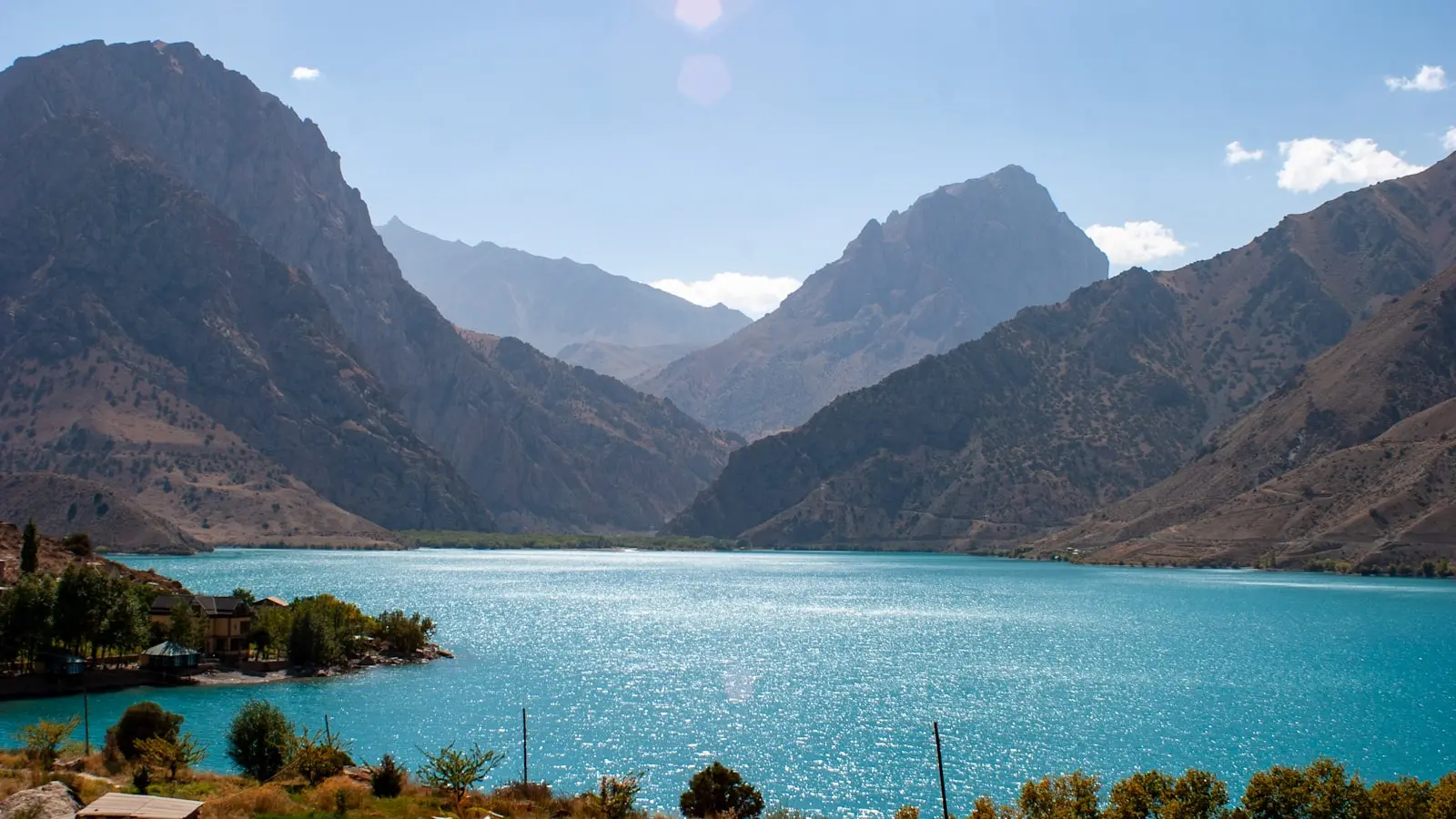
The lakes themselves are a sequence of glacial tarns strung along the Kuli-Kalon River, each a different shade of blue due to varying mineral content and depth. The lowest, Mijon, is a milky turquoise; the highest, Khurmi, a deep sapphire. They sit at altitudes between 1,600 and 3,200 meters, meaning the air grows thin and the sunlight sharp. A hiker can walk from one to the next in four to five hours, passing waterfalls, juniper groves, and the occasional shepherd’s yurt. The landscape is raw — no hotels, no cafe, just a few stone shelters where local families sell yogurt and bread. (Frankly, the emptiness is the point.)
The geological story is one of forces that predate the Silk Road by millennia. The Fann Mountains were pushed up by the collision of the Indian and Eurasian plates, then carved by glaciers that receded only 10,000 years ago. The lakes are young, geologically speaking, but ancient relative to human memory. This is a land that has never been tamed into a garden. Compare this to the Registan, where every brick was shaped by a human hand. One is a monument to civilization; the other, to the planet’s indifference.
The Trade-Off: Immersion vs. Exhaustion
The Reddit thread reveals a split between nature enthusiasts and culture purists. One user wrote: “I loved it because it broke the rhythm of mosques and mausoleums. By day seven, I needed to breathe.” Another: “I regretted every minute. The drive was exhausting, the lakes looked like every other mountain lake I’ve seen, and I missed the final hour of the Ulugh Beg Observatory.” This tension is real. A 13-day Uzbekistan itinerary typically covers Tashkent, Samarkand, Bukhara, and Khiva — all cities of immense historical density. Adding a day trip to the mountains means sacrificing a morning in Samarkand’s bazaars or an afternoon in a tiled courtyard. The trade-off is between depth and breadth, between the human story and the natural one.
For the traveler with a camera, the payoff can be extraordinary. The light on the seventh lake at dusk, when the water turns opaque and the peaks reflect upside down, is not replicable in a square in Shahrisabz. But the cost in fatigue is high. After a day of border stress and bumpy roads, returning to a Samarkand hotel at 8 p.m. leaves little energy for a night walk to the Registan.
Practicalities for the 13-Day Planner
Any traveler considering this detour must secure a double-entry visa for Uzbekistan (or a single-entry if not returning) and a visa for Tajikistan (e-visa available for most nationalities, taking three days). The driver must have a vehicle that can handle the Tajik side’s gravel road — a typical sedan will manage, but a 4x4 is better. Most guides recommend leaving Samarkand by 7 a.m., reaching the border by 8, and returning by 5 p.m. to avoid driving the mountain road in darkness. (This schedule leaves no room for wandering in Panjakent’s bazaar, which some might call a loss.)
The season matters. The lakes are accessible from May to October; winter snow closes the road. Late spring brings wildflowers; early autumn offers crisp air and fewer tourists. The lakes are not a destination for luxury — there is no lodge, no Internet, no plumbing above the first lake. For the traveler seeking comfort, the detour may feel punishing. For the traveler seeking a break from the man-made, it becomes essential.
The Verdict: Is It Worth It?
To answer the question, one must ask what a trip is for. If the itinerary is a pilgrimage through Islamic architecture and Persian poetry, the Seven Lakes are a divergence. But if the trip is an immersion into the whole of Central Asian landscape — the arid steppe, the irrigated oases, the high-altitude silence — then the lakes are not a detour but the missing piece. The Reddit consensus leans toward “worth it for the right traveler.” The key is knowing which traveler you are.
The lakes offer something the cities cannot: a palpable sense of time before humans. The mountains are older than any madrasa, and the water is older still. Standing at the edge of a glacial pool, watching the ice melt into turquoise, the traveler may experience a silence that no Friday prayer can match. That is not a better experience — just a different one. And for those with 13 days in Uzbekistan, that difference may be exactly what the journey needs.