The European backpacker circuit operates on ruthless efficiency. Trains funnel millions across the continent, dictating cultural consumption by rail schedules. Brussels sits directly at the geographical center of this transit web, yet it faces an enduring reputation as an obstacle rather than a destination. Budget travelers frequently label the Belgian capital as a skippable administrative hub, favoring the immediate visual gratification of Bruges or Amsterdam. The narrative is sustained by endless forum threads detailing chaotic arrivals, heavy bureaucracy, and endless construction zones. The reality demands a slower pace.
Brussels-Midi station offers an unforgiving introduction. Passengers disembarking from high-speed rails face a terminal that feels purely utilitarian, surrounded by neighborhoods grappling with transit-induced transient populations. The concrete corridors echo beneath harsh fluorescent lighting. Baggage wheels clatter over uneven pavement outside. For travelers clutching rigid itineraries, the gritty texture of the immediate blocks triggers an immediate defense mechanism. They pivot toward the historic center, allocate four hours to check off landmarks, and board the next train. (This rushed consumption guarantees disappointment). The station’s architecture prioritizes rapid dispersion over human comfort, effectively programming visitors to leave before they ever actually arrive.
The Economics of the Layover
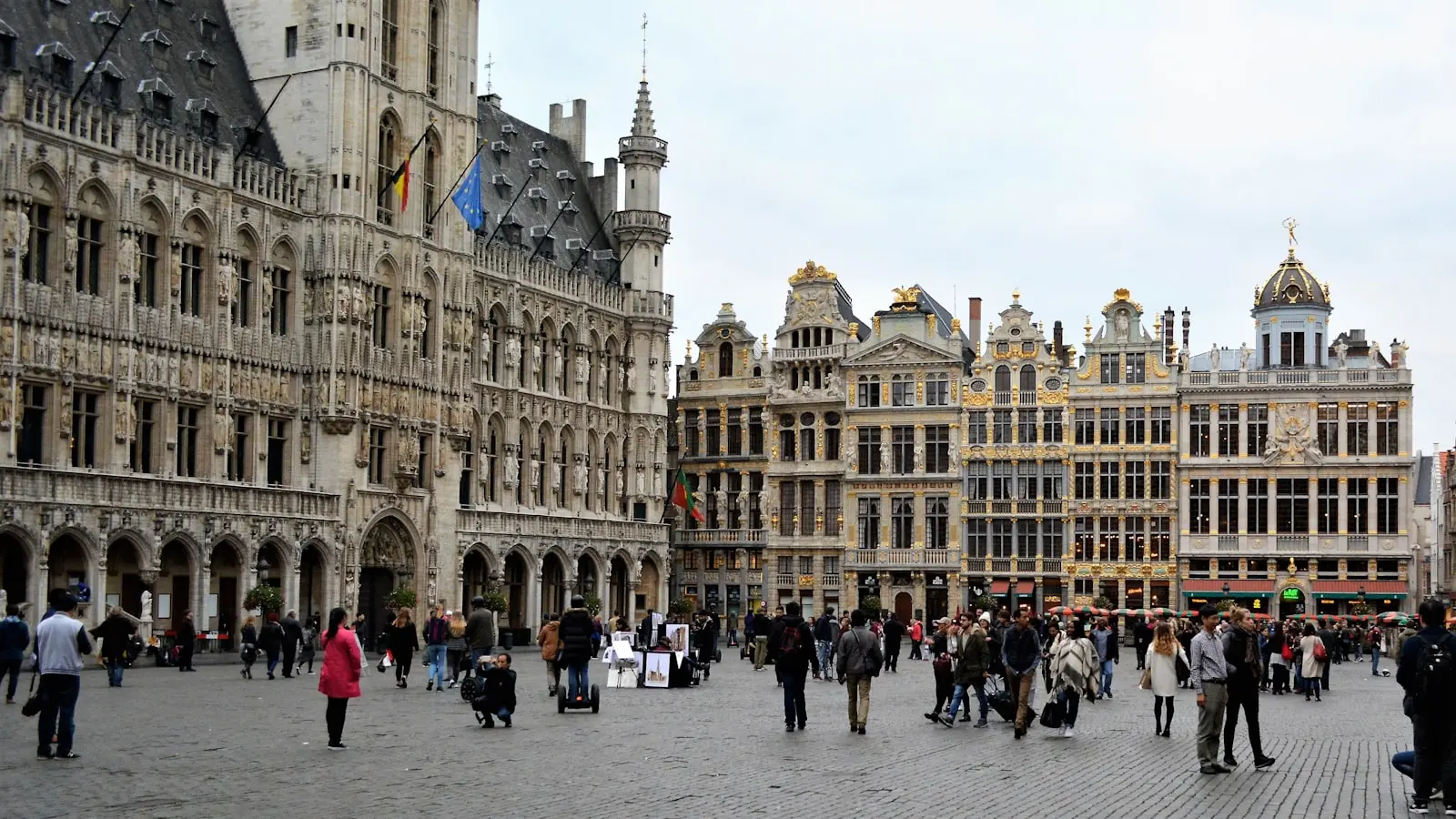
Tourism data frequently highlights a stark divide in visitor satisfaction based entirely on duration. The half-day layover restricts human movement to a tightly cordoned commercial zone. Visitors shuffle into the Grand-Place, gaze at the ornate guildhalls, photograph the Manneken Pis—a bronze fountain heavily burdened by oversized expectations—and retreat to the station. This artificial boundary prevents any engagement with the actual rhythm of the city. The architecture serves as a mere backdrop for rapid consumption rather than a lived environment.
When tourists treat a living metropolis as a checklist, the local economy adapts to extract maximum capital in minimum time. Waffle stands and chocolate shops proliferate around the central square, pricing their goods for a captive, transient audience. The budget traveler views these prices, notes the surrounding crowds, and incorrectly deduces that Brussels lacks authenticity. They miss the fundamental truth of urban economics. Authenticity never survives adjacent to a major transit node. To find the culture, one must escape the gravity of the tourist center.
Brusselization and Spatial Fracture
The visual dissonance of Brussels requires historical context. The term “Brusselization” entered the urban planning lexicon as a pejorative during the mid-20th century. Developers aggressively demolished historic blocks to insert high-rise office buildings, expansive government ministries, and broad avenues meant to accommodate the automobile. This haphazard modernization fractured the city’s continuity. A gothic church sits awkwardly adjacent to a glass-paneled corporate headquarters. Concrete flyovers cut through 19th-century neighborhoods.
For tourists conditioned to expect the preserved, museum-like uniformity of Paris or Prague, this architectural dissonance feels chaotic. Yet, this exact fracture generates the city’s contemporary energy. Unregulated boundaries allow diverse communities to intersect. The lack of a uniform aesthetic prevents the city from fossilizing into a historical theme park. Bruges functions flawlessly as a preserved artifact, but it lacks the friction required to generate new culture. Brussels uses its disjointed layout to foster distinct micro-cultures, forcing residents and deliberate travelers to navigate the contrast.
Organic Geometry in Ixelles and Saint-Gilles
Moving southeast into Ixelles and Saint-Gilles alters the spatial reality entirely. The bureaucratic grayness dissolves into neighborhood ecosystems defined by Art Nouveau architecture. Architects like Victor Horta and Paul Hankar designed these streets at the turn of the 20th century to break the rigid constraints of classical geometry. Wrought iron twists like organic vines across facades. Sunrooms capture the muted, diffused Belgian light. Asymmetrical doors invite curiosity.
These structures do not merely house residents; they mandate a specific way of living. The fluid lines of Art Nouveau encourage slower movement. Cafes bleed onto the wide sidewalks, forcing pedestrian interaction. The neighborhoods demand lingering. Here, the true multicultural fabric of Brussels materializes outside the sterile corridors of European Union institutions. Independent galleries operate out of converted townhouses. Local markets blend North African spices with traditional Flemish produce. The budget traveler who skips these districts completely misses the city’s core identity. (The failure lies in the itinerary, not the destination).
The Liquid Geography of the Zenne Valley
Cultural preservation in Brussels extends beyond stone and iron. The Brasserie Cantillon operates as a working museum of liquid geography. Located in the working-class district of Anderlecht, the brewery produces lambic beers using wild airborne yeast native specifically to the Zenne valley. The sensory experience of entering the facility immediately overwrites the modern city outside. The air inside smells fiercely of damp wood, oxidized hops, and sharp, acidic fermentation. Dust coats the aging oak barrels stacked in the shadows.
The brewers leave the cooling vats open to the night air under the roof tiles, allowing the environment to physically inoculate the wort. This process cannot be replicated elsewhere, nor can it be accelerated by modern technology. It requires immense patience and a surrender to local atmospheric conditions. (Sterility would completely destroy the product). The resulting beer—tart, complex, and uncarbonated—reflects the exact terroir of the city. Understanding Cantillon requires an understanding of time. This mirrors the exact requirement Brussels demands of its visitors. A quick taste shocks the palate; a deliberate session reveals profound depth.
The Value Proposition for Slow Travel
Budget travelers often miscalculate the value proposition of the Belgian capital. They measure cost strictly against immediate visual charm. Bruges delivers cobblestones and canals at a premium, operating almost exclusively as an extraction economy based on tourism. Brussels operates as a functional, working metropolis. The culinary and cultural scenes reflect this underlying utility.
- The Transit Stop: Focuses exclusively on the Grand-Place and Midi Station. Averages 4 to 8 hours. Results in high costs and low cultural return.
- The Slow Route: Explores Ixelles, Saint-Gilles, and Anderlecht. Requires 3 to 4 days. Delivers high value and deep cultural immersion.
Neighborhood bistros outside the center serve moules-frites and stoemp not as novelties, but as caloric necessities for a working population. Prices stabilize when restaurants rely on returning locals rather than a rotating cast of transient backpackers. Engaging with the city on these terms changes the financial equation. Craft beer bars in Saint-Gilles offer world-class selections at margins far below those in central London or Paris. Accessing this value simply requires the willingness to navigate the initial urban friction.
Brussels refuses to perform for the impatient. It hides its best assets behind bureaucratic facades and complex neighborhood boundaries. The city rewards persistence, sensory awareness, and a willingness to look past the scaffolding. When budget travelers skip Brussels, they are not bypassing a sterile administrative hub. They are surrendering to the superficiality of the transit schedule, missing an opportunity to engage with one of the most culturally layered environments in Western Europe.