Online travel communities frequently operate on inherited wisdom. For years, digital consensus has designated the Belgian capital as a sterile bureaucratic zone, a city to bypass in favor of the medieval stagings of Bruges or Ghent. Travelers mapping their first European itineraries absorb this narrative. They route trains around the city, treating it merely as a transfer station. Yet, an emergent counter-narrative disrupts this established digital advice. Recent consensus shifts across travel forums indicate that avoiding Brussels strips first-time visitors of the most strategic, low-stress gateway to the continent. (The digital echo chamber fractures upon contact with actual cobblestones).
The Architecture of Arrival
Examine the mechanics of a transatlantic arrival. A tourist lands at Brussels Airport carrying luggage, sleep deprivation, and the disorientation of a shifting time zone. Paris Charles de Gaulle and London Heathrow overwhelm the senses through sheer scale and logistical friction. Brussels routes passengers into the city center via a direct, seventeen-minute rail connection. When the train doors open at Gare Centrale, the transition from airport terminal to urban core completes itself with minimal friction. This matters. (Design shapes behavior, and urban design dictates the stress levels of the newly arrived).
A three-night stay serves a specific biological and logistical function. It provides enough temporal runway to reset circadian rhythms without demanding exhaustive daily navigation. The city operates at a manageable scale. Instead of fighting through labyrinthine subway transfers just to secure a morning coffee, travelers step out of central hotels directly into walkable, localized neighborhoods.
Urban Texture and Spatial Hierarchy
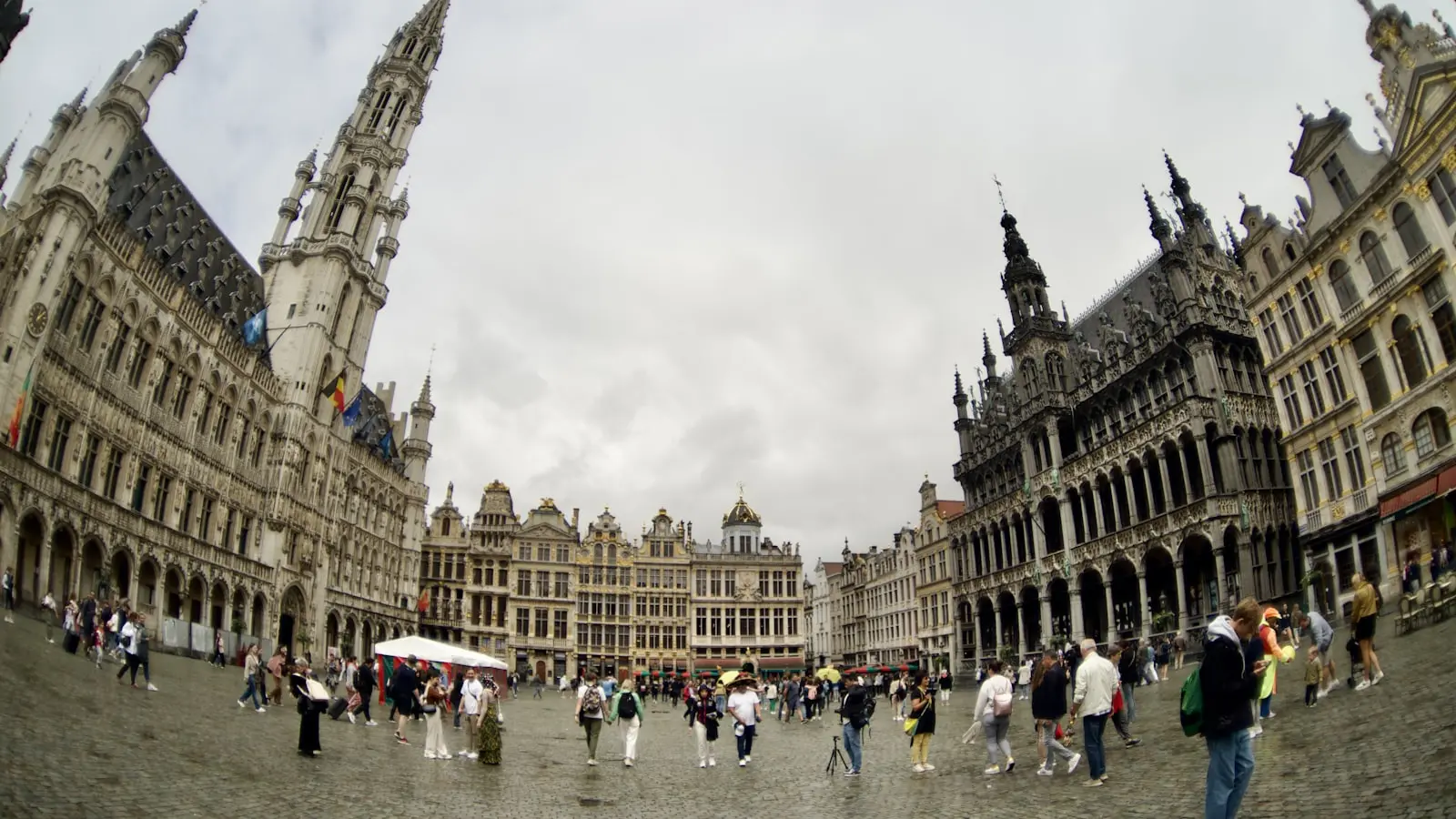
Visitors emerging from the subterranean rail network encounter a city that balances administrative function with deep historical textures. The Grand-Place dictates the spatial hierarchy of the lower town. Gold-leafed guildhalls and the flamboyant Gothic spire of the Hôtel de Ville enclose the square. It does not feel like a museum. Rain slicks the stone, reflecting the warm illumination of the surrounding architecture. Observers note how the space commands attention without requiring the exhausting navigation demanded by larger European capitals.
The topography of Brussels enforces a natural division of culture. The Mont des Arts acts as a physical staircase between the working-class roots of the lower town and the royal, administrative weight of the upper town. Walking this incline forces a shift in perspective. Below, the narrow alleys of the Îlot Sacré smell of hot oil and wet stone. Above, the wide neoclassical boulevards framing the Royal Palace speak the language of empire and statecraft.
Moving away from the central square, the city splinters into distinct atmospheres. The Sablon district presents antique markets and dense concentrations of master chocolatiers. The European Quarter anchors the east with glass facades and steel geometries. Critics dismiss the EU district as corporate sterility. They miss the contrast. The juxtaposition of the modern bureaucratic apparatus against the Art Nouveau curves engineered by Victor Horta creates a specific visual tension. At the turn of the 20th century, Horta utilized industrial materials—iron and glass—to mimic organic, twisting plant life, actively rebelling against the rigid stone structures of the establishment. Architecture here maps the evolution of European power and taste.
The Economics of Craft
Consider the local gastronomy not as a list of indulgences, but as an economy of craftsmanship. Belgian beer and chocolate occupy a specific cultural weight. Mass-market tourist shops crowd the streets feeding off the Manneken Pis foot traffic. However, deliberate navigation yields access to generational expertise.
- Chocolate: Cacao sourcing and tempering techniques shift chocolate from a confection to a disciplined art. Master chocolatiers balance ganache and praline with architectural precision. The snap of the temper reveals the structural integrity of the product.
- Brewing: Fermentation transforms from a factory process into a localized science. Lambics and gueuzes utilize wild airborne yeasts specific to the Zenne valley. The resulting liquid carries a complex, sour profile that rejects mass-market homogenization.
- Frites: The double-fry technique utilizing beef tallow demonstrates how foundational street food relies on rigorous methodology. The temperature differential between the first and second fry dictates the texture.
Tourists consume these items. Travelers study them. A first-time visitor anchoring their trip in Brussels gains immediate exposure to culinary standards that reframe their expectations for the remainder of their journey. (Taste requires baseline calibration).
Basecamp Strategy and Rail Connectivity
The geographical position of Brussels dictates its primary utility for the international traveler. The city functions as the central node in the Western European rail network. Once the initial fatigue dissipates, the traveler commands unparalleled access to surrounding regions.
Analyzing the departure boards at Brussels-Midi reveals the logistical leverage of the city. High-speed rail lines radiate outward across borders.
| Destination | Rail Network | Approximate Transit Time |
|---|---|---|
| Paris | Eurostar / Thalys | 1h 22m |
| London | Eurostar | 1h 53m |
| Amsterdam | Eurostar / Intercity | 1h 50m |
| Cologne | ICE | 1h 50m |
The anti-Brussels advocates recommend establishing bases in Bruges or Ghent. While those cities offer intense concentrations of medieval aesthetics, they lack the high-speed infrastructural spine required for aggressive regional exploration. Bruges operates as a preserved artifact. Brussels operates as a living transit mechanism. First-time visitors utilizing the capital as a basecamp reduce their transit friction while maximizing their geographical reach.
Psychological Pacing for the Uninitiated
The psychological burden of the first European trip often goes uncalculated. Travelers arrive burdened by itineraries demanding the consumption of multiple cities, museums, and landmarks within a compressed timeframe. Paris demands relentless navigation of the Métro and vast boulevards. Rome requires battling intense crowds under the shadow of monumental antiquity. London drains budgets and energy through its sheer sprawl.
Brussels demands nothing. The city permits the traveler to breathe. A morning spent walking through the Parc de Bruxelles, watching commuters navigate the gravel paths beneath the linden trees, offers a localized rhythm. Visitors sit in cafes in the Saint-Géry neighborhood, observing the daily commerce of the city without the pressure of an aggressive sightseeing checklist. The museums—whether the Magritte Museum or the Royal Museums of Fine Arts—provide dense cultural value without the soul-crushing queues associated with the Louvre or the Uffizi. (Frankly, the modern museum experience requires serious structural reform, but Brussels manages the crowds effectively).
This pacing matters deeply for trip longevity. Burning out on day three in a massive metropolis ensures the second week of a vacation operates purely on endurance rather than curiosity. Brussels functions as an airlock. It slowly pressurizes the traveler to European norms, currency, transit systems, and dining habits before they plunge into the deep water of the continent’s megacities.
Shifting the Digital Consensus
The reevaluation of Brussels happening within digital travel spaces signals a maturation in how tourists plan their routes. The initial instinct to chase postcard perfection yields to a desire for structural efficiency and manageable scale. The bureaucratic reputation serves as a filter. It keeps the overwhelming tourist masses concentrated in other capitals, preserving a layer of authenticity within the city core.
Travelers who ignore the negative advice secure a specific advantage. They secure a landing zone that accommodates their initial disorientation, feeds them with world-class craftsmanship, and positions them at the absolute center of the European rail grid. The decision to start in Brussels shifts the entire trajectory of a trip. The initial days define the momentum of the weeks that follow. Establish a chaotic baseline, and the trip becomes a survival exercise. Establish a structured, manageable baseline in the Belgian capital, and the trip transforms into deliberate exploration. (The internet gets it wrong quite often).