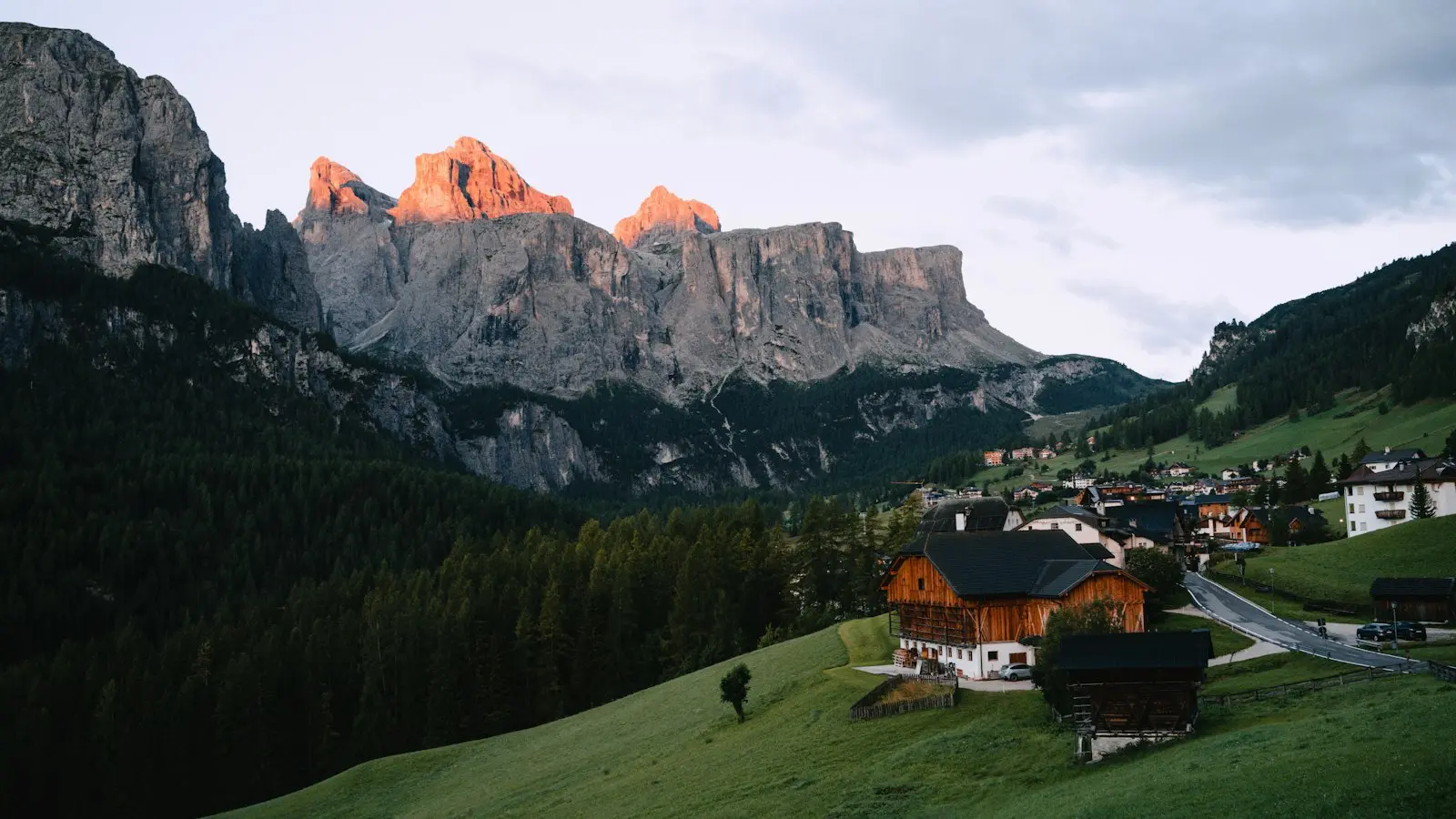
If you are deciding between Ortisei or Cortina, neither town is the universal winner. Choose Ortisei for a compact, walkable base centered on Val Gardena scenery and lift-linked outings; choose Cortina d’Ampezzo for dramatic eastern Dolomites landscapes, resort amenities, and a wider spread of possible excursions. A split stay can work, but on a short trip the second hotel often costs more time and energy than travelers expect.
The best answer depends on what you want to do each day, whether you have a car, how much weather flexibility you need, and whether changing accommodation feels like part of the adventure or an avoidable chore.
Key Takeaways
- Choose Ortisei for a focused Val Gardena holiday, compact village base, and easier access to nearby lift-linked outings.
- Choose Cortina for dramatic eastern Dolomites scenery, resort amenities, and a broader range of potential day trips.
- Travelers without a car may find Ortisei simpler, but both towns require current checks of buses, lifts, and seasonal schedules.
- Stay in one town for most five-night trips; a split becomes more practical with six or seven nights and a clear reason to experience both areas.
- Base your choice on your priority activities, not on the assumption that one town is universally more beautiful or convenient.
Ortisei and Cortina offer different Dolomites experiences
Ortisei has the feel of a compact mountain village in Val Gardena. Its center is relatively easy to explore on foot, and the surrounding landscape is closely tied to the western Dolomites, with mountain access and excursions organized around the valley. For a first visit, that concentration can be reassuring: you can settle into one base and build days around nearby lifts, walks, villages, and viewpoints rather than constantly crossing the region.
That does not make Ortisei quiet in every season. It is a well-established mountain destination with hotels, restaurants, shops, and substantial winter and summer activity. Its appeal is more about coherence than isolation: many parts of a holiday can be connected to one village and its immediate transport network.
Cortina d’Ampezzo feels different. It is a larger, more resort-oriented destination set within a particularly dramatic eastern Dolomites landscape. The town works well for travelers who want a recognizable alpine base with a broad choice of restaurants, hotels, shops, lifts, drives, and day trips. Its surroundings can feel expansive, and the visual drama is often part of the point even when you are simply moving around town.
The practical distinction is not that one landscape is more beautiful. It is that Ortisei makes a focused Val Gardena holiday straightforward, while Cortina can support a more dispersed eastern Dolomites itinerary. If you prefer a compact home base and simple daily geography, Ortisei may feel better. If you want several different directions to explore and are comfortable planning each outing, Cortina may be the stronger fit.
Choose Ortisei if lift-linked scenery and a convenient village base matter most
Ortisei is a strong choice for first-time visitors who want mountain scenery without making every day a transport project. Its village setting, walkability, and access to nearby mountain areas make it especially appealing to travelers who would rather step out for breakfast, reach a lift or bus, and begin the day from a familiar base.
This is also where the difference between “near a hike” and “able to hike independently from town” matters. Cable cars and lifts can make high mountain terrain accessible, but the lift still has an operating calendar, weather limits, ticket conditions, and a final service time. Once you arrive at the top, the route may be easy, strenuous, exposed, or unsuitable in poor conditions. A lift-assisted day is convenient, but it is not automatically a low-effort day.
For travelers without a car, Ortisei may be the easier place to organize a focused holiday, particularly if the itinerary is built around Val Gardena and nearby excursions. Buses and lift connections can be useful, but routes, frequencies, and final departures vary by season. Check the current local timetable rather than assuming that a summer service operates in the shoulder season or that the last bus matches your plans.
Ortisei is less compelling when your priority is a long list of eastern Dolomites attractions. Cross-region trips may involve multiple connections or a substantial drive, and the time spent reaching distant sights can take attention away from the walks and mountain areas close to your base. If you already know that your top priorities lie far to the east, staying in Cortina may be more efficient.
An Ortisei travel guide should therefore be read as a guide to a concentrated mountain holiday, not as a promise that every famous Dolomites sight is close by. The base is at its best when you allow the surrounding valley and nearby mountains to define the trip.
Choose Cortina if iconic viewpoints and eastern Dolomites access are the priority
Cortina suits travelers drawn to dramatic viewpoints, landmark mountain scenery, and a wider range of eastern Dolomites excursions. It can be a rewarding base for visitors who want to combine hiking with scenic drives, lift access, town-based dining, and visits to several distinct areas.
The trade-off is that “more options” does not always mean “less planning.” Some attractions around Cortina are best reached by car, while others may depend on buses, seasonal shuttles, lifts, parking arrangements, or a carefully timed combination of services. A viewpoint that looks close on a map may involve a winding mountain road, a busy approach, a walk from a parking area, or a timetable that limits how long you can stay.
Cortina can suit drivers because a car opens more possible directions. It also introduces decisions that are easy to underestimate: where to park, whether a road is comfortable for you, how traffic behaves in high season, and whether weather or roadworks change the day’s route. A car provides flexibility, but it does not remove the need to check conditions.
Without a car, Cortina remains possible, but the itinerary should be designed around confirmed transport rather than general assumptions. Identify the specific bus routes, transfers, lift access, and return times for each planned excursion. You may have an excellent day with public transport, but spontaneous cross-region travel is less dependable when services are seasonal or infrequent.
A Cortina travel guide is therefore most useful for travelers who are happy to treat the town as a launch point for several different kinds of day. If your ideal trip includes a mix of iconic scenery, resort life, and varied excursions, Cortina can offer a natural framework. If you want every day to be simple and walkable, its wider geography may become a burden.
Compare hiking, cable cars, transport, and seasonal access before booking
Start with your hiking ambitions. For short walks, lift-assisted viewpoints, and a flexible mix of activities, either town can work. For a particular route, however, investigate its trailhead, elevation, terrain, exposure, current condition, and the transport needed to return. Fitness, weather, footwear, and route-finding ability can change the experience substantially.
Then check the lift network for your travel dates. Summer and winter operations are different, and shoulder seasons can bring maintenance closures or reduced services. A lift that is central to your plan may not operate daily, may close earlier than expected, or may be affected by wind. Confirm operating dates and ticket arrangements with the relevant operator before booking a hotel around a single excursion.
Public transport favors a deliberate itinerary. It can reduce the stress of mountain driving and eliminate some parking problems, but it may require transfers and limit late changes. Ortisei is often a better fit for a car-free trip focused on nearby Val Gardena activities, while Cortina can work well without a car when the itinerary is built around its confirmed local connections. Neither should be treated as consistently simple without checking the current timetable.
Driving creates a different set of trade-offs. Mountain roads may be slow, winding, busy, or uncomfortable in poor weather. Parking can be limited or subject to local rules, and a day that looks short in distance can take much longer in practice because of traffic, roadworks, stops, and road conditions. In winter, check any current equipment requirements and access restrictions before setting out.
Weather flexibility is another deciding factor. If clouds obscure viewpoints, a traveler with a car may be able to change direction, but poor conditions can also make driving less attractive. A traveler relying on lifts may need indoor alternatives, town walks, museums, cafés, or a rest day. Before choosing where to stay in the Dolomites, list two or three realistic bad-weather options for each base.
Match accommodation, food, evenings, and budget to the trip style
The best accommodation is often not in the abstract “better” town but the property in the right location. In Ortisei, being able to walk to the village center, a lift, or a useful bus stop can reduce daily friction. In Cortina, proximity to the center or a confirmed transport point may matter more if you plan to dine out or leave without driving.
Prices and availability vary by season, dates, room type, and demand, so avoid assuming that either town is always cheaper. Compare the total cost rather than the nightly rate: parking, local transport, lift tickets, transfers, meals, and the cost of moving between hotels can alter the result.
Both towns offer restaurants and evening options, but the useful question is what kind of evening you want. A compact base may make it easier to stroll from dinner back to your room. A resort destination may provide a broader range of dining and shopping, while also bringing more reservations and seasonal demand. Opening hours can change outside the main summer and winter periods, so check directly for the dates of your trip.
If your days are built around early lifts or buses, a hotel location near the relevant departure point may be worth more than a slightly cheaper room farther away. Conversely, if you have a car and prefer quiet evenings, a property outside the center might offer better value, provided parking and road access are clear.
Should you stay in one town or split five to seven nights between both?
For five nights, choose one base in most cases. A split can make sense only when both western and eastern Dolomites experiences are central priorities and the transfer is practical on your dates. Otherwise, changing hotels may consume a meaningful part of a short holiday through packing, checkout, travel, parking, check-in, and reorganizing plans.
For six nights, a three-night Ortisei and three-night Cortina split is possible, but it is the least forgiving arrangement. Confirm accommodation availability, transfer logistics, luggage storage, and likely road or public transport conditions before committing. A weather change on the transfer day can affect both the move and the first activity at your new base.
For seven nights, a four-night/three-night split is more comfortable. Give the longer stay to the area containing your highest-priority activities, then use the shorter stay to experience a genuinely different landscape rather than repeating similar day trips. The split should add contrast, not simply create two hotel rooms for the same kind of holiday.
An adaptable Dolomites itinerary might therefore look like this: spend four nights in Ortisei for nearby lift-linked scenery and valley excursions, then three nights in Cortina for eastern viewpoints and a different resort atmosphere. Reverse the order if your arrival route, weather forecast, or must-see attraction makes Cortina the better starting point. Keep the transfer day light and avoid booking a time-critical lift immediately after moving.
The decision summary is straightforward. Car-free travelers with a focused, walkable plan should lean toward Ortisei, subject to current transport checks. Drivers seeking varied eastern excursions may prefer Cortina, provided they are comfortable with parking and mountain roads. Hikers should choose based on their actual trail clusters, not the town’s reputation. Viewpoint-focused visitors may favor Cortina, while first-time visitors wanting a simpler introduction may find Ortisei easier. Travelers with only a few nights should usually stay put; those with seven nights and a real interest in both regions can consider splitting.
FAQ
Is Ortisei or Cortina better for a first trip to the Dolomites?
Ortisei is often the easier first base for travelers who want a compact village, nearby mountain access, and a focused itinerary. Cortina may be better if your first-trip priorities are eastern Dolomites viewpoints, resort amenities, and varied day trips. Your arrival route, car access, travel season, and must-see attractions can change the recommendation.
Is it worth staying in both Ortisei and Cortina on a five- to seven-night trip?
Usually not for five nights, unless both regions are essential to the trip. Six nights can support a split with careful planning, while seven nights makes a four-night/three-night division more reasonable. Always account for the hidden cost of moving accommodation and confirm the transfer before booking.
Can you visit the main sights around Ortisei and Cortina without a car?
You can reach many areas without a car, but the practical range depends on current buses, lifts, transfers, seasonal schedules, and return services. Build a car-free itinerary around confirmed connections, allow extra time, and do not assume that every major attraction is directly accessible from either town.