The Arithmetic of Exploration
Kazakhstan sits at the intersection of geography and silence. The country’s tourism infrastructure, still emerging from decades of Soviet-era isolation, offers a raw counterpoint to the polished circuits of Western Europe. A 10-day trip from Almaty to the Kolsai Lakes, Charyn Canyon, and Altyn Emel National Park reveals a landscape that is both immense and intimate — but the deeper story is one of value. Analysts estimate that a solo traveler can cover these destinations for $400 to $800, including all accommodation, ground transport, and food. That figure undercuts a comparable itinerary in, say, Switzerland or Norway by a factor of four. The question is not whether Kazakhstan is cheap; the question is whether the logistics can match the price.
The Itinerary’s Architecture
The route traces a rough arc east of Almaty. Day one: arrival. Days two through four: the Kolsai Lakes and Kaindy Lake. Days five and six: Charyn Canyon. Days seven through nine: Altyn Emel National Park with its singing dunes and Aktau mountains. Day ten: return to Almaty. The distances are moderate — the longest drive is about four hours — but the roads degrade quickly outside the city limits. (Rental cars are available, but shared jeep tours remain the pragmatic choice.)
Shared tours departing from Almaty cost approximately $60 per day per person. That covers transportation, a driver-guide, and often a homestay or guesthouse. The pricing is competitive because the market is fragmented; dozens of small operators compete for the same pool of backpackers. The result is a buyer’s market that keeps costs low but introduces variability in vehicle quality and reliability.
Budget Breakdown in Human Terms
To materialize the numbers: $400 at the low end assumes dorm-style homestays and street food. $800 at the high end buys private rooms in guesthouses, restaurant meals, and occasional bottled water. A midrange traveler spending $600 can expect comfortable conditions without frills. The largest variable is transportation. Public buses do not regularly reach the national parks; travelers who fail to book shared tours will face private taxi rates that can triple the daily budget. (One Reddit commenter noted that a private driver for a multi-day circuit quoted $150 per day — more than double the shared option.)
Meals hover at $3 to $5 per meal in Almaty and $2 to $4 in remote villages. A supermarket trip in Almaty costs $10 to cover snacks, instant noodles, and water for several days. Cash dominates the economy beyond the capital. ATMs exist only in district centers like Saty (near Kolsai Lakes) and Shelek, but they often run empty on weekends. Carrying $200 in small denominations is not paranoia; it is survival logic.
Physical Reality of the Landscape
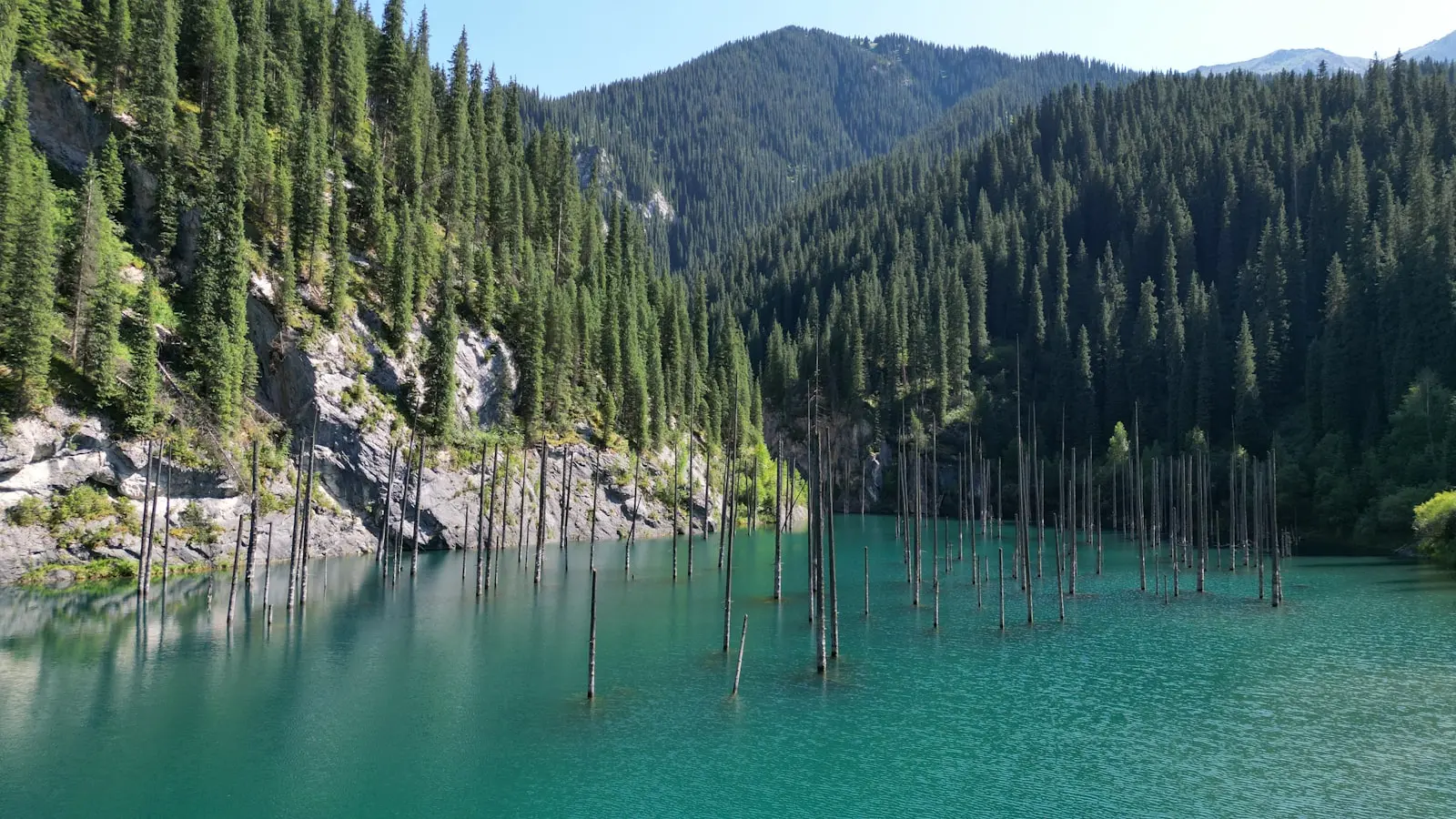
The Kolsai Lakes present three glacial lakes stacked at ascending altitudes. The trail between the first and second lake climbs through spruce forest; the air thins and the temperature drops 10 degrees Celsius between the parking lot and the upper lake. Local families operate yurt-style homestays near the first lake — plywood walls, diesel heaters, and basins of warm water for washing. The smell of woodsmoke and mutton fat hangs over the settlement.
Charyn Canyon is a geological incision, 90 kilometers long and 300 meters deep. The Valley of Castles, a narrow section of sandstone hoodoos, concentrates the drama. The wind shear across the canyon floor carries particles of dry earth and wild thyme. Walking the canyon floor in late afternoon, when the light angles through the crevices, turns the rock into a palette of burnt umber and ochre. (The official entry fee is under $2; the unofficial photography permit is free.)
Altyn Emel National Park requires an additional permit and a guide. The singing dunes — a 3-kilometer crescent of sand that emits a low-frequency hum in dry conditions — are the headline. But the Aktau mountains, a badlands of white and red clay, offer a more subtle geometry. The park’s scale defies easy comprehension: a single dirt track runs 80 kilometers from the gate to the dunes.
The Hidden Tax of Inefficiency
The low price tag carries a hidden tax: time. Shared tours wait for the group. Homestay owners often cook one meal at a fixed hour. Buses to Almaty depart at dawn or not at all. The traveler who arrives with a rigid schedule will bleed patience. The traveler who surrenders to the rhythm — who accepts that dinner happens at 9 PM because the host forgot to buy bread — will find the friction becomes texture.
(Is this a luxury? No. But it is a design trade-off. Kazakhstan’s tourism sector operates on trust and improvisation. There is no central booking system. Facebook Messenger and WhatsApp are the primary reservation tools. The network functions because the operators know each other. The system breaks when a foreign SIM card fails to roam.)
Cultural Strategies for Cost Containment
Experienced travelers recommend packing snacks from Almaty supermarkets. A loaf of bread, a container of yogurt, and a tube of condensed milk cover two days of breakfast for under $3. Water purification tablets eliminate the need to buy bottled water in remote areas where markup can reach 200%. A pocket knife and a reusable cup turn a roadside stop into a picnic.
The Reddit community also advises carrying a printed map. Cellular coverage is intermittent beyond the major roads, and Google Maps offline downloads expire after two weeks. A paper map doesn’t require battery. (The irony is that the Soviet-era road signs, occasionally still standing, use Cyrillic only. A traveler who cannot read the script will rely on landmarks: the white mosque, the single gas pump, the line of drying laundry.)
The Emotional Architecture of the Journey
The landscape in Kazakhstan does not compete with the traveler; it simply exists. The Kolsai Lakes do not apologize for the rain. Charyn Canyon does not perform. Altyn Emel’s silence is not a feature — it is the default. This absence of marketing is precisely the point. The design of the journey is not engineered for maximum Instagram yield. It is engineered for survival of the self.
When Western travelers complain about Kazakhstan’s “lack of infrastructure,” they are often criticizing the absence of a cushion. There is no buffer zone between the traveler and the environment. The wind is cold. The toilet is a hole. The homestay mattress is a foam pad on a wooden frame. And yet, after three nights sleeping on that pad, the body recalibrates. The discomfort becomes data.
Why This Matters for the Future of Budget Travel
Kazakhstan occupies a rare position: it is under-touristed and underpriced, but the barriers to entry are real. The country’s tourism ministry has announced plans to improve road access to Altyn Emel and to install more ATMs at park entrances. If those improvements materialize, the current price range will shift upward. A 10-day trip at $500 may become a memory within five years.
For now, the arithmetic holds. The traveler who can tolerate asphalt roads that revert to gravel, who can accept that a “restaurant” is a room with a table and a kettle, will find a value proposition unmatched anywhere west of the Caspian Sea. The secret is not in the budget. The secret is in the willingness to let the landscape dictate the terms.
The wind across the Charyn Canyon floor does not care about your itinerary. It is a design element no hotel can replicate.
That, in the end, is the real cost of travel. Not the money. The surrender.