The clinical diagnosis is medial tibial stress syndrome. The street-level translation is a catastrophic failure of load management. According to ongoing tracking by the American Physical Therapy Association, a distinct demographic repeatedly fractures under the specific biomechanical demands of European travel. They are not elite marathoners logging high-mileage training blocks. They are tourists.
Travelers departing sedentary office environments routinely step onto the uneven streets of London, Rome, or Brussels and spike their daily walking volume from a baseline of 3,000 steps to upwards of 25,000 steps within a 24-hour window. This represents a physiological anomaly. In professional sports, sudden exponential spikes in repetitive impact invariably trigger connective tissue breakdown. Yet, tourists romanticize the physical exertion of navigating historical capitals entirely on foot, treating the activity as casual leisure rather than high-volume endurance output. The lower leg absorbs the reality of this miscalculation. The tissue does not care about the itinerary.
The Acute-to-Chronic Workload Crisis
Sports science relies heavily on a metric known as the acute-to-chronic workload ratio (ACWR). This formula divides a subject’s immediate short-term training load by their historical baseline to predict injury probability. A safe, sustainable ratio hovers between 0.8 and 1.3. When athletes exceed an ACWR of 1.5, their risk of soft tissue damage doubles.
Consider the arithmetic of the average tourist. An accountant who sits for eight hours a day might average two miles of cumulative walking per week. Upon arriving in Europe, this individual immediately subjects their body to eight to twelve miles per day. The resulting ACWR shatters the 1.5 threshold, frequently entering the 4.0 or 5.0 range. No professional running coach would ever authorize a training program that spikes volume by 400 percent overnight. Yet millions of tourists execute this exact protocol every summer.
Every footfall generates a ground reaction force equivalent to roughly 1.2 to 1.5 times the individual’s body weight. Multiplying a 160-pound frame by 20,000 daily repetitions yields an extraordinary cumulative tonnage absorbed primarily by the feet, ankles, and lower legs. The tibialis anterior and the posterior muscle groups must engage eccentrically with every step to decelerate the foot and prevent it from violently slapping the pavement. Under sudden, unconditioned volume, these muscles fatigue rapidly. Once the musculature fails, the kinetic shock transfers directly to the connective tissue and the periosteum—the thin layer of tissue wrapping the tibia.
Inflammation follows immediately. Micro-tears multiply along the bone line. Pain registers.
Terrain Analytics and Biomechanical Instability
Volume alone does not entirely explain the severity of the clinical outcomes. The playing surface dictates the damage. Modern running tracks and treadmills offer predictable energy return and uniform flatness. European urban environments offer the exact opposite.
Centuries-old cities utilize materials designed for durability, not human biomechanical efficiency. Cobblestone, in particular, operates as an asymmetrical trap for the human foot. Because no two stones sit at precisely the same angle, the surface forces the ankle into micro-bouts of pronation and supination with every step. The intrinsic stabilizing muscles of the foot and lower leg—structures largely dormant during office work—must fire continuously to maintain upright posture and balance.
(This forces structural exhaustion long before cardiovascular fatigue sets in).
Concrete sidewalks present a different threat. Concrete ranks among the least forgiving surfaces on earth, possessing a near-zero coefficient of restitution. It absorbs no impact. It returns all shock directly back up the kinetic chain. Tourists alternating between erratic cobblestone grids and rigid concrete pathways subject their lower extremities to a relentless combination of torsional strain and blunt force trauma.
The Equipment Failure
Athletes select footwear based on the specific demands of their environment. Tourists frequently select footwear based on aesthetic integration with their wardrobe. This decision accelerates the onset of medial tibial stress syndrome.
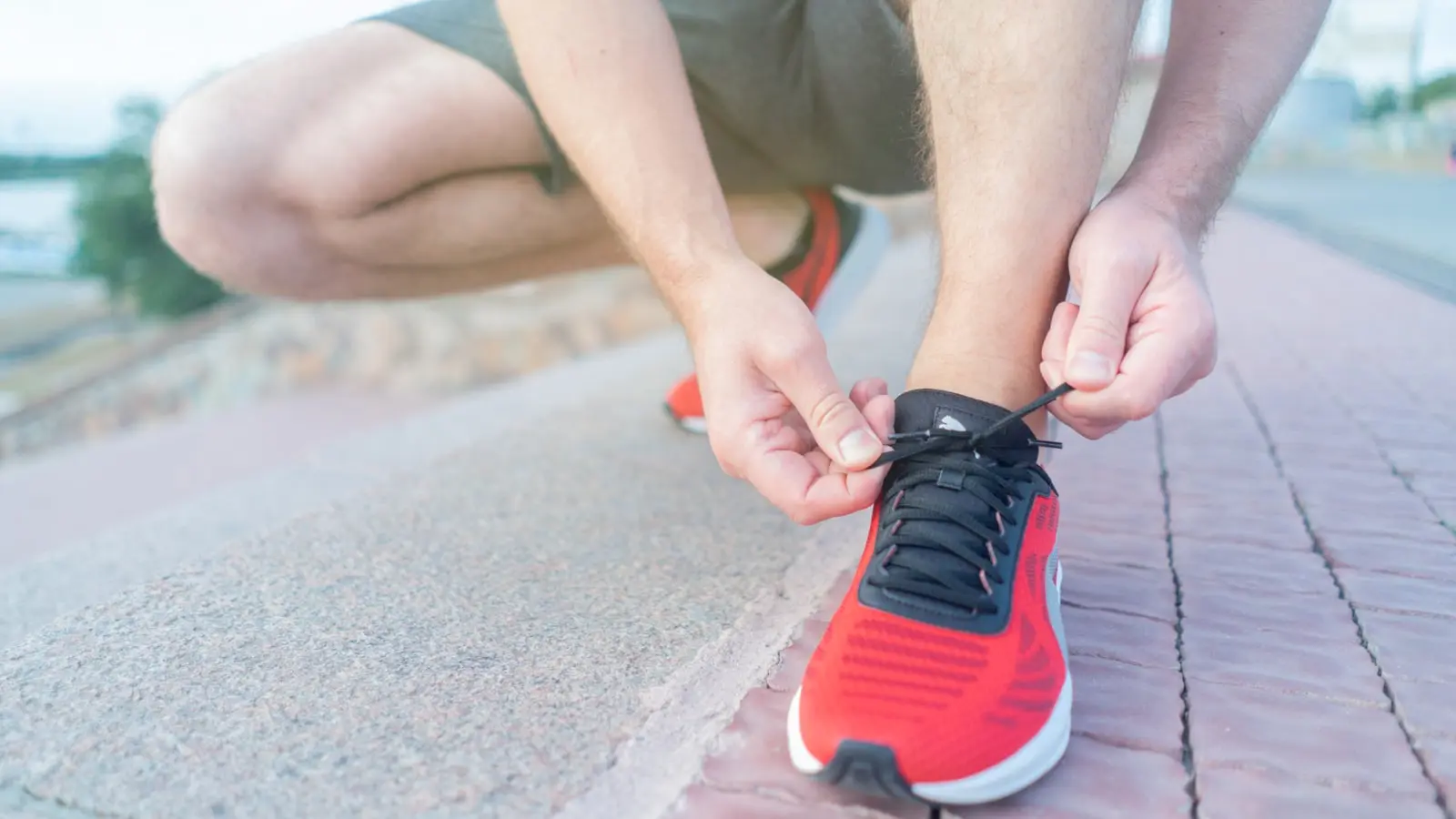
Flat, fashionable lifestyle sneakers dominate the travel landscape. These shoes typically feature zero rigid heel counters, minimal arch support, and dense, unresponsive rubber cupsoles that degrade under sustained mileage. Without proper structural geometry, the foot collapses inward—overpronating—upon impact. Overpronation dramatically increases the traction forces pulling on the medial tibia.
Sports medicine professionals analyzing travel-induced injuries consistently point to this equipment deficit. To survive a multi-day urban endurance event, the biomechanical requirement shifts away from aesthetics and directly toward function. A functional endurance shoe requires specific engineering:
- Stack Height: Sufficient midsole foam depth to dampen the transmission of ground reaction forces from concrete surfaces.
- Heel-to-Toe Drop: A geometric offset (typically 8mm to 12mm) that relieves tension on the Achilles tendon and the calf complex, shifting the workload upward to the larger muscle groups of the posterior chain.
- Torsional Rigidity: Structural stiffness through the midfoot to prevent the shoe from twisting laterally on uneven cobblestones.
Trading a vulcanized lifestyle sneaker for a maximalist running shoe fundamentally alters the equation. It introduces an artificial shock-absorption layer that the unconditioned human body lacks.
Tactical Intervention and Load Management
The most effective countermeasure to tourist shin splints remains aggressive pre-trip conditioning. Gradually increasing daily walking volume weeks before departure forces the osteoblasts in the lower leg to remodel the tibia, increasing bone density to handle the impending workload.
However, when failure occurs mid-trip, recovery requires strict, athletic load management. Ignoring the inflammation guarantees severe degradation, potentially leading to tibial stress fractures that require immobilization. Sports therapists suggest intervening the moment localized tenderness appears along the inner edge of the shinbone.
Ice therapy constricts blood vessels, temporarily halting the localized inflammatory cascade. Non-steroidal anti-inflammatory drugs manipulate the chemical pain pathways, but they do not heal the underlying micro-trauma. (Relying on painkillers to maintain a 20,000-step pace merely masks the destruction of the tissue).
The only mathematically sound intervention is volume reduction. Modulating the daily itinerary to allow for 24 to 48 hours of low-impact movement provides the periosteum a brief window to initiate cellular repair.
Walking across London or Paris is an athletic performance. It demands an athletic approach. The human body operates on strict physiological laws regarding load and recovery. Tourists who ignore these parameters by expecting unconditioned muscles to absorb marathon-level stress will inevitably encounter the physical limits of their anatomy. The data does not bend to enthusiasm.