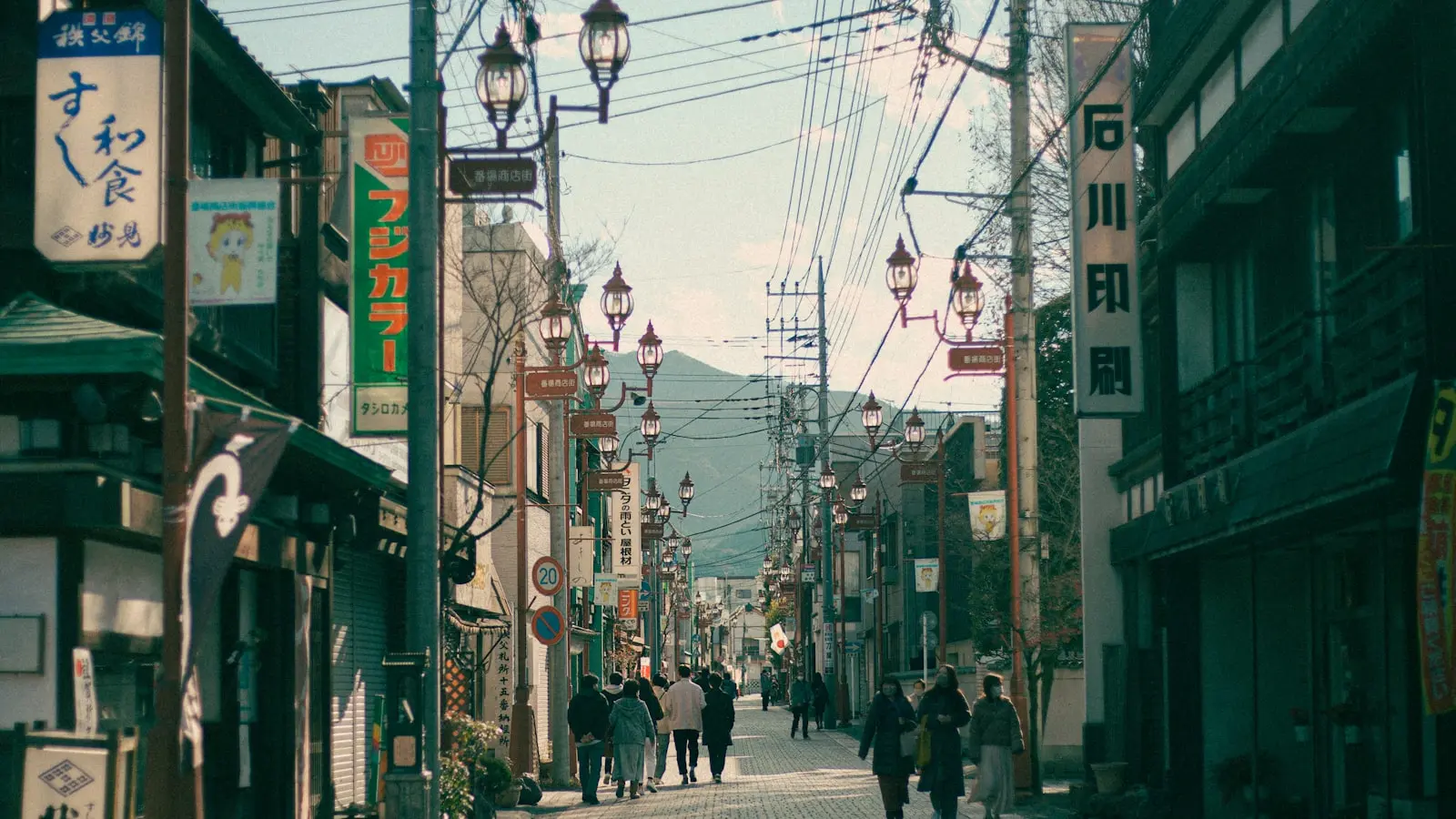
Travelers often notice a stark contrast between the visual experience of Chinese megacities like Beijing and smaller Japanese towns such as Nikko or Matsumoto. While both are distinct in scale, the scenic appeal of the latter stems from measurable differences in urban design, greenery distribution, historical preservation, natural setting, and sensory quality. The following key takeaways summarize the main factors.
Key Takeaways
- Chinese megacities rely on superblocks and wide roads that overwhelm human scale, whereas Japanese towns use compact, mixed-use streets that create visual interest and refuge.
- Japanese towns integrate numerous small gardens and street-side greenery into daily life, while Beijing concentrates green space in a few large parks, reducing overall aesthetic satisfaction.
- Preservation laws and organic growth in Japan produce layered historical textures; rapid redevelopment in Chinese megacities led to uniform, recently built skylines.
- Topography, air quality, and cultural aesthetics (like wabi-sabi vs. symmetry) further amplify the perceived scenic difference.
- Chinese cities such as Chengdu and Suzhou demonstrate that targeted greening and preservation can enhance scenic quality without sacrificing economic growth.
1. Urban Density and Street-Level Design
A traveler driving from Shenyang to the Japanese Alps might notice an immediate shift in visual experience. Shenyang, a Chinese megacity of over 10 million people, is built on superblocks: wide arterial roads, massive building complexes, and limited pedestrian permeability. Streets feel uniform and overwhelming in scale. In contrast, a small Japanese town like Matsumoto offers narrow, winding streets, mixed-use neighborhoods, and buildings that align with human proportions.
The difference lies in how urban density is organized. Chinese megacities often prioritize vehicle throughput and efficient land use through large blocks that reduce street intersections. This creates monotonous facades and long, uninterrupted sightlines that lack visual interest. Japanese small towns, by contrast, grew organically over centuries. Their block sizes are small, and zoning allows residences, shops, and temples to coexist on the same street. This diversity at eye level stimulates the brain and makes walking feel exploratory.
Prospect-refuge theory in environmental psychology suggests that humans prefer environments where they can see without being seen, and where scale feels manageable. The superblock design overwhelms this sense of refuge, while the intimate street networks of Japanese towns offer visual complexity and frequent changes in perspective. The result is that the megacity feels less scenic not because it lacks beauty, but because its design erodes the sensory engagement that makes a place memorable.
2. Green Space Distribution: Large Parks vs. Pocket Gardens
Beijing’s green space ratio is often estimated around 15%, with most of that concentrated in a few large parks like the Olympic Forest Park or Temple of Heaven. Many residential and commercial districts are dominated by concrete and asphalt. Trees are sparse along wide boulevards, and small gardens are rare. In a Japanese town like Nikko, greenery is not a separate destination—it is woven into the urban fabric. Temple grounds, backyard gardens, and street-side plantings are ubiquitous. The forest of Nikko National Park extends right into the town boundaries.
Urban greening research indicates that frequent, small green patches contribute more to aesthetic satisfaction than a few large parks. People encounter pocket gardens daily, which improves mood and perception of environmental quality. In Chinese megacities, the scarcity of distributed greenery means many residents walk through sterile streets for long distances before reaching a park. This reduces the overall scenic impression of the city.
The trade-off is between maintenance efficiency and distribution. Centralized parks are easier to water and maintain, but distributed planting requires more coordination among property owners and municipal departments. Japanese towns benefit from cultural traditions of gardening and a legal framework that often requires greenery in new developments. Chinese megacities, focused on rapid housing construction, have historically deprioritized such micro-greening, though recent efforts like Beijing’s “sponge city” initiatives are beginning to change that.
3. Historical Preservation and Building Age
Chinese cities such as Beijing and Shenyang underwent intense redevelopment from the 1980s onward. To accommodate explosive population growth, older neighborhoods—many with historic courtyard houses—were demolished and replaced with high-rise apartment blocks. This wiped out layers of architectural history and created a uniform skyline of recent construction. Some cities like Chengdu have preserved historic areas, but in North China the pattern of demolition was widespread.
Japan’s approach has been markedly different. The Cultural Properties Protection Act and local preservation ordinances protect historic districts in towns like Takayama, where wooden machiya houses line streets that have remained unchanged for centuries. Even in smaller towns, there is a cultural preference for maintaining and restoring traditional buildings rather than replacing them. This results in a built environment with visible historical depth—different eras coexist, offering visual texture.
When a city’s buildings all date from a similar recent period, the streetscape lacks the variety of materials, colors, and styles that make older towns interesting. The scenic value of Japanese towns is partly due to this layered history, where each building tells a story. Chinese megacities, by prioritizing speed and volume, sacrificed that texture. Exceptions exist, but the general trend accounts for the perceived difference.
4. Topography and Natural Backdrop
Japan is a mountainous archipelago. Many of its small towns are nestled in valleys, with forested hills visible from almost every street. This natural framing provides a constant reminder of the larger landscape. The aesthetic concept of shakkei (borrowed scenery) intentionally incorporates distant mountains into garden and town design. Walking in Nikko or the Japanese Alps, the eye is always drawn to a green ridge or a river.
North China’s megacities sit on vast, flat plains. Beijing lies on the North China Plain, with no significant elevation changes within the city limits. The horizon is defined by buildings, not hills. Without a natural backdrop, the urban environment becomes self-contained, and the lack of contrast makes it feel monotonous. Topography alone does not determine scenic beauty—flat cities like Paris or Amsterdam are highly scenic—but when combined with uniform architecture and sparse greenery, the flatness amplifies the sense of visual sameness.
Scenic perception is enhanced when there is a dynamic relationship between built and natural elements. Japanese towns leverage this relationship. Chinese megacities often do not, partly because of geography and partly because development has not prioritized preserving views of distant mountains even where they exist.
5. Cultural Aesthetics: Order vs. Imperfection
Chinese urban design has historically favored symmetry, grand axes, and monumental scale. Beijing’s Forbidden City and the central axis line are prime examples. This tradition extends to modern planning: wide boulevards, symmetrical layouts, and uniform building heights create a sense of order. Japanese aesthetics, by contrast, embrace wabi-sabi—the appreciation of imperfection, asymmetry, and natural materials. Temples, gardens, and even street layouts favor irregularity and intimate spaces.
Psychological studies on landscape preference suggest that people rate environments higher when they offer variety, mystery, and coherence. Monotonous order can feel sterile. The narrow alleys, hidden gardens, and unexpected views in Japanese towns provide these qualities. The wide, straight avenues of Chinese megacities offer predictability but little visual reward. This is not a universal truth—some people prefer grand order—but it explains why many travelers find Japanese towns more scenic.
Cultural preferences are just one factor. They are not inherent to nationality but are embedded in architectural traditions and planning practices that have persisted for centuries. Understanding this helps avoid value judgments and instead recognizes differing design philosophies.
6. Air Quality, Visibility, and Sensory Pollution
Air quality significantly affects how scenic a place looks. Beijing has experienced episodes of high PM2.5 concentrations, especially in winter, which reduce visibility and dull colors. Even on moderate days, the haze can mask distant views and make buildings appear gray. This atmospheric degradation directly lowers scenic value because the brain relies on clarity and color contrast to judge a scene as beautiful.
Japanese towns like Nikko typically have much better air quality, thanks to lower industrial density, topographic dispersion of pollutants, and prevailing winds from the Pacific. Clear air allows fine details—tile roofs, moss on stones, autumn leaves—to register vividly. Visibility often exceeds 20 kilometers in mountain towns, compared to frequent sub-10-kilometer visibility in North Chinese cities.
Visual pollution also differs. Japanese towns often bury power lines and regulate signage, which reduces clutter. Chinese megacities have overhead wires, large billboards, and uncoordinated storefronts that add visual noise. These factors compound the perception of scenic quality. Better air and less visual clutter make Japanese towns feel more pristine and intentionally designed.
Air quality data varies seasonally. Beijing’s air has improved in recent years due to pollution controls, but it still lags behind Japan’s small towns on average. The contrast is not permanent, but it remains a measurable contributor to the scenic difference.
FAQ
Why don’t Chinese megacities have more greenery like Japanese towns?
Urban planning in China historically prioritized industrialization and housing capacity over aesthetics. High land values and density pressures make it difficult to carve out small green spaces. Centralized park maintenance is more feasible, but distributed greening requires governance models that are still developing.
Is the scenic appeal of Japanese towns just because they are smaller?
Size matters, but design choices—mixed-use zoning, building height limits, and preservation laws—play a larger role. Even small Chinese towns often lack the same aesthetic due to different planning traditions that emphasize wide streets and new construction over texture.
Can Chinese cities become more scenic without losing economic function?
Yes. Cities like Chengdu have built greenway systems, and Suzhou restored its historic canals. Targeted greening, preservation of older districts, and street-level improvements can enhance scenic quality without halting growth. These examples show that change is possible, though large-scale transformation takes time.