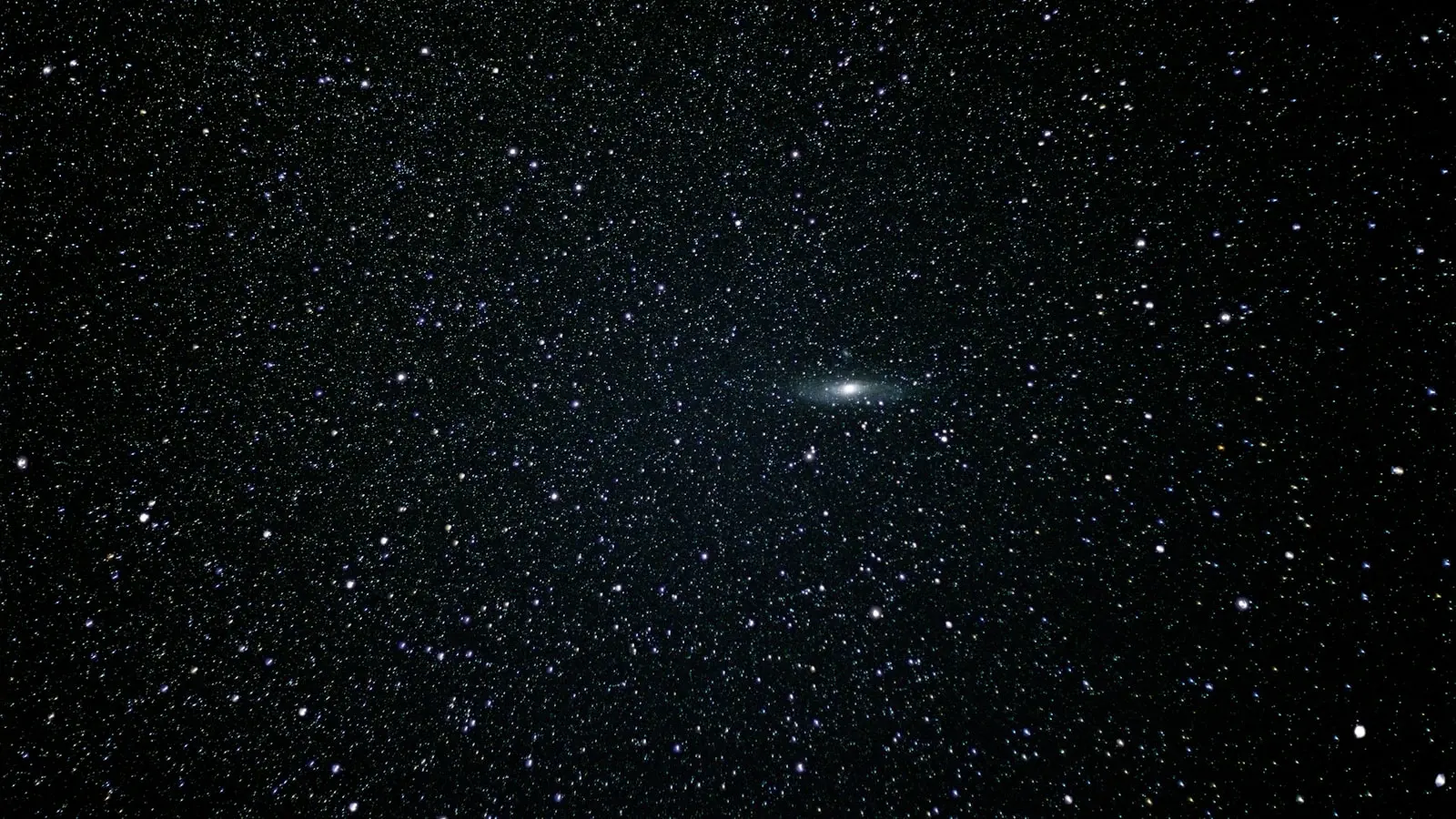
The James Webb Space Telescope recently captured near-infrared light from a patch of sky representing the cosmos just 500 million years after the Big Bang. Instead of the diffuse, infant star clusters predicted by decades of astrophysical modeling, the sensors registered six distinct galactic structures. These structures contain up to 100 billion solar masses of stars. This specific telemetry immediately fractures the standard cosmological timeline. The math refuses to align.
A mass of 100 billion suns roughly equals the current stellar weight of the Milky Way galaxy. The Milky Way required 13.8 billion years of galactic mergers and slow gas accretion to build this population. The objects identified by JWST managed to assemble the exact same density in roughly three percent of that timeframe. If early galaxies formed this rapidly, the fundamental mechanisms governing baryonic matter require immediate structural overhaul. (The timeline constraint remains absolute).
The Instrumentation Barrier
Before JWST deployed its segmented beryllium mirrors, the Hubble Space Telescope defined the extreme boundary of observable space. Hubble relied primarily on visible and ultraviolet light detection. Because the universe expands continuously, light emitted by the earliest galaxies physically stretches as it travels. By the time ultraviolet photons from the cosmic dawn reach Earth orbit, they stretch deep into the infrared spectrum.
Hubble lacked the hardware to detect these specific infrared wavelengths. Astronomers subsequently inferred the conditions of the early universe based entirely on the faint, fractional structures Hubble managed to capture at its absolute detection limits. Physicists built comprehensive models around the assumption that what Hubble saw represented the entirety of what existed. The absence of evidence transformed into evidence of absence. JWST shatters this assumption entirely.
The Arithmetic of Galactic Assembly
Under the standard Lambda Cold Dark Matter framework, the early universe expanded as a uniform soup of hydrogen, helium, and dark matter. Dark matter interacts exclusively through gravity, slowly clumping into invisible halos over millions of years. These halos eventually generate enough gravitational pull to drag in normal baryonic gas. Once captured, the gas must cool, compress, and ignite into stars.
The entire process operates within strict thermodynamic limits. Gas in a vacuum does not simply collapse under gravity. As it compresses, it heats up. Heat generates outward thermal pressure that directly counteracts gravitational pull. To form a star, the gas must somehow radiate that heat away into space. Modern galaxies utilize heavy elements like carbon and iron as highly efficient coolants. The early universe possessed none of these elements. It contained only primeval hydrogen and helium, which cool notoriously poorly. Gravity acts slowly across expanding space. Dark matter gathers. Gas falls inward. Stars eventually ignite. But that sequence requires extended timeframes. The JWST data suggests the early universe skipped the incubation phase entirely.
Astrophysicists face an immediate mathematical deficit. Current models dictate that galaxies convert approximately ten percent of their available gas into stars. The remaining gas gets ejected into the intergalactic medium by violent stellar winds and supernovae explosions. To build galaxies weighing 100 billion solar masses in just 500 million years, that conversion efficiency must approach near-total thermodynamic limits. Every available atom of hydrogen would need to simultaneously collapse into a stellar furnace. (A scenario that breaks known fluid dynamics).
When researchers examine the raw telemetry streaming down from the Lagrange Point 2 orbit, the contrast becomes stark. Engineers viewing server readouts see dense, mature structures where theoretical physicists proved only void or sparse gas should exist. The narrative of a gradual cosmic dawn shatters. A period of violently rapid galaxy formation replaces it.
The Photometry and Spectroscopy Divide
The current crisis relies heavily on how astronomical instruments measure distance and time. Astronomers utilize cosmological redshift to determine galactic age. As light travels through an expanding universe, its wavelength stretches toward the red end of the electromagnetic spectrum. JWST initially identified these high-redshift objects via photometric measurements. Photometry analyzes the overall color of the light passing through specific wide-band filters, looking for sharp drops in luminosity caused by neutral hydrogen absorbing ultraviolet photons.
Photometry provides a rapid but imprecise estimate. Dust clouds heavily complicate these readings. If dense fields of interstellar dust obscure a closer, older galaxy, the particulate matter absorbs blue light and lets red light pass. A mature, dust-shrouded galaxy located three billion years after the Big Bang looks mathematically identical to a dust-free infant galaxy located 500 million years after the Big Bang.
Spectroscopy removes this ambiguity. By splitting the light into its constituent wavelengths, spectrometers generate an exact chemical fingerprint and a precise redshift measurement. Initial spectroscopic follow-ups on similar JWST targets have occasionally revised their distances closer to modern epochs. However, several of these massive structures maintain their extreme redshift status even under rigid spectroscopic analysis. The measurement error hypothesis loses traction. The anomalies persist.
The Stellar Light Alternative
If the galaxies genuinely exist 500 million years post-Big Bang, the analysis of their mass requires intense scrutiny. Telescopes do not weigh galaxies directly. They measure light and convert that luminosity into mass using established stellar mass-to-light ratios. These ratios assume the distant galaxies contain a standard mixture of heavy, bright stars and light, dim stars.
The earliest stars, known as Population III stars, lacked the heavier chemical elements forged by later stellar generations. Without metals to efficiently cool collapsing gas clouds, these primordial stars grew exceptionally heavy. They burned at extreme temperatures and lived brief life cycles. A galaxy populated densely by Population III stars emits significantly more light per unit of mass than a modern galaxy.
If these early structures contain hyper-luminous primordial stars, their light output heavily distorts the mass calculations. A small cluster of violently bright early stars effectively mimics the light output of 100 billion modern stars. This calculation adjustment resolves the mass crisis. It simply replaces it with a new variable.
The Black Hole Masquerade
The astrophysics community actively debates an alternative mechanical explanation. Supermassive black holes exist at the center of nearly all major galaxies. When these black holes actively consume surrounding gas, they form accretion disks that generate immense friction and radiation. These active galactic nuclei emit enough energy to outshine the entire host galaxy.
If early supermassive black holes grew faster than their surrounding stellar populations, JWST might be measuring the blinding radiation of a compact quasar rather than the collective glow of distinct stars. Identifying a quasar requires analyzing the light spectrum for broad emission lines, which serve as signatures of gas swirling at high velocities around a singularity.
This black hole hypothesis solves the immediate baryonic mass problem. If the light originates from an accretion disk, the surrounding galaxy can remain relatively small and within standard modeling limits. (This offers a convenient escape hatch). Yet, it instantly creates a secondary physics problem. Cosmological models fail to explain how supermassive black holes could form and grow to such immense scales within 500 million years. Black hole seeds originating from dead stars require billions of years of continuous feeding to reach supermassive status. The timeframe constraint simply shifts from star formation to black hole accretion.
Redefining the Mechanics of Dark Matter
If the precise redshift measurements hold, and if the extreme mass calculations survive the black hole scrutiny, standard dark matter frameworks face severe pressure. The existing model assumes dark matter operates cold and slow. This velocity constraint dictates the exact timeline for gravitational halo formation.
If baryonic gas clusters rapidly enough to form these structures, dark matter must either group more aggressively or possess interactive properties missing from current equations. Theoretical physicists currently test alternative dark matter properties, including self-interacting dark matter or fuzzy dark matter, to force the mathematics to match the observed reality.
Others target gravity directly. Modified Newtonian Dynamics frameworks attempt to explain galactic rotation curves without relying on dark matter entirely. While highly controversial, the JWST data provides immediate leverage for physicists attempting to break the dark matter consensus.
Observational astronomy exists to test the limits of theoretical mathematics. For decades, models operated safely beyond the physical detection limits of our instruments. The deployment of advanced near-infrared sensors abruptly removed that safety net. The universe continues to display structural complexity far earlier than our models permit. Physicists face a distinct choice. They must drastically alter the thermodynamic rules of early star formation, or they must abandon the baseline cosmological model that governed astrophysics for thirty years. The data dictates the path.