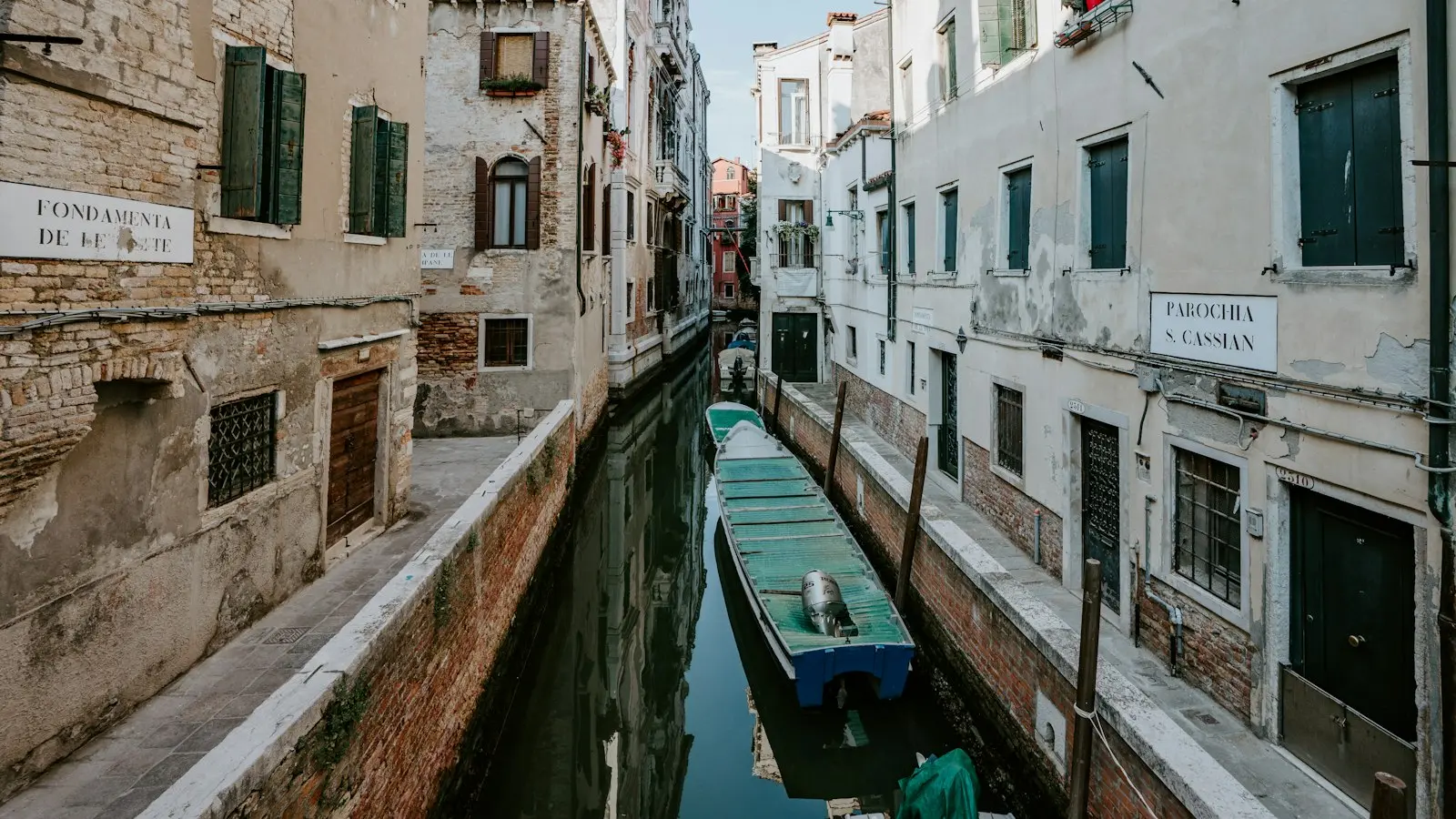
A coastal city can feel calm and chaotic at once because the two impressions arise from different sensory and movement conditions within the same compact space. Open water, reflected light, slower boat traffic, and repetitive natural sounds may create relief, while narrow lanes, bridges, queues, heat, noise, and competing pedestrian flows increase pressure.
Venice makes this contrast especially visible, but the mechanism applies more broadly to historic waterfront cities. The important point is not that every visitor experiences the city in the same way. Changes in openness, sound, movement, and perceived scale can make a coastal city feel calm in one moment and overwhelming in the next.
Key Takeaways
- Open water can widen perceived space and provide visual or sensory relief, but a busy waterfront is not necessarily quiet.
- Narrow streets, bridges, queues, and limited sightlines amplify the pressure of concentrated pedestrian movement.
- Historic architecture can alternate rapidly between enclosure and openness, changing how large or navigable a place feels.
- Moving from a quiet canal or side street into a crowded route makes both states feel more intense and memorable.
- Timing, route choice, extra time, and respect for residents can reduce overload without promising a universally quiet itinerary.
Water Creates Openness, Rhythm, and Sensory Relief
Water changes how an urban space is seen and heard. A canal, lagoon, harbor, or shoreline interrupts the continuous wall of buildings and gives the eye a longer view. Even when the city remains dense, a visible surface of water can create a sense of distance and visual breathing room.
That effect is partly about perceived scale. A narrow street offers only a short view, often ending at a wall, corner, or crowd. A waterfront may provide a wider field of vision, reflected light, moving boats, and a more legible horizon. These features can make the same city feel less enclosing without changing its physical density.
Many people associate shorelines with calm or renewal because water, wind, open space, and opportunities for movement can offer a change from enclosed urban surroundings. That response varies from person to person. Water does not automatically improve everyone’s mood, but it can alter the visual and sensory conditions that shape how a place feels.
Sound may contribute as well. Repetitive natural sounds, such as waves or water movement, can provide a relatively predictable background against which other sounds are noticed less sharply. Wind and open space can alter how voices and traffic reach a listener. But waterfront acoustics are not inherently quiet. Engines, wakes, construction, deliveries, announcements, and groups of visitors can make a canal or harbor louder than a side street.
This is why a brief pause beside open water may feel restorative even during a busy day, while a transport landing or heavily used promenade may feel hectic. The relevant question is not simply whether water is present. It is what kind of water edge it is, how much activity surrounds it, and whether the visitor has space to stop rather than being carried along by a flow.
Narrow Streets Turn Movement Into Crowd Pressure
The chaotic side of the coastal city calm-and-chaotic feeling often appears when people enter a constrained route. Narrow streets, bridges, archways, entrances, and queues reduce the options available to pedestrians. A modest disruption can then affect everyone behind it.
Crowds feel more stressful when walking becomes stop-start rather than continuous. People may need to slow down for luggage, wait for others to cross a bridge, or adjust their path around a group taking photographs. Limited sightlines make it harder to judge how far the obstruction extends or whether the route ahead will open soon.
Personal space matters, but so does uncertainty. A person can tolerate a busy square more easily when the exits and directions are clear. In a narrow passage, the same number of people may feel more burdensome because movement is less predictable. When visitors cannot see the next turn or understand why the flow has stopped, congestion can feel larger than it is.
Different users also have different reasons for moving. Residents may be trying to reach home, workers may be carrying supplies, commuters may be following a regular route, and visitors may be looking for a landmark or checking a map. These goals can conflict without anyone behaving unusually badly. A city corridor that works for daily life can become difficult when many unfamiliar users arrive at the same time.
Heat, fatigue, luggage, and noise intensify the experience. Carrying bags makes detours harder. Warm weather increases physical discomfort. Repeatedly stopping and restarting demands attention. The result is not only a denser crowd but a greater sensory and physical load.
Conditions at particular bottlenecks can also change from one day or hour to the next. A bridge, landing, or landmark route may be easy to cross at one moment and difficult at another, depending on transport activity, deliveries, weather, events, and the number of people arriving together. The general mechanism is more stable: constrained space magnifies the consequences of concentrated movement.
Historic Architecture Magnifies the Contrast
Architecture can alternate between enclosure and release with unusual speed in historic waterfront cities. Continuous façades and narrow passages may make a person feel surrounded, then a sudden square, canal edge, or broad quay can open the scene dramatically.
Grand buildings influence perceived scale in the opposite direction. A monumental façade can make an individual feel small, especially when the surrounding space is open enough to display the building’s full height and width. A narrow lane can produce the reverse sensation: the city feels physically close, difficult to read, and almost immediate.
This shift affects navigation as well as mood. Visual continuity, decorative detail, and repeated architectural forms can be absorbing. They give the eye plenty to inspect and may encourage slower attention. Yet dense historic form can also make orientation difficult. Similar-looking passages, concealed intersections, and limited views can increase the effort required to decide where to go.
That is why architecture should not be treated only as scenery. In Venice and comparable cities, the built environment is also a workplace, a residential setting, a transport network, and public infrastructure. The same bridge that creates a memorable view may be an essential daily crossing. The same square that feels spacious to a visitor may be a place where people wait, work, meet, or pass through.
The urban sensory experience therefore depends on use as well as appearance. A visually beautiful setting can still be tiring if it requires constant route-finding or negotiating with traffic. Conversely, a plain stretch of waterfront may provide relief because it is easier to understand and offers room to pause.
Why Serenity and Overload Become More Memorable Together
Rapid changes between quiet and crowded settings make both states feel more pronounced. A visitor may leave a nearly empty canal-side lane and enter a tightly packed route within minutes. The contrast draws attention to itself, making the overall visit easier to remember than a city that feels uniformly busy or uniformly quiet.
This is partly a matter of expectation. Someone arriving with an image of a consistently romantic or peaceful waterfront may interpret ordinary congestion as a sharper disruption. Someone expecting a working city full of visitors may be less surprised by it. Expectations do not determine the experience, but they influence how strongly a change is felt.
Tourism patterns can produce these uneven conditions. Popular landmarks, bridges, arrival points, and transfer routes tend to concentrate movement, while nearby streets may carry fewer people. The result can be a patchwork of pressure and relief rather than a city-wide level of busyness.
The same compact urban form helps create both outcomes. Dense historic buildings bring destinations close together, which can make exploration rewarding and efficient. But limited routes also concentrate people. Water provides open views and a strong sense of place, while bridges and waterfront access points can act as movement channels.
Tourism is part of this system, but visitors are not the only source of activity. Residents, service workers, deliveries, public transport users, and local businesses continue to use the city. Understanding the contrast should encourage patience rather than treating congestion as a spectacle. A crowded route is often a shared piece of urban infrastructure under pressure.
How to Find Calmer Conditions During a Short Visit
Visitors cannot guarantee a quiet route, but they can reduce the likelihood of sensory overload by treating timing and route choice as variables. High-demand paths may be easier to navigate outside the busiest part of the day, when feasible. Current official information about access, transport, events, and temporary restrictions is more reliable than assuming that a particular hour or season is always calm.
A less direct route may also change the experience. Side streets, smaller squares, and waterfront pauses can provide breaks from continuous crowd movement. However, a side street is not automatically quiet, and a waterfront may be busy near a landing, restaurant, or transport stop. The useful strategy is to observe conditions as they are rather than follow a fixed promise about a supposedly hidden refuge.
Allowing extra time is a practical form of crowd management. If a bridge or queue slows progress, a visitor with no immediate appointment can pause, wait for movement to loosen, or choose a lawful alternative route. Someone carrying luggage, traveling with children, or managing limited mobility may reasonably prioritize directness and accessibility over a quieter but longer path.
A simple decision framework helps. Consider the current crowd level, temperature, luggage, navigation confidence, route accessibility, and whether arrival at a fixed time matters. A visually open route may be calming but exposed to sun and wind. A less crowded path may offer fewer services or make orientation harder. A faster route may be more stressful, while a slower one may provide better opportunities to stop beside water.
The goal is not to eliminate the city’s complexity. It is to create enough variation in pace and space that the experience does not become one continuous negotiation. A short pause, a wider view, or a decision to stop following the main flow can change the balance between stimulation and recovery.
FAQ
Why can Venice feel peaceful and overwhelming within the same walk?
Venice combines open water, reflective light, historic architecture, and slow-moving boats with narrow paths, bridges, queues, and concentrated pedestrian flows. Because these environments can appear only minutes apart, the shift from visual openness to constrained movement feels especially strong.
Does being near water really make a city feel calmer?
Water can contribute to calm by widening views, adding rhythmic movement, and creating visual or acoustic relief. For some visitors, these changes in surroundings feel restorative. It is not a universal effect, however, and busy waterfronts can be noisy, crowded, or physically uncomfortable.
What is the best way to avoid the most stressful crowd conditions in a waterfront city?
Check current official information, allow extra time, and avoid relying only on the most direct or famous route when circumstances permit. Consider less busy travel periods, side streets, open squares, and waterfront pauses, while checking accessibility and respecting residential and working areas. No route is guaranteed to be quiet, so adjust to real-time conditions rather than treating a general tip as a rule.