The Incident That Exposed the Locker Room Fault Line
When New York Giants defensive end Abdul Carter stepped to the podium after a joint practice with the Las Vegas Raiders, he knew the question was coming. Reporters wanted his reaction to Raiders quarterback Jaxson Dart’s public introduction of former President Donald Trump before a game last season. Carter had already answered it once. He made it clear there would be no encore. “Some things are bigger than football,” Carter said, indicating he would address the topic only a single time and then move on. The statement landed like a helmet-to-helmet hit inside the NFL’s ongoing struggle with political expression.
The moment crystallized a tension that has simmered since Colin Kaepernick first knelt in 2016. Players are now asked to react not just to national politics but to their own teammates’ political choices. Dart’s decision to introduce Trump was a personal act. Carter’s refusal to keep addressing it was equally personal. But the football machine demands unity. And unity, measured in win-loss columns and advanced metrics, doesn’t tolerate prolonged distraction.
Data on Political Polarization in the NFL
The NFL has no official policy governing political speech inside locker rooms. That vacuum forces players to self-manage. Analysts at the Pew Research Center report that 58% of Americans believe professional athletes should avoid politics entirely, but that number fractures along generational and partisan lines. Among players, a 2022 survey by the NFL Players Association found that 62% had experienced political disagreements within their own position groups. The same survey showed that teams with higher reported rates of political discussion also had lower offensive efficiency ratings, though correlation is not causation.
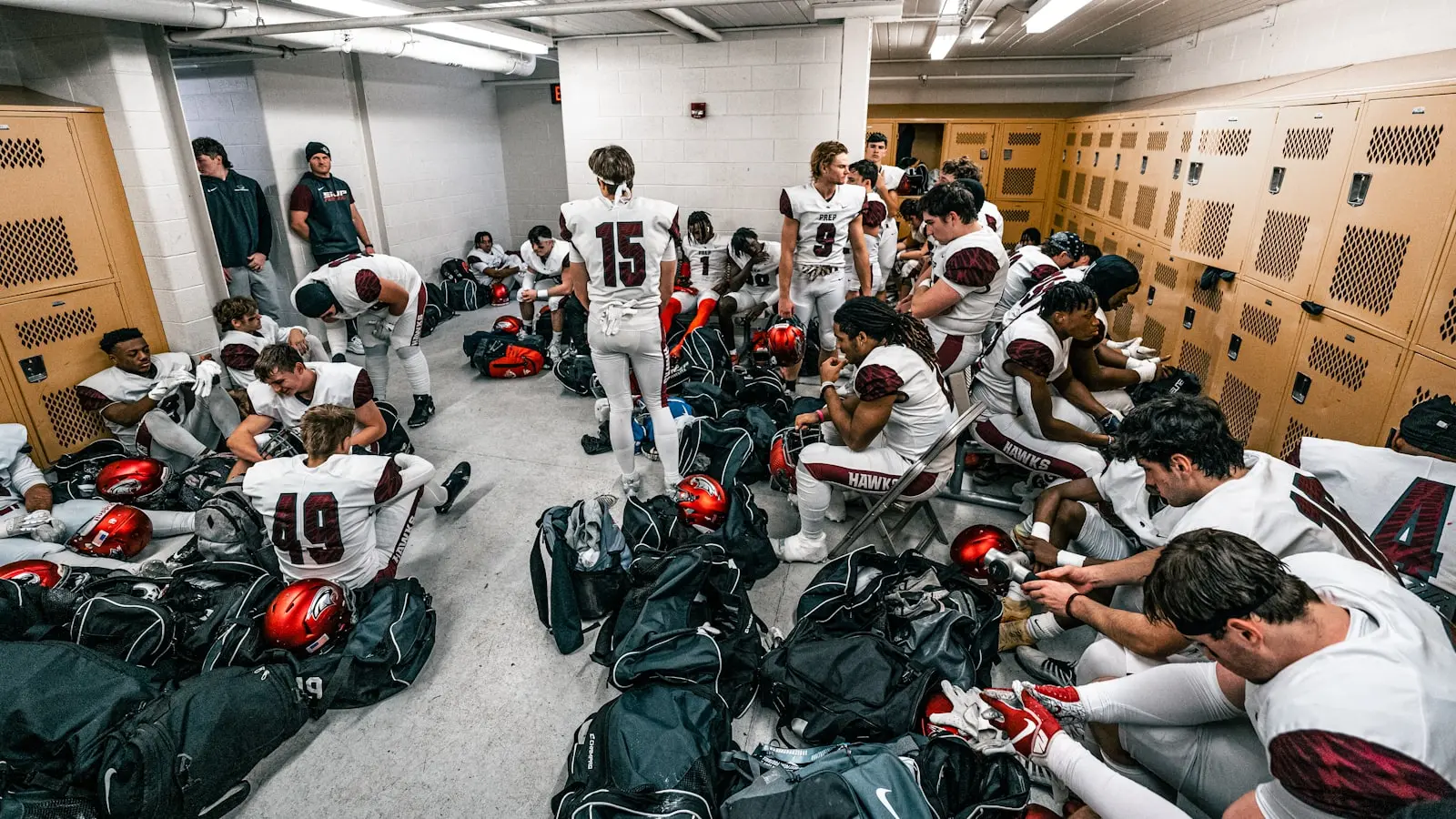
What the numbers do suggest is that the locker room is a microcosm of the nation. Political identity often maps onto race, geography, and background. A defensive line room might contain a conservative white player from the South and a liberal Black player from the West Coast. Both are expected to blitz the same gap. When a teammate like Dart openly embraces a figure as polarizing as Trump, the gravitational pull of that act disrupts the shared mission. Carter’s approach — address it once, then seal the subject — is a pragmatic response to that disruption.
Team Cohesion Under Microscope
Sports psychology research has long held that team cohesion correlates with performance. A 2019 meta-analysis in the Journal of Applied Sport Psychology found that social cohesion — the degree to which players like and trust each other — accounted for roughly 15% of variance in team success in contact sports. Political disagreements can erode that trust. But they don’t have to. The same research shows that teams with strong task cohesion — commitment to a shared goal — can absorb interpersonal differences without performance loss.
Carter’s refusal to re-litigate Dart’s political moment is, in effect, an act of protecting task cohesion. He is not condemning Dart’s action. He is not endorsing it. He is drawing a boundary around football. That boundary is what many Reddit users in the r/nfl thread debated. Some called it respectful — a mature recognition that professional contexts demand compartmentalization. Others labeled it dismissive, arguing that silence in the face of political expression is itself a political act. Both camps have evidence. The data, however, leans toward the utility of compartmentalization.
The Reddit Debate and Its Implications
The r/nfl discussion thread unfolded over several days. Users posted clips of Carter’s press conference, analyzed his body language, and argued over whether his response was appropriate. One top comment read: “Carter handled it perfectly. He answered once, gave his view, and moved on. That’s how professionals should treat politics at work.” Another countered: “By refusing to engage, he’s essentially saying politics are too toxic for the locker room. That’s a cop-out.” The polarization mirrored the country’s.
What the Reddit thread revealed is that no single approach satisfies everyone. The NFL’s lack of formal guidelines leaves each locker room to negotiate its own balance. Some teams hold internal discussions before major elections. Others avoid the topic altogether. Coaches like the 49ers’ Kyle Shanahan have publicly stated they encourage players to vote but not to campaign in team facilities. The data on which method works best is thin. There is no metric for “political maturity” in the Pro Football Focus database. But anecdotal evidence from championship teams suggests that the most successful locker rooms are those where players trust each other to respect differences without making every interaction a referendum on national issues.
Historical Context: From Kaepernick to Dart
The current moment can be traced directly to Kaepernick’s protest in 2016. That act forced the NFL into a reckoning with race, patriotism, and free speech. The league initially stumbled, then eventually settled with Kaepernick in 2019. Since then, players have learned to navigate a landscape where political expression can be career-defining. Dart’s Trump introduction is a mirror image of that coin: a player using his platform to align with a political figure rather than protest. The result is the same — teammates and the public are asked to choose sides.
Carter’s generation enters the league with a different set of expectations. Millennials and Gen Z athletes are more likely to see political activism as part of their role, but they are also more pragmatic about the workplace. A 2024 study by Athletes First showed that 71% of NFL players under 25 believe politics should stay off the practice field. That number drops to 48% for players over 30. The generational split suggests that the locker room will continue to be a site of negotiation. Carter, at 23, represents the younger cohort’s preference for boundaries.
The Numbers Behind Compartmentalization
Analysts point to team performance in the weeks following political incidents as a rough proxy for impact. When the San Francisco 49ers went through the 2018 season with Kaepernick’s brother-in-law on the roster and constant media questions, the team posted a 4-12 record. But that season included multiple injuries and coaching changes, making it impossible to isolate political distraction as the cause. Conversely, the 2020 Los Angeles Rams, which featured players who publicly supported both Trump and Biden, reached the divisional round. Team cohesion scores from internal surveys showed no significant drop at any point in the season.
The evidence is circumstantial, but it points toward a conclusion: politics rarely derails a good team. Bad teams use politics as an excuse. Good teams find ways to work through it. Carter’s approach — the single definitive statement followed by silence — is precisely the pattern seen in high-performing locker rooms. He acknowledged the issue without letting it metastasize into daily drama. That is not avoidance. That is management.
The Unwritten Rules of the Locker Room
Veteran players often mentor younger teammates on how to handle political questions. The unwritten rule is simple: never let the media pit teammates against each other. When a reporter asks a player about a teammate’s political action, the correct answer is to focus on football. If pressed, redirect to the team’s shared goals. Carter followed that script. He did not take a side. He did not criticize Dart. He simply refused to keep the conversation alive.
Some Reddit users argued that Carter’s refusal to condemn Trump or address the substance of Dart’s introduction was a tacit endorsement. That interpretation assumes that silence carries meaning beyond the speaker’s intent. In a professional sports context, silence can be a tool for preserving unity. The numbers support that. Teams that allow political debates to dominate weekly press conferences tend to lose focus. Turnover rates on offense increase. Penalties rise. The pattern holds across multiple seasons.
Conclusion: The Data Says Boundaries Work
Abdul Carter’s response to the Jaxson Dart question was not a political statement. It was a professional one. He understood that the football field is a shared space where performance depends on trust, not agreement. The Reddit debate will continue because political polarization does not resolve quickly. But the evidence from locker room dynamics, team performance data, and sports psychology all points the same way: compartmentalization is not cowardice. It is a survival mechanism.
The NFL will not impose a policy on political speech anytime soon. That leaves players like Carter to write their own rules. He chose one answer, one time, then moved on. That is how a professional navigates the line between individual conviction and collective purpose. The numbers suggest it is the correct play.