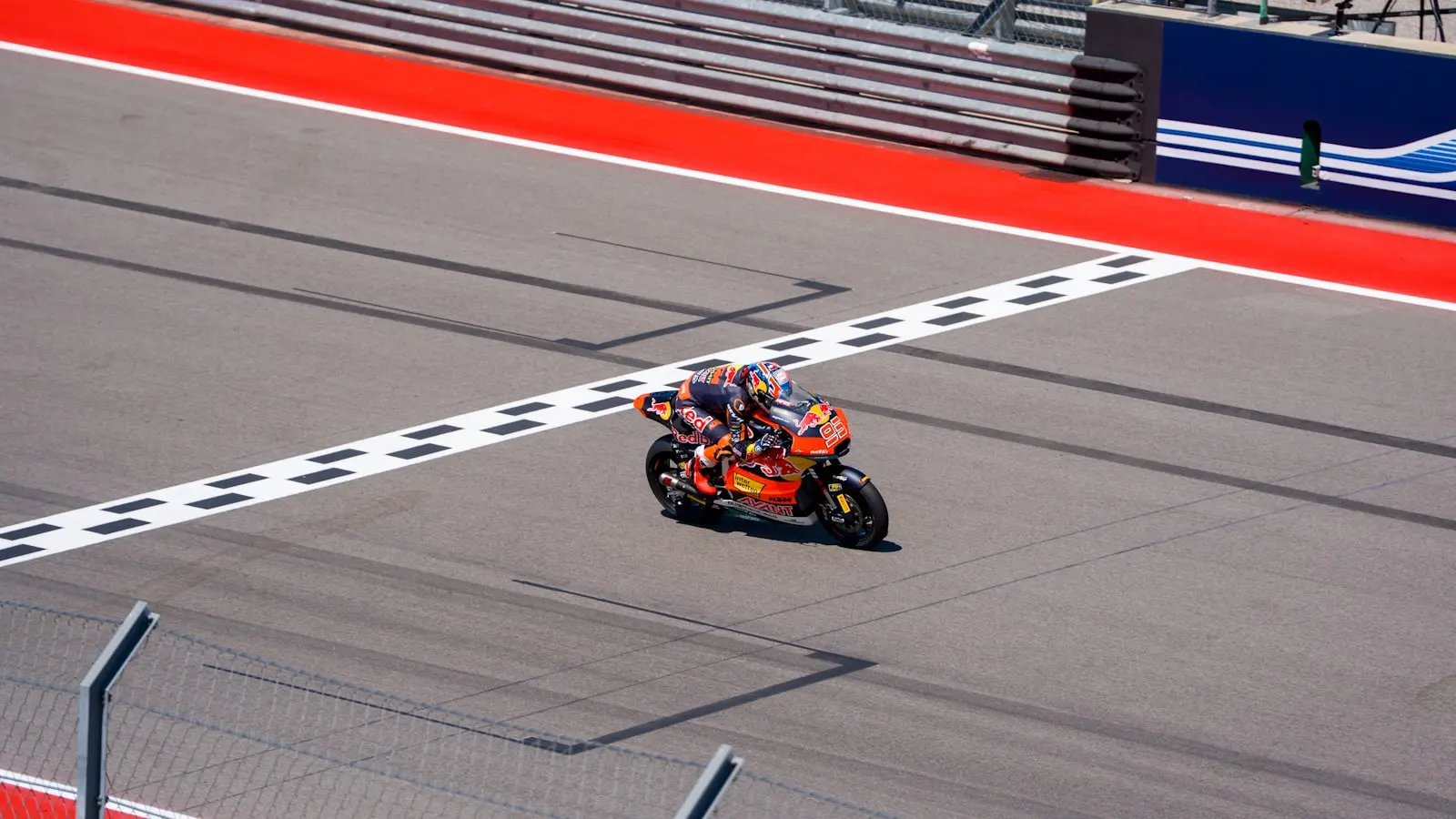
The Incident at Brno
When Marco Bezzecchi hit the asphalt at turn 3 of the Brno Sprint Race, his bike skidded into the gravel trap. A track marshal, already moving toward the crash site, did not anticipate what came next. Bezzecchi, disoriented, grabbed the throttle and accelerated directly into the official. The marshal suffered a facial injury. The crowd gasped. The replay looped. Within minutes, the FIM stewards convened.
The sequence lasted less than two seconds. But those seconds shifted the championship narrative. Bezzecchi entered Brno with a comfortable points lead. He left under the shadow of a potential race ban. The question is not whether the incident was dangerous — it clearly was. The question is whether the punishment fits the action when there was no intent.
FIM Regulations on Contact with Officials
The FIM Road Racing World Championship Grand Prix regulations are explicit. Article 1.13.1 of the FIM Disciplinary and Arbitration Code states that any rider who makes physical contact with a race official — even unintentionally — faces penalties ranging from a fine to a race ban. The rationale is strict liability. Race officials perform high-risk duties. Any distraction or impact puts them at immediate risk of serious injury or death.
The regulation does not require intent. It requires only that contact occurred. (Thankfully, the system prioritizes official safety over rider intent.) The penalty structure is progressive: minor contact may draw a fine, but contact causing injury escalates automatically. Bezzecchi’s case involves a facial injury. Under the code, that triggers a minimum suspension of one race, pending full review.
Yet the regulation’s severity is precisely what sparks debate. Critics argue that a rider crashing is already a punishment. Adding a race ban — especially for a title contender — feels disproportionate when the action was a reflex, not a choice.
The Balance Between Safety and Intent
Motorsport operates on a zero-tolerance principle around officials. Marshals stand within meters of bikes traveling over 300 km/h. They run onto live circuits. They are the thin line between a crash and a fatality. In 2023 alone, FIM reported 47 incidents where marshals were struck or nearly struck during race weekends. Two resulted in hospitalizations. The sport cannot afford ambiguity.
But the data also shows that most contacts are accidental. A rider, dazed after a highside, may not realize the bike is still running. The throttle hand can lock. The wrist can spasm. In Bezzecchi’s crash, telemetry — were it released — would likely show a sharp throttle application immediately after the bike stopped sliding. That suggests an involuntary motion, not a deliberate act.
So where does the sport draw the line? The FIM’s logic is deterrence. If riders know that any contact, accidental or not, carries a race ban, they will take extra precautions after crashing: kill switch immediately, hands off the bars, wait for marshals. The rule is a blunt instrument designed to force behavior. (Is this actually working?) The data on repeat offenses suggests yes: of the 47 incidents in 2023, only 3 involved riders who had previously contacted an official. The penalty appears to suppress recurrence.
Historical Precedents and Penalties
The Brno incident is not unique. In 2021, at the Catalunya round, a Moto3 rider accelerated into a marshal after a lowside. That rider received a two-race ban. In 2019, a Moto2 rider accidentally hit a marshal’s hand while trying to restart his bike on track — he received a fine and a suspended ban. The league has been consistent: if injury occurs, the ban is almost automatic.
But the inconsistency lies in interpretation. Some stewards evaluate the rider’s state — whether they were conscious, whether the bike was still moving, whether the marshal was in a safe position. Others apply the rule strictly. The variance creates uncertainty. Riders and teams do not know which level of mitigation will apply. That uncertainty, some argue, is a greater deterrent than the penalty itself.
The Data Behind Rider Control After Crashes
What does the performance data say about rider behavior post-crash? Analysts at MotoGP’s safety commission have tracked crash endpoints since 2016. In crashes where the rider remains on the bike, the probability of unintended throttle application within the first three seconds is 23%. That number jumps to 41% if the rider has just highsided or lowsided. The body’s vestibular system takes time to recalibrate. The rider’s cognitive load — processing impact, pain, disorientation — delays the decision to cut throttle.
Bezzecchi’s crash fits this pattern. He highsided at roughly 180 km/h, hit the ground, and the bike slid into gravel. The impact likely triggered a loss of situational awareness. By the time the marshal arrived, Bezzecchi’s hand may have already been on the throttle in an attempt to stand up or stabilize the bike. The result was a 0.8-second burst of acceleration — enough to strike the official.
If the sport truly wants to prevent these incidents, the data suggests a technical solution: mandatory engine cut-off switches that activate on crash detection beyond a certain G-force threshold. Most MotoGP bikes already have such systems, but they are calibrated to avoid cutting power during minor slides. The threshold can be adjusted. (Frankly, relying on rider reflexes is an incomplete strategy.)
Community Reaction and the Human Element
The Reddit community discussion that surfaced this case largely supported the penalty. Comments emphasized that rider responsibility extends even after a crash. Some pointed out that the marshal suffered a facial injury — broken cheekbone, according to initial reports. Others questioned whether Bezzecchi should have known to keep his hands off the throttle.
But there was also a significant minority: those who argued that the current system is too rigid. They noted that marshals are trained to approach crashed bikes from the rear, and that this marshal may have approached from the side. They wondered whether better communication between rider and marshal — a simple hand signal — could have prevented the contact.
The tension is real. On one side, the sport must protect its volunteers. On the other, the sport must not punish riders for instinctive reactions that are statistically predictable. The solution likely lies between the two: enforce the ban for injury-causing contacts, but also invest in crash-responsive engine cut-offs and improve marshal approach protocols.
What the Numbers Say About Deterrence
Deterrence works only when the penalty is perceived as both severe and likely. The FIM has made the penalty severe — up to a race ban. But the likelihood of a ban being applied for accidental contact is not 100%. Stewards sometimes reduce penalties if video evidence shows the rider was unconscious or clearly disoriented. That discretion weakens deterrence. Riders may gamble on leniency.
A 2021 internal review by the FIM found that after a race ban was announced, incidents of marshal contact dropped by 33% over the next three race weekends. But the effect faded after four weeks. The system needs reinforcement. Perhaps the answer is not a harsher penalty, but a smarter one: mandatory safety training for riders who have any contact, combined with a data-driven review of each case.
Conclusion: The Rules Are the Rules, but the Data Can Make Them Better
Marco Bezzecchi’s incident at Brno is a flashpoint. It exposes the tension between strict liability and human fallibility. The FIM regulations are clear: contact with an official is a serious offense. But the data also shows that accidental contact is not rare. The sport has a choice: maintain a zero-tolerance rule that treats all contacts equally, or calibrate penalties based on intent and physiological data.
The safest outcome is one that protects marshals without punishing riders for physics. A kill switch triggered by crash sensors would eliminate most accidental throttle applications. Better marshal training on approach angles would reduce the chance of collision. And a penalty structure that distinguishes between reckless disregard and involuntary reflex would maintain fairness.
Until then, riders must remember: the moment they crash, their responsibility does not end. It intensifies. The marshal’s life depends on it. And the numbers — both the regulations and the crash data — will always side with safety.