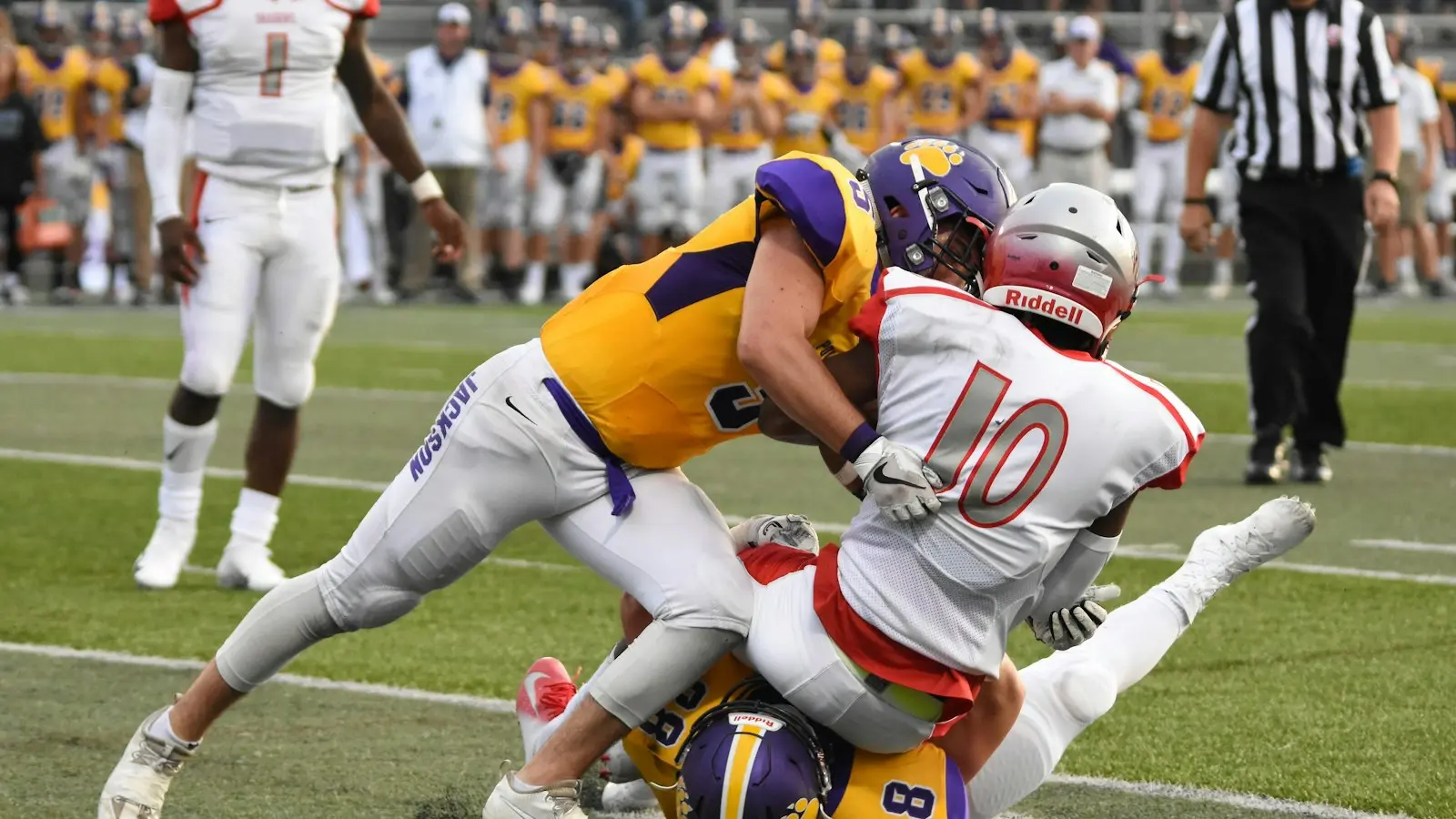
A linebacker’s neck injury is especially difficult because the position demands repeated collisions while the player is accelerating, stopping, changing direction, and making decisions in crowded, unpredictable spaces. A player may walk, move the arms and legs, and look comfortable in a public update while still needing extensive evaluation before absorbing full football contact.
That distinction is central to understanding linebacker neck injury risks. The issue is not simply whether the neck can move. It is whether the cervical spine and surrounding structures can safely tolerate repeated, high-load impacts without unacceptable neurological or symptom-related risk. Only the treating medical team can make that determination for an individual athlete.
Key Takeaways
- Linebackers combine short-area acceleration, sudden deceleration, lateral movement, tackling, and frequent exposure to unpredictable contact.
- Head and neck position, tackling angle, rotation, and force direction can all affect football neck injury mechanics.
- Normal walking or limb movement may be encouraging but does not establish readiness for full-contact football.
- Helmets, shoulder pads, technique, conditioning, and rehabilitation can reduce some risks but cannot eliminate every collision or guarantee protection.
- Return-to-play decisions must be individualized and prioritize long-term neurological safety over short-term roster needs.
Why linebackers face repeated high-load neck demands
Linebackers operate in one of football’s most collision-heavy areas. They may begin a play with a rapid forward burst, then stop abruptly, move laterally, redirect toward a ball carrier, engage a blocker, and tackle within a few seconds. That combination creates several types of physical stress.
A running player carries momentum. When a linebacker stops or changes direction, the body must manage that momentum through the feet, hips, trunk, shoulders, and neck. If contact arrives during the transition, the player may absorb force while the body is not in an ideal position to distribute it.
The contact is also difficult to predict. A linebacker can be struck by a ball carrier, blocked from the side, pulled into another player, or landed on after making a tackle. Teammates and opponents may arrive after the initial collision, creating secondary forces that are not fully under the defender’s control.
This is why comparing a linebacker with a less collision-heavy position requires care. It does not mean every linebacker faces the same injury outcome or that other positions are safe. It means the job routinely combines pursuit, close-range contact, sudden deceleration, and falling bodies in a way that makes football neck injury mechanics particularly demanding.
Ordinary daily movement does not reproduce that exposure. Walking, turning the head, lifting light objects, or jogging in a controlled setting may test useful functions, but none recreates the speed, impact, rotation, and uncertainty of a live tackle.
How tackling mechanics can stress the cervical spine
The position of the head and neck matters because force can travel through the body differently depending on alignment. A head-down tackle or contact made with the crown of the helmet can place the neck in a vulnerable posture. In simplified terms, force directed along a relatively straightened neck can create axial loading, meaning compression along the spine.
Axial loading is only one part of the picture. A tackle may also involve flexion, when the neck bends forward; extension, when it bends backward; or rotation, when the head turns relative to the torso. These movements can happen together, especially when a defender is reaching, being spun by a runner, or falling while trying to finish a play.
Tackling angles influence the exposure as well. A square, controlled approach gives the athlete more opportunity to align the torso and use the shoulder and hips to manage contact. A late or off-balance angle can leave the defender reaching across the body, lowering the head, or absorbing force while the feet are no longer beneath the center of mass.
Linebackers must make these adjustments at speed. They are reading blocking schemes, identifying the ball carrier, avoiding teammates, and deciding how to engage. A technique that appears simple in a coaching demonstration becomes harder when the target changes direction and another player enters the collision.
Modern tackling instruction generally emphasizes keeping the head out of the contact area, maintaining better body position, and using the shoulder and arms rather than leading with the crown of the helmet. These principles can reduce certain dangerous exposures. They cannot eliminate every awkward fall, mistimed collision, or force transmitted through the neck.
The important point is not that one tackle position automatically causes a particular injury. Football neck injury mechanics are influenced by speed, angle, posture, contact location, timing, body control, and the forces that follow the initial impact. A public video or brief description rarely provides enough information to determine what happened medically.
Why normal movement does not equal contact clearance
An encouraging movement update can be reassuring in a limited sense. It may suggest that the athlete can perform some basic functions. But movement in the limbs, walking, or appearing comfortable does not establish that the player is ready for repeated high-force football collisions.
Return-to-play decisions are built around the individual injury and the athlete’s clinical progress. Depending on the circumstances, medical teams may consider current symptoms, a neurological examination, strength, sensation, reflexes, balance, range of motion, functional movement, and imaging when appropriate. They may also assess whether symptoms return as activity becomes more demanding.
The exact process varies because a neck injury is not one single condition. Muscle strain, joint irritation, disc-related problems, nerve symptoms, and more serious cervical-spine injuries can present differently and require different decisions. Some early symptoms may overlap, which is one reason clinicians do not treat a positive public update as a complete medical assessment.
Sport-specific testing is another critical step. A player might first tolerate controlled running, then change-of-direction work, contact-free football drills, and increasingly complex practice situations. Full-contact clearance may require confidence that the athlete can react, brace, absorb force, and protect the body under conditions that resemble the position’s actual demands.
That progression is not a formality. A linebacker cannot choose where the next collision occurs. The medical question is broader than whether the player can perform a planned movement. It is whether the player can safely handle repeated, unpredictable contact without unacceptable neurological or symptom-related risk.
A cautious timeline may be appropriate even when public reports sound positive because medical teams are balancing long-term safety against a short-term roster need. The club may need a starter, but that pressure does not change the biology of healing or the consequences of returning before the evaluation is complete.
What equipment, technique, and rehabilitation can—and cannot—do
Football injury prevention works best as a layered approach rather than a single piece of equipment or one coaching point. A properly fitted helmet, correctly fitted shoulder pads, sound tackling instruction, appropriate strength and conditioning, and careful medical supervision can each address part of the risk.
Equipment can help manage certain impacts, but helmets and pads do not make the neck immune to force. A helmet may protect the skull from some contact, while shoulder pads can distribute force across the upper body. Neither guarantees that the cervical spine will avoid compression, bending, rotation, or sudden deceleration.
Technique also has limits. Keeping the head out of contact and improving body position can reduce the likelihood of dangerous head-first engagement. Yet a linebacker may still be hit from an unexpected direction, lose balance, or be caught in a pile. Better technique lowers some exposures; it does not remove the unpredictable nature of the sport.
Rehabilitation for a collision athlete has to address more than pain reduction. Goals may include restoring neck and upper-body function, rebuilding strength and movement control, improving conditioning, monitoring neurological or radiating symptoms, and restoring confidence without allowing confidence to outrun physical readiness.
Progression is normally controlled and sport-specific. An athlete might move from basic exercises to running, cutting, non-contact football drills, and eventually supervised contact if the medical team considers that appropriate. Neck-strengthening work can support overall preparation, but it should not be presented as guaranteed protection or as a substitute for diagnosis and clearance.
The same principle applies to conditioning. A linebacker who is fit enough to complete a workout may still need to demonstrate that fatigue does not cause the head to drop, the torso to lose position, or tackling mechanics to deteriorate. Contact risk can increase when reaction time and body control decline late in a practice or game.
The long-term decision behind a linebacker’s return
The key question is not simply whether a linebacker can walk, run, or participate in part of practice. It is whether repeated high-load contact is medically acceptable given the specific injury, examination findings, symptoms, imaging, recovery pattern, and demands of the position.
That decision involves trade-offs. Returning too soon could expose the athlete to recurrent symptoms, additional structural stress, or neurological danger, depending on the underlying condition. Waiting longer can cost games, roster opportunity, income, and team momentum. Medical teams must weigh those pressures against the possibility that a short-term return creates a much larger long-term problem.
Uncertainty makes the decision harder. Two athletes can report similar neck discomfort yet have different causes, examination findings, and risk profiles. Conversely, a player who looks well in a brief public appearance may still have limitations that are invisible to spectators.
This is also why a positive update should be interpreted carefully. It can indicate progress without answering the more important football question: can the athlete repeatedly tackle, be tackled, fall, rotate, and absorb contact without unacceptable risk? A movement report is one piece of information, not a return date or a diagnosis.
For fans, the practical takeaway is straightforward. Linebacker neck injury risks are tied to the position’s combination of acceleration, sudden stopping, close-range tackling, awkward angles, and unpredictable secondary contact. Technique, equipment, conditioning, and rehabilitation can reduce risk, but none can guarantee protection. The final decision must prioritize neurological safety and come from the treating medical team rather than a roster timetable.
Frequently asked questions
Why are linebackers more exposed to neck injury risks than many other football positions?
Linebackers repeatedly pursue ball carriers, engage blockers, change direction, and tackle in confined spaces. They can absorb force from several directions while moving or stopping suddenly. That creates a distinctive exposure pattern, although it does not mean every linebacker has the same risk or outcome.
Does movement in the arms and legs mean a linebacker is ready to return to football contact?
No. Movement can be encouraging, but it does not test the athlete’s ability to tolerate repeated collisions. Medical teams generally need to consider symptoms, neurological findings, strength, range of motion, imaging when appropriate, functional testing, and a gradual sport-specific progression.
Can proper tackling technique and equipment prevent a serious cervical-spine injury?
They can reduce some dangerous exposures, particularly those associated with head-first contact and poor alignment. They cannot prevent every collision, awkward fall, or force transmitted through the neck. Prevention is risk reduction, not a guarantee of safety.