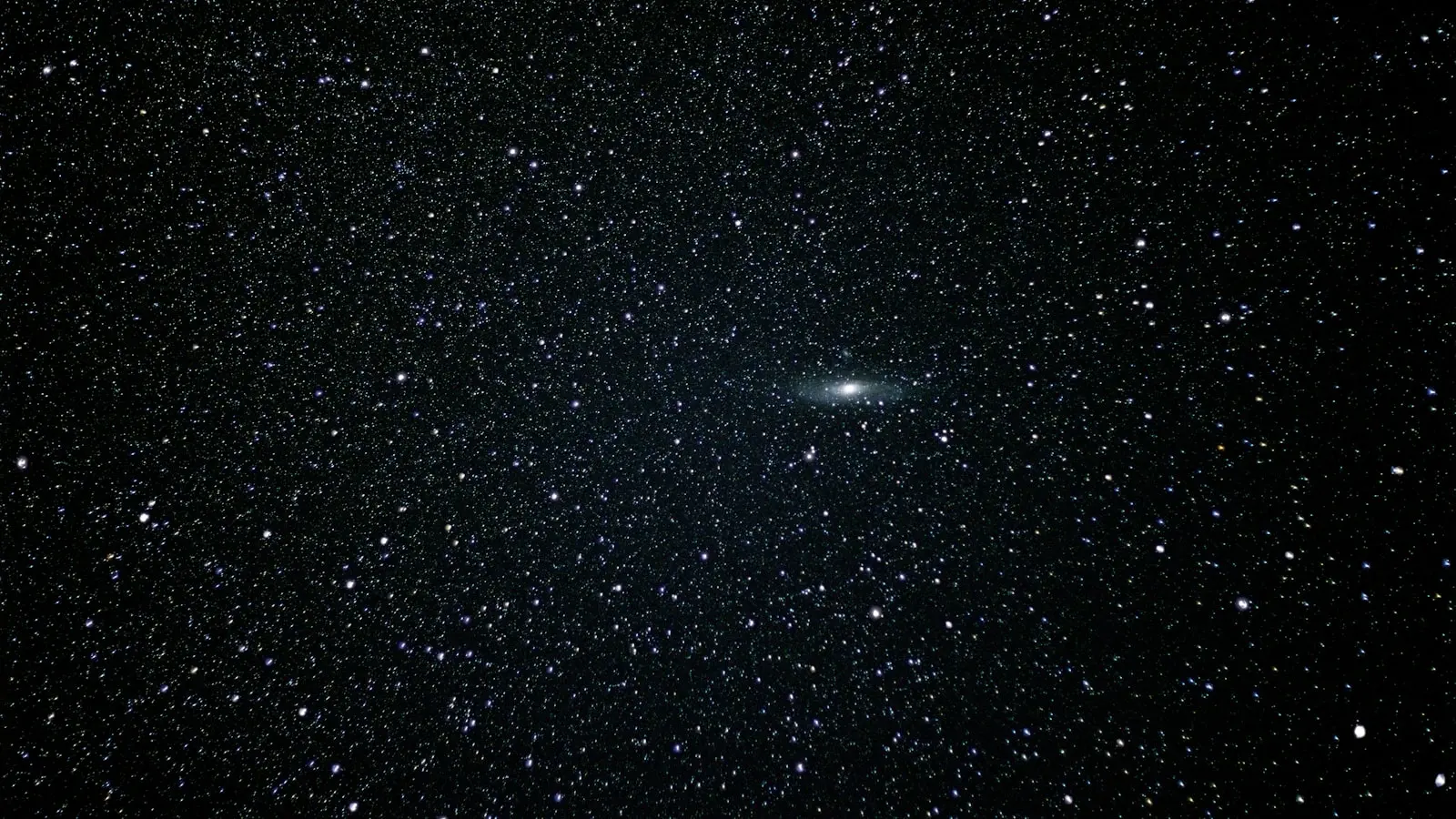
The James Webb Space Telescope recently detected six ultra-massive galaxies sitting deep in the early universe, positioned precisely 500 million years after the Big Bang. Astrophysical models dictate that systems of this magnitude require billions of years of gravity pooling cooling gas to form. Yet these structures contain up to 100 billion solar masses of stars. They break the established timeline of cosmic evolution.
Packing 100 billion solar masses into a universe operating at just three percent of its current age directly violates the timeline constructed by the Lambda Cold Dark Matter standard model. There simply are not enough millions of years available for baryonic matter to cool, clump, and ignite at this scale. Researchers label these anomalies universe breakers.
Before JWST launched in 2021, the Hubble Space Telescope mapped this epoch and found exactly what theorists predicted. Hubble saw only infant star clusters. The legacy data suggested a gentle and gradual cosmic dawn populated by faint, fragmented stellar nurseries. The new infrared observations turn that gentle dawn into a violently rapid era of galaxy construction. Something in the foundational physics of the early universe remains fundamentally misunderstood.
The Crisis in the Cosmic Dawn
Astronomers rely on redshift measurements to determine distance and age in the expanding universe, calculating how far wavelengths of light stretch into the infrared spectrum during their journey toward Earth. The James Webb Space Telescope possesses the exact instruments required to capture these deeply stretched photons. Hubble could not reach them. Webb forces a reckoning.
The Near-Infrared Camera aboard the observatory captures light from the epoch of reionization, a period when the first stars burned away the opaque hydrogen fog of the cosmos. Finding a fully formed galaxy with 100 billion solar masses in this era equates to finding a fully grown adult in a kindergarten classroom. (The math simply refuses to align). Forming a structure equivalent to the modern Milky Way requires a long sequence of dark matter halo mergers and steady gas accretion. Our Milky Way required roughly 13 billion years to assemble its mass. These newly discovered systems somehow achieved the same feat in a fraction of that time.
Scientists analyzing the Nature Astronomy data confront a stark binary choice. Either the standard model of cosmology requires an overhaul, or the fundamental methods used to measure cosmic distances and stellar masses carry hidden flaws. Discovery expands possibility, but it also destroys comfortable assumptions.
The Mechanics of Baryonic Clumping
To understand why these massive galaxies present such a severe theoretical obstacle, one must look at the mechanics of the Lambda Cold Dark Matter model. In this framework, dark matter forms the invisible scaffolding of the universe. After the Big Bang, dark matter pooled into gravitational wells known as halos. Baryonic matter, which includes all the protons and neutrons that make up visible gas and stars, eventually fell into these dark matter halos.
When gas falls into a gravity well, it heats up. Before that gas can collapse into the dense cores required to ignite nuclear fusion and create stars, it must shed that heat. Cooling takes time. The thermodynamics of early universe gas clouds place a strict speed limit on star formation. Once stars do ignite, their intense radiation pushes surrounding gas outward, a process called stellar feedback that actively slows down further star creation.
Standard models estimate that early galaxies convert roughly ten percent of their available gas into stars. To form galaxies of the mass Webb detected within 500 million years, that star formation efficiency would need to approach nearly 100 percent. The gas would need to collapse and ignite without triggering the feedback mechanisms that normally blow galaxies apart. (This contradicts known fluid dynamics). Such perfectly efficient star formation requires physical conditions completely absent from modern astrophysical frameworks.
Phantom Stars or Supermassive Black Holes
Dr. Joel Leja from Penn State University noted that the discovery shifted the paradigm of the cosmic dawn entirely. The scientific community, including rigorous physics forums and enthusiasm boards like r/space, aggressively debates the nature of the red dots captured by Webb. If adjusting the efficiency of star formation requires breaking the laws of thermodynamics, physicists must look for alternative light sources.
One prominent alternative suggests these objects are not heavily populated star systems, but rather supermassive black holes consuming vast amounts of primordial gas. When a black hole feeds, the surrounding accretion disk heats up to extreme temperatures through immense friction, glowing brightly enough to outshine an entire galaxy of stars. An actively feeding black hole can mimic the light output of an oversized galaxy.
This hypothesis resolves the stellar mass problem but immediately creates a new physical paradox. Forming supermassive black holes just millions of years after the Big Bang presents an equal challenge to the standard model. Black holes typically form from the collapse of massive stars and grow slowly through mergers over billions of years. To achieve supermassive status by the 500-million-year mark, the universe would need to produce direct-collapse black holes. This requires immense clouds of pristine hydrogen collapsing under their own weight without ever forming stars. (A theoretical workaround that lacks observational precedent). Pick your physics violation.
The Imperative for Spectroscopic Proof
The initial findings rely on photometric redshift, a method that estimates distance by observing the brightness of an object through various broad filters. While highly effective, photometry occasionally misidentifies nearby, heavily dust-obscured galaxies as distant early-universe objects. Dust scatters blue light, making objects appear redder and falsely older than they actually are.
To solidify the universe-breaking nature of these galaxies, astronomers must secure spectroscopic confirmation. Spectroscopy takes the light from the galaxy and splits it into a detailed rainbow spectrum, revealing the exact chemical signatures of the object. By measuring precisely how far specific emission lines shift toward the red end of the spectrum, researchers determine an exact, undeniable distance.
If spectroscopy confirms that these 100-billion-solar-mass systems sit securely at the 500-million-year mark, the implications cascade through the entirely of modern astrophysics. It forces a recalculation of dark matter behavior. It mandates new theories regarding primordial gas cooling. The standard model rarely yields without a fight, but evidence dictates the direction of progress. Webb continues to map the darkness. The early universe was not a quiet nursery, but an engine of staggering and incomprehensible scale.