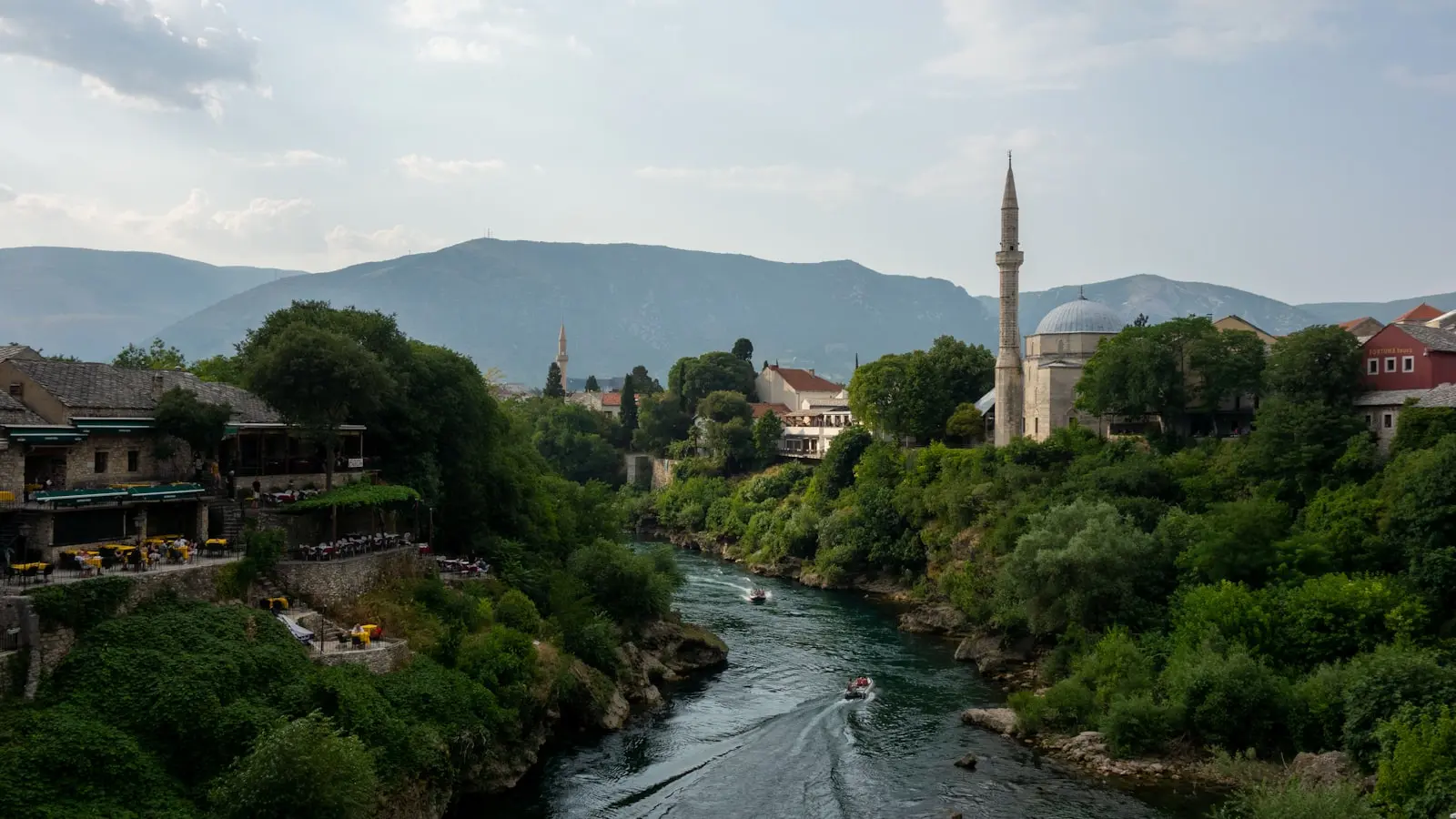
When the sun begins to dip behind the Neretva valley, the cobblestones of the old trail catch a golden hue. Most travelers in Mostar never see this. They wander the polished stones of the Old Town, snap a photo of Stari Most from ground level, and leave. The hike up the hill—the one with the cross looming above—remains a secret, buried in travel forums and Reddit threads. The question is simple: does that 30-minute slog pay off?
The Trail and Its Metrics
The primary route starts near the Koski Mehmed Pasha Mosque, a landmark most tourists visit for its minaret viewpoint (entry fee around 10 BAM, roughly €5). From its base, a narrow cobblestone path winds upward through residential streets, then narrows into a rough dirt-and-rock track. The gradient is punishing: a vertical gain of about 100 meters over roughly 800 meters of path. That’s a 12.5% average grade—steeper than most urban staircases. For context, climbing it equals roughly 30 flights of stairs in a high-rise building. The surface is uneven, with loose stones and exposed roots. After rain, the rocks turn slick. Reddit users consistently warn: “Wear proper shoes, not flip-flops.” (Though some still try and regret it.)
The full trek to the white metal cross—officially the Hum Hill viewpoint—takes 25 to 40 minutes depending on pace and fitness. No entrance fee. No guards. Just a trail that feels older than the concrete sidewalks below.
Why Tourists Miss It
Mostar’s tourism infrastructure concentrates attention on the Old Town. The Stari Most bridge, the mosque, the bazaar—they glue visitors into a walking loop of a few hundred meters. Guidebooks and tour operators rarely promote the hike. TripAdvisor’s top activities in Mostar list the bridge, the mosque, and a few museum tours. The climb appears on page three of search results, if at all. On Reddit’s r/travel, a user recently posted a 5-day itinerary for Bosnia that included a day in Mostar but omitted the hill entirely. When asked why, the response was simple: “Didn’t know it existed.”
That information gap is the whole problem. Travelers who do know often find the trail by accident or through a friend. The reward is disproportionate to the effort—but only if you know where to look.
The Reward: A Data-Free Heaven
Metrics cannot quantify the view. But the physical data helps frame it. From the cross, the observer stands roughly 120 meters above the river. The sightline drops directly onto the reconstructed arch of Stari Most, the blue-green Neretva splitting the city, and the terracotta rooftops of the Ottoman quarter. The human eye resolves details that a camera flattens: the texture of the stone, the shadows lengthening as the sun arcs west. (Photographers who arrive before sunset capture a light that turns the old houses into honeycombs.)
Reddit comment excerpts, collated from multiple threads, paint the same picture: “Worth every drop of sweat.” “Do it at sunset, you won’t regret it.” “The trail is slippery but the top is unforgettable.” A few dissenting voices mention the steepness as a deterrent for older visitors or those with knee issues, but the consensus is loud: short, intense, rewarding.
Comparing the Alternatives
There is a cheaper, easier option: the minaret of Koski Mehmed Pasha Mosque. For a small fee, a spiral staircase takes you to a platform that offers a partial view of the Old Town and the bridge. But the perspective is lower—roughly 20 meters above ground—and crowds are common. The hilltop view is unobstructed, higher, and free. The minaret offers a sample; the hill offers the whole menu.
Another alternative is the park above the Old Town, reachable by a longer but gentler road. But that route lacks the drama of the steep cobblestone ascent and the cross as a landmark. The pure effort-to-reward ratio favors the Hum Hill route.
The Human Element: Locker Room Psychology
Hiking a steep hill after a day of walking old streets is a decision that rubs against vacation norms. Tourists come to relax, not to sweat. Yet the satisfaction of earning the view—of pushing through the burn—aligns with the same psychology that drives a runner to finish a 5K. The Reddit thread participants explicitly note that the hike “felt like a workout” but also “cleared the head after hours of crowds.” The physical exertion acts as a reset, a break from the tourist flow. (Is this a luxury that only fit travelers can afford? Partially. But the 30-minute duration means even moderate fitness can handle it with a few pauses.)
Practical Data for the Would-Be Hiker
- Duration: 30 minutes up, 20 minutes down (with stops for photos)
- Elevation gain: ~100 meters
- Difficulty: Moderate (steep, uneven surfaces)
- Best time: 1 hour before sunset (golden hour light on the city)
- Gear: Grip-sole shoes, water, a towel if you sweat heavily
- Alternative in rain: Skip it—the trail becomes a mud-slick danger
The trail is unmarked in places. Turn right at the first fork after the mosque, then follow the switchbacks. A local tip: look for the white cross as your beacon—if you lose sight of it, you’ve gone wrong.
The Broader Context: Why This Hike Matters
Mostar is a city that survived war and reconstruction. The Stari Most was shelled in 1993 and rebuilt in 2004, a symbol of resilience. The hilltop cross is a more modern addition, erected by the local Catholic community. Climbing it is not just a scenic detour—it’s a move toward understanding the city’s topography, both physical and emotional. The view shows the Neretva valley, the green hills beyond, the bridges that connect communities. It’s a lesson in geography that no guidebook can teach.
For the data-minded traveler, the hike offers a clear ROI: 30 minutes of exertion for a memory that lasts a lifetime. The numbers don’t lie. The scoreboard (like a quick review site rating) might only show the mosque’s minaret. But the real win is up the hill.
The Verdict: Go Up
If you are in Mostar for more than a half-day, the hike is non-negotiable. The effort is moderate, the risk is low (except in rain), and the payoff is panoramic. Reddit users who have done it are unanimous: it’s the best view in town. The data backs that up—no other free viewpoint offers the same combination of height, angle, and ambiance. Skip the minaret. Go for the cross. Your quads will ache, but your camera roll will thank you.
(And if you forget to bring water, there’s a small bar near the top—cash only, and no one knows if it’s open. Plan ahead.)