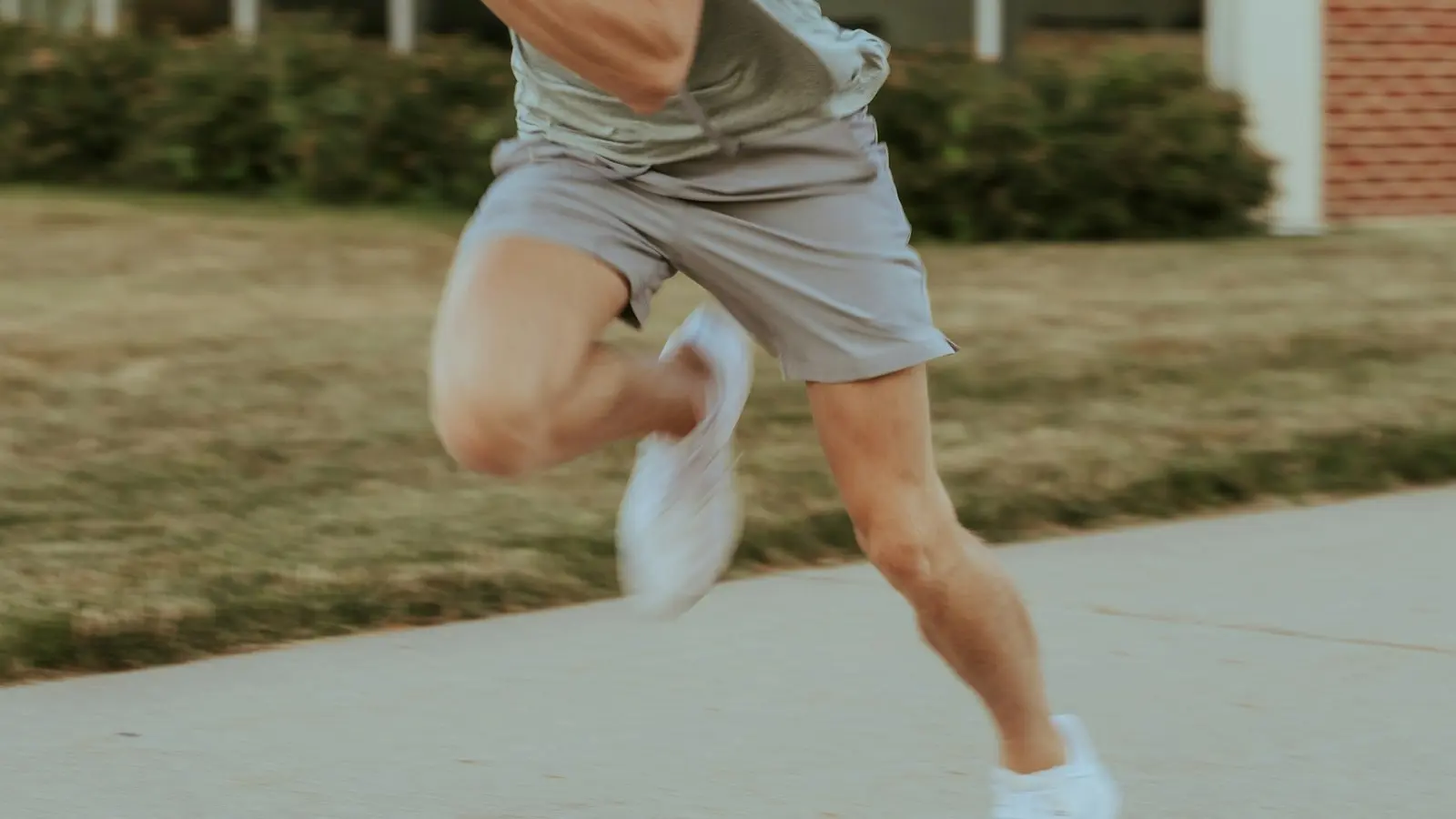
Running calf pain can involve a muscle strain, deeper soleus overload, Achilles tendon symptoms, or another condition altogether. The most useful clues are pain location, whether it began suddenly or gradually, which running demands trigger it, and how it responds later that day and the following morning.
A running calf pain strain pattern is only one possibility. Pain intensity alone cannot identify the tissue involved or confirm that it is safe to keep training. Use these patterns to decide whether to modify your running, arrange an assessment, or seek urgent care.
Key Takeaways
- Sudden, localized pain during acceleration, sprinting, jumping, or forceful push-off is more consistent with a calf muscle strain pattern than a gradual tendon problem.
- Gradual stiffness or pain along the Achilles tendon above the heel, especially after rest, can fit an Achilles tendinopathy pattern.
- Deep calf discomfort that builds with hills, sustained pace, fatigue, or longer runs may involve the soleus, but location alone cannot diagnose it.
- Track symptoms during the run, afterward, and the next morning; a tolerable run can still represent too much load if symptoms flare later.
- Stop running and seek urgent or prompt assessment for swelling, warmth, redness, chest symptoms, a pop, major weakness, inability to push off, or trouble walking normally.
Start with the pattern: location, onset, and what load brings it on
Map the pain as precisely as you can. Pain in the bulky, superficial calf may behave differently from pain that feels deep in the mid-calf, pain centered along the Achilles tendon above the heel, or pinpoint pain that seems close to bone.
Then consider onset. A distinct sharp pull during one stride is different from stiffness that gradually becomes more noticeable across several runs. Neither pattern proves a diagnosis, but the time course helps determine the safest next step.
Record what brings symptoms on: sprinting, acceleration, jumping, hills, intervals, faster pace, longer distance, or the first few steps after sitting or getting out of bed. Also note whether discomfort changes your stride, since compensation can shift load to the opposite leg, foot, knee, or hip.
Distance-to-symptom onset is useful for monitoring. If pain reliably begins after a certain distance, your current duration or intensity may exceed present capacity. It does not establish whether the source is muscle, tendon, bone, nerve, or circulation.
Calf Strain vs Achilles: Symptom Patterns That Guide the Next Step
A calf muscle strain is more often linked to a sudden event. It may feel like a pull, sharp pain, or pop during a forceful push-off, acceleration, sprint, jump, or abrupt pace change. Localized tenderness in the calf muscle may follow, and loading or stretching the area can reproduce symptoms.
The gastrocnemius is the more superficial calf muscle and crosses both the knee and ankle. A problem involving it may be more noticeable when the knee is straighter, although that remains a clue rather than a reliable self-test. Bruising, swelling, and weakness can occur with a more substantial muscle injury.
Achilles tendinopathy symptoms more often develop gradually. Pain or stiffness is commonly felt in the tendon above the heel, although the exact area can vary. Initial movement after rest may feel stiff or sore, while repeated push-off demands—such as hills, faster running, or high training volume—may aggravate it.
In a calf strain vs Achilles comparison, pain location and time course are usually more informative than any single movement test. Both can hurt during push-off, and both can become symptomatic after rapid increases in hills, speedwork, or total running volume.
Do not keep trying to distinguish the issue alone if function is clearly impaired, symptoms are escalating, or the pattern is unclear. A sudden pop, severe pain, visible change around the tendon, rapidly developing bruising, or inability to push off normally warrants prompt clinical assessment because a significant muscle or tendon injury is possible.
Why Deep Soleus Pain Can Feel Different During Running
The soleus is a deeper calf muscle beneath the gastrocnemius. It contributes to ankle push-off during walking and running, and it remains active when the knee is bent. That can make soleus pain running feel different from a more superficial upper-calf strain.
A soleus-related overload may become more noticeable with sustained running, hills, fatigue, longer efforts, or a steady pace rather than one explosive stride. Symptoms may emerge later in a run as repeated calf loading accumulates. This does not confirm soleus involvement, but it can explain why a short easy jog feels manageable while a hill session does not.
Deep mid-calf discomfort differs from pain clearly centered near the Achilles insertion at the heel or a superficial focal ache in the upper calf. Still, it is difficult to identify anatomy accurately by feel alone. A clinician may need to assess tenderness, ankle and knee movement, calf strength, walking mechanics, and possible alternative causes.
Less common causes deserve attention because they require a different approach. Focal pain near bone can raise concern for bone stress injury. Burning, tingling, numbness, or weakness may point to nerve involvement. Predictable exertional tightness, pressure, cramping, or neurologic symptoms may need assessment for compartment-related conditions. Pain from the back, knee, or other structures can also be felt in the calf.
Check the Training-Load Story Before Changing the Plan
Calf pain after running often reflects a mismatch between recent training demand and current tissue capacity. This can happen without a single obvious misstep. Symptoms may appear when the load placed on a muscle or tendon rises faster than it can adapt.
Review the previous days and weeks, not just the run that hurt. Consider increased weekly mileage, a longer long run, more hills, intervals, racing, changes in surface, new shoes, a different heel-to-toe drop, or a return after illness or time away. Reduced sleep, accumulated fatigue, limited recovery, and a previous calf or Achilles problem can also reduce tolerance.
Use a simple load-response log for several sessions. Record the pain location, trigger, whether it changes your gait, how it feels after the run, and how it feels the following morning. This provides a clearer picture than discomfort during the workout alone.
A low pain level during a run does not automatically mean the session was appropriate. Symptoms that build later in the day, increase next-morning stiffness, or reduce walking comfort suggest the total load may still be too high. A run that causes limping, guarding, or compensation is not a useful fitness test.
A practical first adjustment is to remove the most provocative demand. Avoid hills, speedwork, sprinting, and hard accelerations before repeatedly testing them. Reducing overall volume, choosing flatter routes, and shortening sessions can help clarify the load response.
If lower-impact conditioning is comfortable and does not worsen symptoms afterward, it may help preserve general fitness while running is modified. The appropriate option depends on the person and the suspected problem. Do not use cross-training simply to train through worsening calf pain.
When to Pause Running, Seek Urgent Care, or Rebuild Capacity
Seek urgent medical evaluation for new one-sided calf swelling, warmth, redness, or unexplained marked tenderness. Seek emergency care for chest pain, shortness of breath, coughing blood, fainting, or similar symptoms that could indicate a serious vascular or cardiopulmonary problem.
Prompt, non-emergency assessment is appropriate for severe sudden pain, a pop, inability to push off, inability to bear weight or walk normally, rapidly increasing bruising or swelling, numbness, notable weakness, focal bone pain, pain at rest or at night, or symptoms that do not improve with sensible load reduction. These signs do not establish a diagnosis, but they should not be managed through trial-and-error running alone.
For milder symptoms that are improving, a cautious return to running after a calf injury starts with daily function. Walking, stairs, and ordinary activities should be comfortable or clearly improving before running is added. Easy, flat running is generally a more conservative re-entry point than hills, intervals, or racing.
Change one variable at a time. Maintain an easy pace while modestly increasing duration, for example, rather than increasing duration, pace, and hill exposure in the same week. Check the response during the session, afterward, and the following morning before progressing again.
Stable function matters more than a fixed calendar. A runner who can walk comfortably, run easily without altered mechanics, and recover without a delayed flare may be ready for gradual progression. If symptoms repeatedly worsen after similar loads, reduce demands further and consider clinical guidance rather than testing harder.
Clinician-approved progressive calf-strengthening and tendon-loading exercises can be useful in rehabilitation, but the right approach depends on the diagnosis, severity, current function, and symptom response. A sudden muscle injury may not be progressed in the same way as persistent Achilles symptoms or a possible bone stress problem.
FAQ
Can I run with calf pain if it only starts after a certain distance?
Treat that distance as a current tolerance limit rather than proof that the pain is harmless. If symptoms begin predictably, worsen through the run, alter your stride, or leave you more sore later or the next morning, reduce the load and avoid repeatedly testing the same painful distance. Seek assessment if the pattern persists or progresses.
How can I tell the difference between soleus pain and Achilles pain?
Soleus pain may feel deeper in the calf and can be more noticeable with sustained running, hills, fatigue, or bent-knee loading. Achilles pain is more often centered along the tendon above the heel and may include stiffness after rest. These are pattern clues, not self-diagnoses, because pain can overlap and more than one structure may be sensitive.
When can I return to running after a calf strain or Achilles flare-up?
There is no universal timeline. Return is better guided by comfortable daily activity, normal or near-normal walking, no meaningful limp or compensation, and a stable response to easy flat running. Increase one training demand at a time and use the next-day response as part of the decision. If symptoms recur or function declines, step back and consider clinical assessment.