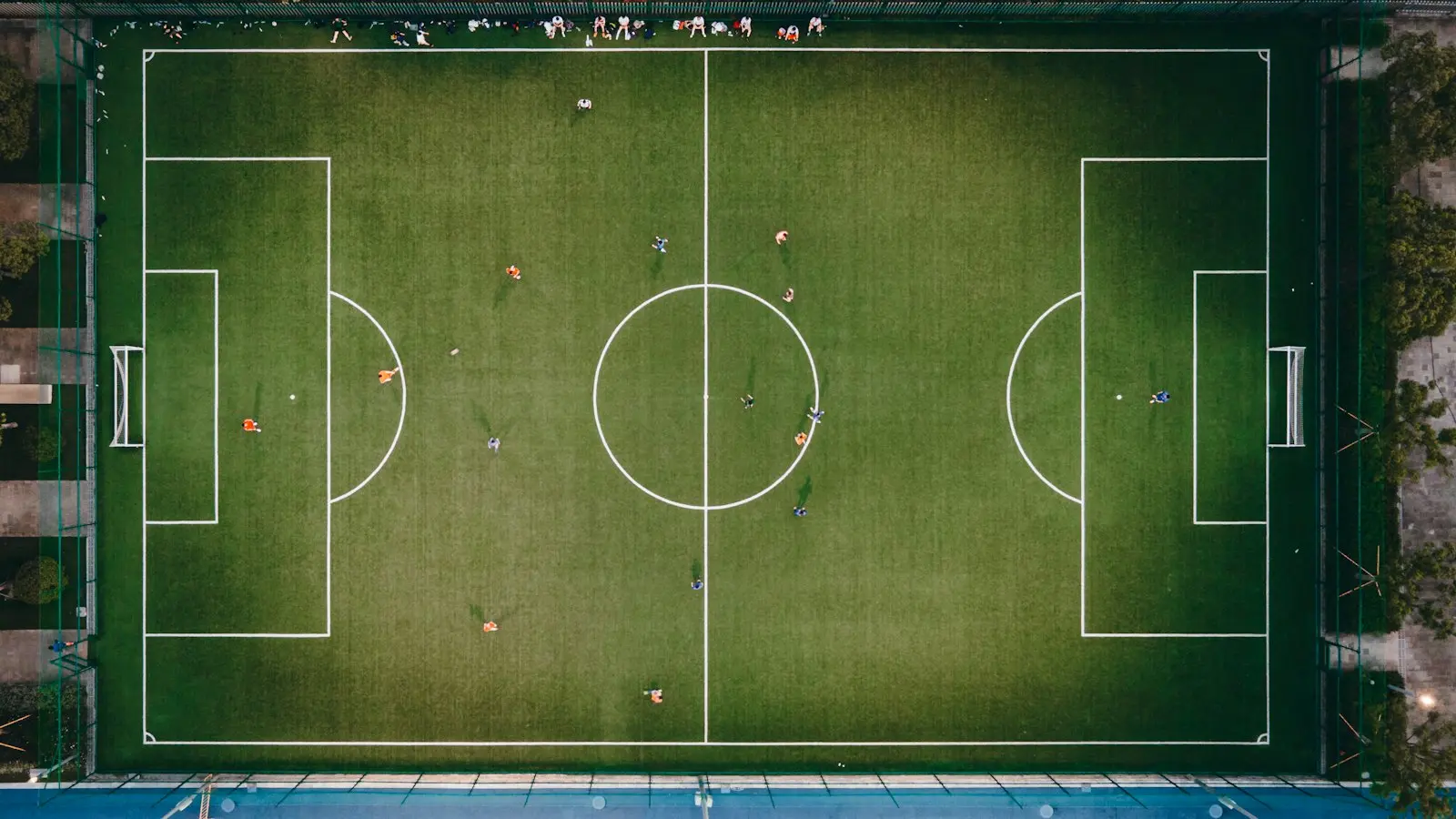
A low block changes the attacking problem from gaining territory to manufacturing space. The defending team retreats close to its own penalty area, keeps its lines connected, and allows harmless passes in wide or deep areas while protecting the central route to goal. That is why a team can dominate possession, pin an opponent back, and still create few clear chances.
The most effective response is not simply to add more attackers or cross earlier. Effective low block soccer tactics require the attacking team to move defenders before attempting the decisive pass, stretch the block across the pitch, and maintain enough structure behind the ball to resist the counterattack. Width, switches, rotations, third-man runs, and carefully selected final actions all matter because they change the defensive shape.
Key Takeaways
- A low block protects central spaces near the penalty area, often conceding harmless possession in wide or deep areas.
- Slow circulation lets defenders shift together; width, switches, and coordinated movement can force them to make difficult choices.
- Third-man runs, overlaps, underlaps, and rotations create openings by changing defensive assignments rather than adding movement for its own sake.
- Crosses, cutbacks, and long shots work best when they follow a defensive movement and suit the attackers’ positions.
- Attacking numbers must be balanced with rest defense so that lost possession does not produce a dangerous counterattack.
What a Low Block Tries to Protect
A low block is a defensive approach in which a team protects space near its own goal. The defensive line retreats, while the midfield line drops close enough to reduce the gaps between midfielders and defenders. The exact arrangement may resemble a 4-4-2, 5-4-1, 4-5-1, or another shape, but the behavior matters more than the formation label.
The central objective is to make the most dangerous passes difficult. A striker should not receive easily between the center-backs, an attacking midfielder should struggle to turn near the penalty area, and passes into the half-spaces should arrive under pressure. The defending team may allow a center-back to carry the ball, a fullback to receive wide, or a midfielder to circulate possession in front of the block if those actions do not threaten the goal.
This is the difference between defensive depth and defensive compactness. A team can defend deep but leave large spaces between its lines, allowing opponents to receive and combine in front of the penalty area. A compact low block keeps distances short enough for one defender or midfielder to support another. Depth determines where the defense is positioned; compactness determines how connected it remains.
A low block is not automatically passive, negative, or poorly organized. It can be an intentional way to protect a lead, deny space to a technically superior opponent, or exploit the speed of forwards in transition. Its success depends on discipline, communication, individual defending, and the opponent’s ability to move the block. The scoreline also matters: a team protecting a result may accept long spells without the ball, while a team needing a goal may eventually have to defend higher or take more risks.
Why Central Attacks Stall Against a Compact Shape
Central areas are valuable because they provide shorter routes to goal and allow attackers to threaten either side of the defense. A low block tries to remove those routes by placing several players between the ball and the penalty area. When the ball moves slowly from one side to the other, the defensive unit can shift together and preserve its protection of the middle.
This creates a familiar match pattern. An attacking center-back passes to a fullback, who returns the ball inside. The midfielder then finds another defender, and the sequence repeats on the opposite side. Possession increases, but the defense has not been forced to make a difficult decision. Nobody has been pulled away, turned toward their own goal, or asked to cover two threats at once.
Central combination play becomes especially difficult when the attacking team tries to force it too early. A pass into a striker may go directly into a center-back’s reach. A midfielder attempting to receive between the lines may be surrounded by a defensive midfielder and a center-back. A forward checking toward the ball can also bring an extra defender into the same area, making the attack more crowded rather than more dangerous.
The problem is not that central play is impossible. It is that central play usually needs preparation. The ball may have to travel wide first, draw a midfielder toward the flank, or create a gap between a fullback and center-back. A receiver between the lines is most useful when the defense is already moving or when another attacker runs beyond him. Without that movement, receiving centrally often means receiving with a defender close behind.
Football tactical shapes influence the details, but they do not provide automatic answers. A back three may offer more width in the first line, while a back four may create different spaces around the fullbacks. The relevant question is always the same: which defender is being asked to leave the compact structure, and what does the attack do with the space created?
How to Break a Low Block With Width, Switches, and Rotations
Genuine width is one of the first tools for attacking against a low block. If the attacking team occupies both touchlines, the defending unit must cover a larger horizontal distance. That can create wider gaps between a fullback and center-back or make a midfielder choose between protecting the half-space and helping on the flank.
Width only works when it represents a real threat. A winger standing wide but receiving slowly and facing two defenders may stretch the block in theory without changing it in practice. The wide player needs support, the possibility of a forward run, or the ability to combine inside. Otherwise, the defense can remain narrow while allowing predictable passes toward the sideline.
Quick switches of play are useful because they attack the far side before the defensive block has fully reset. The switch does not need to lead directly to a cross. Its first purpose may be to give a winger time to receive facing forward, isolate a fullback, or draw the nearest midfielder away from the center. The faster the ball travels compared with the defensive shift, the more likely the receiving player is to find an opponent temporarily out of position.
Overlaps and underlaps create different problems for the defender. An overlap sends a wide player around the outside, often forcing the fullback to decide whether to follow the runner or stay with the ball carrier. An underlap sends a runner through an inside channel, threatening the space between the fullback and center-back. Neither movement guarantees an opening, but both can create uncertainty and force the defense to exchange assignments.
A third-man run is another way to move the block. Instead of trying to pass directly to the final receiver, the ball goes to one player who lays it off or attracts pressure, allowing a third teammate to receive beyond or beside the first defender. The pattern is effective when the first pass changes the defender’s orientation and the third player arrives at a different angle.
Rotations combine these ideas. A winger may move inside while a fullback advances outside. A midfielder may drop toward the ball while a forward moves into the vacated space. These rotations are useful only when they maintain balance and timing. If several players occupy the same lane, the attack becomes easier to defend; if the movement is coordinated, one defender may be forced to choose between two threats.
Patient recycling can therefore be purposeful rather than passive. The ball moving backward is not a failure if it draws a defender out, changes the pressing angle, or opens the opposite side. It becomes sterile when the same circulation occurs without a change in speed, position, or threat. The test is simple: after the recycle, is the next receiver in a better situation, or is the defense facing the same picture?
Crosses, Cutbacks, and Long Shots: Choosing the Final Action
Crossing is not one single attacking action. An early floated cross toward a crowded penalty area is different from a driven delivery behind the first defensive line, a low ball across the six-yard area, or a cutback from near the byline. Their value depends on where the attackers are positioned and how the defense has been moved.
Early crosses can be useful when a striker has gained a favorable position, the defensive line is retreating, or the goalkeeper is uncertain about coming out. They are less attractive when the ball is delivered from a static position and the defending team has time to organize. In that situation, the cross may simply give the center-backs a clear aerial challenge.
Cutbacks often become available when a wide player reaches the byline or a dangerous area inside the penalty box. The pass travels backward toward teammates arriving near the penalty spot or edge of the area, where the receiver may have more time than an attacker waiting between several defenders. But cutbacks are not automatically superior. They require successful entry into the box, good timing, and teammates positioned to attack the delivery.
Long shots can be valuable when the block refuses to engage outside the penalty area. A well-struck effort may create a rebound, force the goalkeeper to make a save, or persuade a midfielder to step out. Repeated shots from poor positions, however, can help the defense by ending attacks without requiring it to move. Blocked attempts may also begin a counterattack.
The correct final action depends on delivery quality, the number and positions of attackers, goalkeeper positioning, the opponent’s aerial strength, and the team’s ability to recover second balls. The broader principle when attacking a low block is to choose the action that follows a defensive movement, rather than treating crossing or shooting as substitutes for creating one.
Attacking Without Losing Control of the Counterattack
Breaking a low block usually requires more players ahead of the ball. Fullbacks advance to provide width, midfielders move into the half-spaces, and center-backs may step forward to support circulation. That improves the attack but increases the space available to the opponent if possession is lost.
This is where rest defense becomes important. Rest defense means the players and positioning retained behind or around the attack so the team can delay, contain, or stop a counterattack. It may involve center-backs positioned wide enough to defend the channels, a holding midfielder screening the middle, or one fullback staying deeper while the other attacks.
A team does not need to keep a fixed number of players behind the ball in every situation. The right balance depends on the opponent’s forwards, the speed of its outlets, the scoreline, and the location of the ball. Losing possession near the opponent’s corner is different from losing it centrally with both fullbacks beyond the ball.
Counterpressing can help when nearby attackers immediately pressure the first pass after a turnover. Yet it is not a guarantee. If the initial pressure is beaten, the remaining defensive structure must still protect central space and delay the next pass. Staggered positioning is valuable because it gives the team several layers of protection rather than placing every player on the same line.
Substitutions can change the tactical problem without changing the nominal formation. A faster winger may turn slow wide possession into a one-versus-one threat. A midfielder who passes quickly may improve the speed of switches. A taller striker can make certain crosses more credible, while a more mobile forward may offer runs behind the defensive line. A defensively stronger midfielder may allow a fullback to advance with less exposure.
The best change depends on what the block is denying. If the opponent is comfortable defending crosses, adding another aerial attacker may not solve the problem unless the delivery improves. If the defense is refusing to leave its penalty area, a player capable of carrying the ball past the first defender may be more useful. If counterattacks are the main danger, improved defensive coverage may be more important than another attacker.
FAQ
What is the best way to break a low block in soccer?
There is no universal solution, but a strong approach usually combines width, quick switches, coordinated rotations, and patience. The aim is to move defenders, create an isolated player or open lane, and then attack that space before the block recovers. The team must also preserve rest defense so a missed pass does not become a clear counterattack.
Are crosses or long shots effective against a low block?
Both can be effective in the right conditions, but neither is reliable by default. Crosses improve when attackers have favorable positions and the delivery follows a defensive movement. Long shots can punish a defense that refuses to step out, but repeated low-quality attempts may simply surrender possession.
Why can a team dominate possession but create few chances against a low block?
Possession measures control of the ball, not necessarily access to dangerous spaces. If circulation is slow and predictable, the defense can shift together while protecting the center. Clear chances become more likely when possession changes the defensive shape through width, movement, switches, carries, or third-man combinations.