The Mandalorian Helmet HUD: A Benchmark for Augmented Reality
Reddit users recently dissected the tactical heads-up display (HUD) inside Din Djarin’s iconic Mandalorian helmet. The thread, sparked by a frame from The Mandalorian and Grogu, highlighted how the fictional overlay manages navigation, targeting, communications, and environmental data in a seamless interface. The question that emerged: How close is real military and consumer augmented reality (AR) tech to this cinematic vision? The answer, after stripping away Hollywood polish, reveals a landscape of impressive engineering wedged between fundamental physics constraints and cost barriers.
What the Mandalorian Helmet HUD Does (Without the Hype)
The fictional system delivers constant situational awareness. The wearer sees a transparent overlay with waypoints, enemy markers, weapon status, and comms inputs. It operates without noticeable latency, adapts to lighting extremes (from Tatooine’s twin suns to dark starship corridors), and runs for days on a single power cell. It is also completely unobtrusive — no external battery pack, no overheating, no weight penalty beyond the helmet itself. This is the gold standard AR advocates chase but cannot yet replicate.
Real Military AR: The IVAS and HoloLens Reality
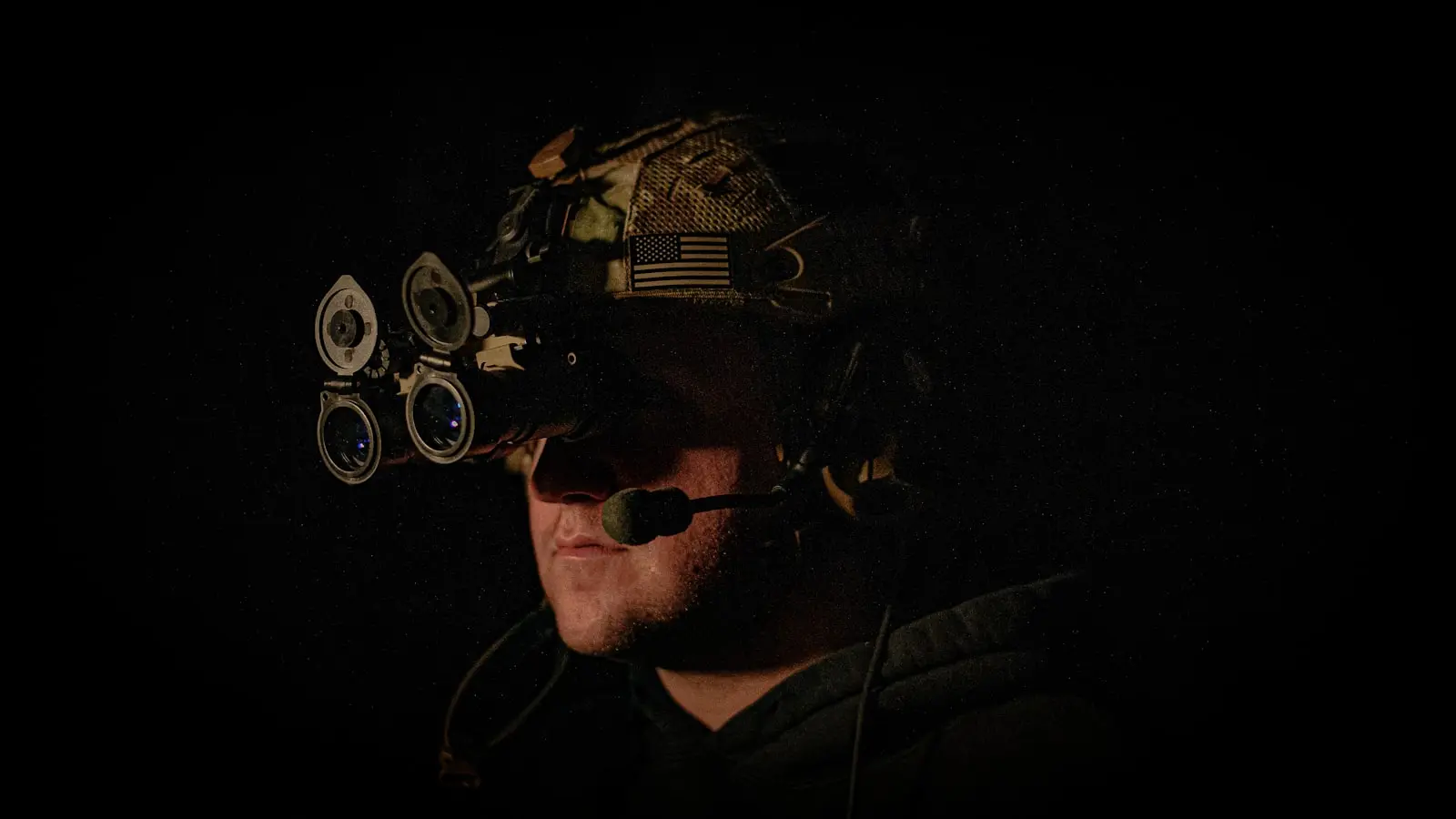
The United States Army’s Integrated Visual Augmentation System (IVAS), built on Microsoft’s HoloLens technology, is the closest real-world equivalent. IVAS overlays navigation data, thermal imagery, targeting reticles, and a digital compass onto a soldier’s field of view. The system uses a waveguide display to project information via a visor. It is undeniably capable. But the trade-offs are brutal.
Weight and bulk: A complete IVAS headset, including the battery pack and processing unit worn on the vest, weighs around 1.5 kilograms (3.3 pounds). The Mandalorian’s helmet appears no heavier than a standard Beskar steel shell. Soldiers carrying a full combat load already feel every additional gram. The current IVAS is not something troops forget they are wearing.
Battery life under load: Microsoft rates the HoloLens 2 at roughly 2-3 hours of mixed-use operation. Military testing places IVAS battery endurance at 4 hours during active navigation and overlay use. A standard infantry patrol often runs 12-24 hours. The power gap forces units to carry spare batteries — more weight, more logistics. The Mandalorian never swaps cells mid-fight.
Field of view: HoloLens 2 offers a diagonal field of view of approximately 52 degrees. The human eye’s natural FOV is over 200 degrees. IVAS has improved slightly, but the overlay remains a floating rectangle in the center of vision. Peripheral awareness requires turning the head. The Mandalorian’s HUD appears edge-to-edge, integrating seamlessly with natural sight. That is a massive optical engineering challenge.
Thermal throttling and environmental limits: AR processors generate heat. In field tests, IVAS units have been reported to throttle performance in desert conditions, dimming the display to prevent overheating. The Mandalorian helmet operates in any environment without performance degradation. Cooling a high-resolution holographic projector inside a sealed helmet without external vents is not yet feasible.
The Fighter Jet Connection: Where HUDs Already Win
Advanced fighter jets — the F-35’s Helmet Mounted Display System (HMDS) — already accomplish much of what the Mandalorian helmet does. The pilot gets targeting symbology, video from external cameras, night vision integration, and even a virtual view through the cockpit floor. The system is combat-proven. However, it weighs roughly 2.2 kilograms and costs over $400,000 per unit. The supporting avionics fill a rack of electronics behind the pilot. Scaling that down to a battery-powered infantry helmet requires dropping an order of magnitude in size, power draw, and cost. That is where the slog lives.
Consumer AR: Still a Different Animal
Products like the Apple Vision Pro, Meta Quest 3 (with passthrough), and Magic Leap 2 push consumer AR closer to lightweight form factors. But none are designed for 24/7 rugged field use. The Vision Pro’s external battery lasts about 2 hours and the device weight (around 600g) feels heavy on the face. The Quest 3 is primarily VR with pass-through AR — no true see-through display. These devices are not drop-proof, dust-proof, or waterproof. They are not meant to survive a blaster fight or a fall onto rocky terrain.
The Core Technical Gaps
1. Waveguide vs. Freeform Optics
Current AR uses waveguides to pipe light from a projector into the user’s eye. This creates a finite eyebox (the area where the image is visible). Shift the helmet slightly, and the overlay misaligns. Mandalorian HUD presumably uses freeform optics or direct retinal projection that maintains alignment regardless of head movement. The latter is in labs today but not in fieldable hardware.
2. Power Density
Battery technology has not advanced at the same pace as processing. A typical AR headset draws 5-15 watts. To match the Mandalorian’s all-day runtime, a battery with 200+ watt-hours would be needed. That means a battery pack the size of a small brick. Until solid-state batteries or energy-dense fuel cells arrive, the weight penalty stays.
3. Sensor Fusion Latency
AR overlays require real-time sensor fusion: cameras, IMUs, GPS, LIDAR, and thermal sensors must all feed data into a coherent spatial map. Current systems introduce 20-50ms of latency between head movement and overlay update. The Mandalorian’s display reacts instantaneously. Latency reduction to under 10ms is essential for combat usage to prevent motion sickness and mistargeting.
4. Brightness and Contrast
In direct sunlight, current AR displays wash out. The Mandalorian helmet operates on Tatooine’s bright desert without issue. High-brightness microLEDs are being developed, but production yields remain low and energy consumption high.
The Cost-to-Performance Ratio
The US Army has spent over $22 billion on the IVAS program, and the per-unit cost still hovers above $20,000. That is for a system that falls short of the Mandalorian’s capabilities. To achieve fictional-level performance, analysts estimate at least another decade of development in display materials, chip fabrication, battery chemistry, and miniaturized cooling. The economics are brutal: military budgets are large but not infinite, and consumer demand for rugged AR is small.
Where the Tech Is Headed
Real AR will likely skip the single-helmet solution. The military is exploring distributed systems: sensors embedded in the uniform, processing in a pocket computer, and a lightweight eyepiece for display. This modular approach mirrors how the Mandalorian’s helmet might actually be built — the Beskar steel itself could house antennas and heat sinks. In the real world, DARPA is funding projects like the Visible-Target program, which aims for sub-20g heads-up displays with all-day battery. Progress is real but incremental.
Verdict: Impressive but Not Yet Beskar Grade
Present-day AR headsets demonstrate the core concept the Mandalorian HUD relies upon — overlay-driven situational awareness. Fighter pilots already use it. Ground troops are testing it. Consumers can buy a HoloLens and see holographic maps. But the execution gap remains wide. The fictional helmet combines extreme miniaturization, infinite battery life, zero latency, and environmental ruggedness all in a single package. No current system clears even half of those hurdles simultaneously.
For anyone expecting a store-bought Mandalorian helmet with a working HUD in 2025: temper expectations. The closest you can get today is a heavily funded military prototype that still requires a battery backpack and a fan-cooled processor. The real takeaway is that the AR foundation exists — the gap is in refinement, not invention. As one Reddit user with a background in AR development put it: “We have the software. The hardware just needs to catch up to the fiction.” And that catch-up is measured in years, not episodes.