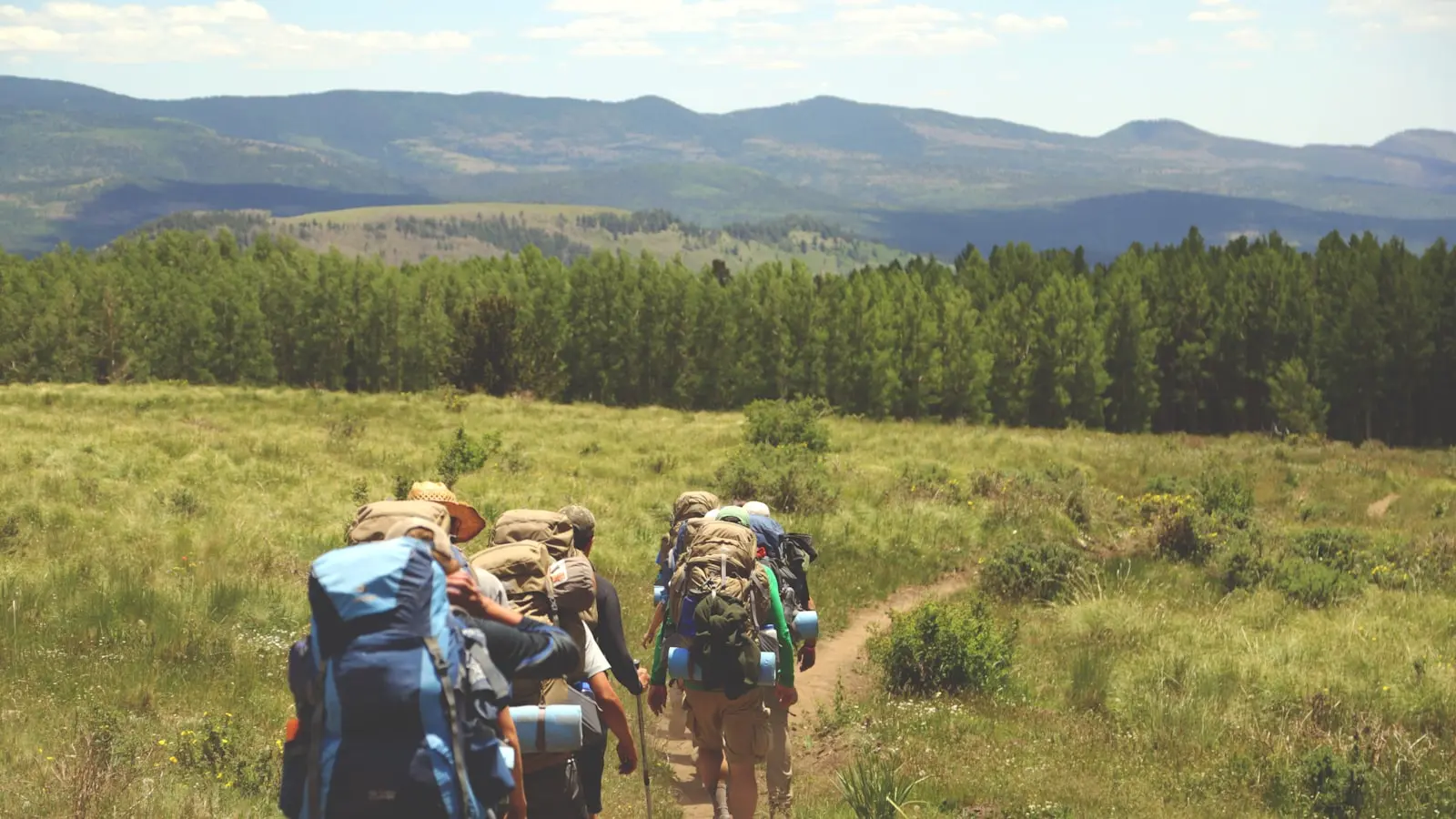
A heavy daypack can provide useful hiking strength training for beginners, especially for leg endurance, trunk control, balance, and aerobic fitness. But it is not a complete substitute for full-body resistance training because hiking mostly involves repeating relatively low-to-moderate force movements rather than progressively challenging the whole body.
The practical approach is simple: use hiking to prepare for hiking, then add a small amount of strength work to cover what the trail does not train well. The challenge of a hike depends on terrain, elevation, pace, duration, pack fit, recovery, and current fitness—not just whether the pack feels heavy.
Key Takeaways
- Loaded hiking can build trail-specific leg endurance, balance, trunk stability, and confidence on uneven terrain.
- Steep grades, long descents, and unstable footing often increase the challenge more than adding a small amount of pack weight.
- A deliberately heavier pack may improve familiarity with carrying a load, but it also increases stress on the feet, legs, joints, shoulders, and back.
- Hiking does not adequately train upper-body pushing, pulling, hip-hinge strength, or higher-force leg strength.
- A brief two-day strength routine can complement beginner hiking fitness without replacing time on the trail.
What hiking strength training actually develops
Hiking combines cardiovascular exercise, muscular endurance, coordination, and movement practice. During sustained uphill walking, the quadriceps, glutes, calves, hamstrings, and muscles around the feet and ankles work repeatedly to propel and stabilize the body.
Uneven terrain adds another layer of demand. Rocks, roots, loose ground, and changing step heights require single-leg control, balance, and coordination. These qualities matter on trails because each foot placement is less predictable than it is on a flat path or treadmill.
Carrying a daypack also increases postural demand. The trunk, hips, and back muscles help keep the load controlled while you walk, climb, turn, and step over obstacles. That is useful conditioning, although it is different from the focused strength stimulus of lifting a challenging weight through a controlled range of motion.
This is why hiking leg strength can improve in a practical, trail-specific sense. Hills, stairs, and long walks may gradually feel easier. However, the main adaptation is usually muscular endurance and familiarity with repeated stepping, not maximal strength.
Flat walking remains valuable general activity, but it does not challenge the lower body in the same way as a steep or uneven route. For many hikers, increasing elevation, terrain difficulty, or time on feet changes the workout more than adding a small extra item to the pack.
How a daypack changes the workout and where weighted hiking has limits
Water, food, layers, navigation tools, and safety essentials make a normal hike more demanding. A loaded daypack can raise the effort needed to walk and reveal whether your shoulders, back, hips, feet, and footwear are ready for the intended route.
Normal day hiking is often the best starting point for beginner hiking fitness. It builds time on feet, helps you practice pacing, and lets you learn how essential gear feels before deliberately increasing the load.
Steep or uneven hiking places greater demands on lower-body endurance and balance. Climbing requires repeated work from the hips, knees, and ankles, while rocky or loose surfaces require more careful foot placement and stabilization.
Deliberately weighted walking can be useful when it reflects the demands of a planned trip. It may help you become more familiar with carrying a heavier load and managing pack movement. At the same time, it increases stress on the feet, lower legs, knees, hips, back, shoulders, and skin—particularly if the pack shifts, the route is hilly, or the session is longer than usual.
Rucking versus hiking is largely a difference of purpose and setting. Rucking generally emphasizes intentional pack loading on a controlled walking route. Hiking adds elevation changes, variable footing, weather, route conditions, and other factors that make the session less predictable. Neither is automatically safer, better, or necessary for every beginner.
A sensible progression is to first become comfortable with the distance and terrain you expect to cover while carrying only the gear you actually need. If you add challenge later, change one variable at a time: distance, elevation, pace, terrain difficulty, or pack load. Changing several variables together makes it harder to judge what exceeded your current capacity.
Pack fit matters as much as pack weight. Keep heavier necessary items close to the back and secure them so they do not swing. Adjusted straps and suitable footwear can improve comfort and control, but no equipment choice guarantees that pain or injury will not occur.
Why downhill hiking can cause more soreness than the climb
Many beginners find that descents are tougher on the legs than climbs. During downhill walking, the quadriceps and other muscles lengthen while producing force to control the body’s drop with each step. This is known as eccentric muscle action.
Eccentric work can lead to notable fatigue and delayed soreness, especially when someone is not accustomed to long descents. A climb may feel manageable in the moment, yet the downhill portion can leave the legs more tired afterward because it requires prolonged braking and control.
As fatigue builds, step control can decline. You may start taking larger or quicker steps, landing harder, or relying on an awkward backward lean. These changes can increase discomfort and make balance more difficult on loose or uneven ground.
Use a shorter stride and prioritize controlled steps over speed. Trekking poles may help some hikers maintain rhythm and balance when used well, but they do not replace the need to slow down, reduce load, or choose an easier route when control is slipping.
Routine post-exercise soreness is generally diffuse and settles with time and recovery. Stop the activity and seek appropriate clinical assessment for pain that is sharp, persistent, worsening, radiating, associated with swelling, or accompanied by numbness or weakness.
What hiking misses for all-around strength
Hiking is valuable conditioning, but it leaves meaningful gaps. Hiking leg strength is mostly endurance and movement-specific capacity; it does not reliably develop the full range of strength needed for lifting, carrying, pushing, pulling, and controlling heavier loads.
Upper-body pushing and pulling are the clearest omissions. A pack and trekking poles involve the arms to some degree, but hiking rarely provides enough progressive resistance to build balanced chest, shoulder, upper-back, and arm strength.
Hiking also undertrains the hip-hinge pattern. Hinging is the coordinated movement used to lift or lower an object by moving through the hips while keeping the trunk controlled. This pattern challenges the glutes, hamstrings, and trunk differently from repeated stepping.
Higher-force lower-body work may also make steps, climbs, and descents feel more manageable over time. That does not require an intense gym program. A few basic movements performed consistently can supplement the patterns that hiking does not emphasize.
Movement variety is another advantage of resistance training. Hiking repeats a relatively narrow set of motions, even when the terrain varies. Strength work can include controlled pushing, pulling, hinging, stepping, carrying, and bracing without treating a heavy backpack as a test of fitness.
A minimal two-day plan for stronger, more comfortable hiking
For healthy beginners, two brief strength sessions can complement hiking preparation without making it gym-centered. Choose variations that allow smooth, controlled movement and leave enough recovery for walking and trail practice. If you have an injury, medical condition, unexplained symptoms, or uncertainty about exercise safety, seek individualized guidance.
Day A: Step and carry control
- Step-ups on a low, stable step or stair, using support if needed
- Split squats with a light hand on a stable surface for balance
- Standing calf raises
- Brief single-leg balance practice near a wall or counter
Step-ups resemble the repeated work of climbing. Split squats build control through each leg, while calf work supports the repeated ankle motion involved in walking. Balance practice provides a controlled setting for rehearsing steady single-leg positioning before relying on it on uneven trails.
Day B: Hips, trunk, and upper body
- A light Romanian deadlift, backpack hinge, or another suitable hinge variation
- Glute bridges or hip thrusts
- A push-up variation or chest press
- A row variation using appropriate equipment
- A simple trunk-bracing exercise performed while breathing normally
The goal is not to exhaust yourself. Start with manageable effort and controlled repetitions, stopping before form becomes unstable. When recovery is normal and technique remains steady, add a small amount of resistance, repetitions, range of motion, or difficulty—one change at a time.
Keep hiking practice specific to the trip. Gradually expose your body to the expected distance, elevation, terrain, and essential pack load. A long, steep, or descent-heavy outing may require more recovery than an equally long flat walk, so plan easier days when needed.
Scale back if soreness accumulates instead of improving, fatigue changes your gait, or you cannot maintain control on stairs or descents. Severe pain, new swelling, numbness, weakness, chest-related symptoms, or symptoms that worsen rather than settle warrant prompt medical attention.
The bottom line: hiking with a daypack is meaningful trail conditioning. Use it to build hiking-specific endurance, balance, and confidence, then add modest full-body resistance work to cover upper-body, hip-hinge, and higher-force strength that hiking alone may miss.
FAQ
Is a heavy daypack good strength training for beginners?
It can be useful trail-specific training, but heavier is not automatically better. A loaded pack may build familiarity with carrying essential gear, yet beginners should generally become comfortable with normal hiking distance and terrain before intentionally adding load.
How much pack weight should a beginner add for daypack training?
There is no universal amount that suits everyone. Start with the gear required for the route, assess comfort and recovery, and avoid increasing pack load at the same time as distance, elevation, or pace. Reduce the load if it changes your walking form or causes persistent pain.
Can hiking replace leg day if I hike steep trails regularly?
Steep hiking can provide substantial lower-body endurance work and improve trail-specific capacity. It does not fully replace resistance training if your goals include higher-force leg strength, hip-hinge strength, or balanced whole-body fitness. A small two-day routine can fill those gaps while preserving time for hiking.