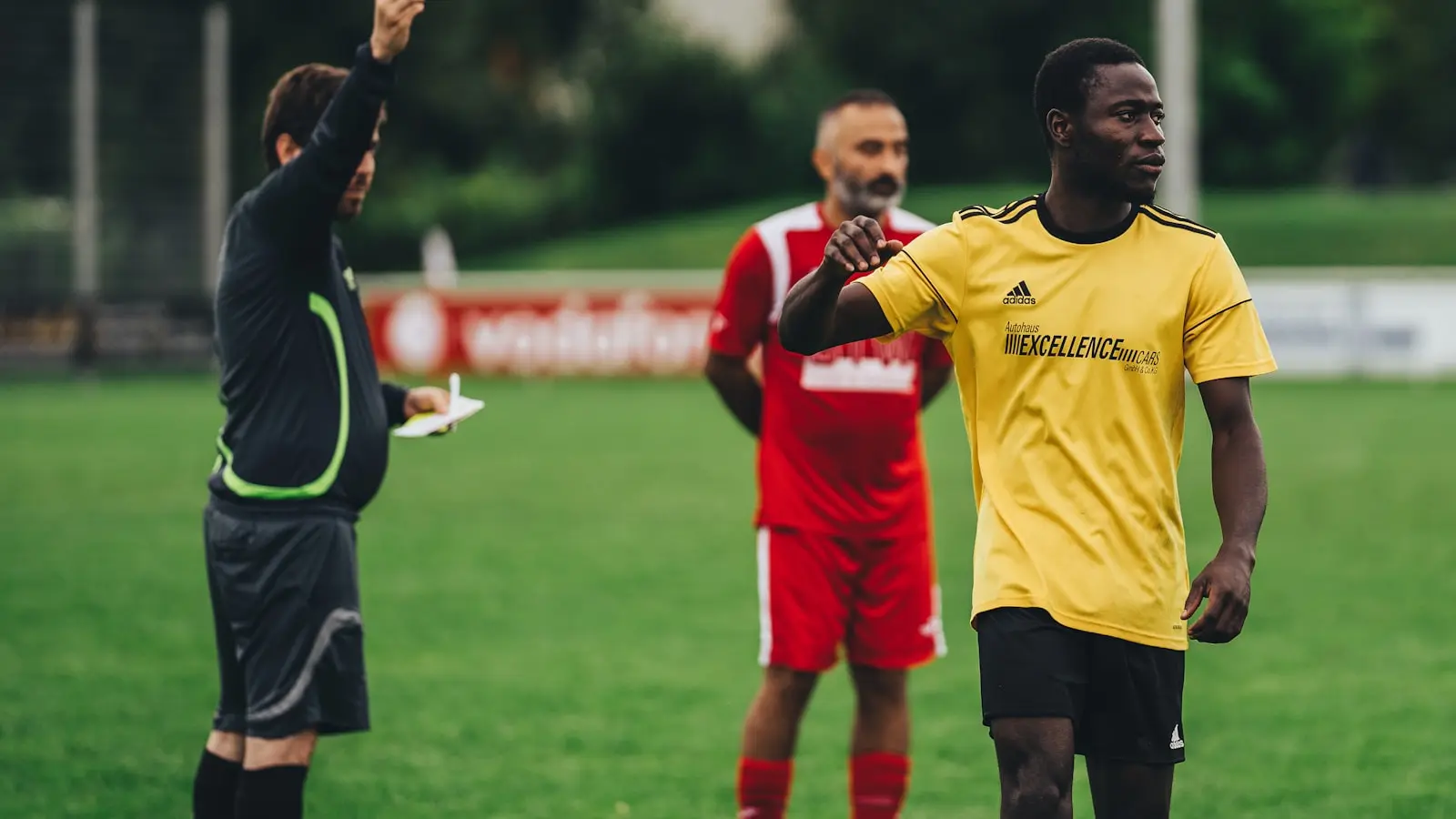
Facial expressions may contribute to an official’s immediate impression of a player, especially during a fast, emotional incident. But a face should not be treated as proof of pain, honesty, aggression, or simulation. Referees assess a wider set of information: the contact itself, movement, position, timing, voice, gestures, nearby players, assistant or video input, and the rules.
For players who feel misread, that distinction matters. A grimace may seem ignored, or a controlled reaction may feel as if it made an injury look less serious. That experience can be frustrating, but it does not by itself prove referee bias. Officiating decisions are often made from incomplete information while play continues.
Key Takeaways
- Facial expressions can shape a quick overall impression, but they are only one part of player nonverbal communication.
- A grimace, calm face, or angry look cannot reliably establish pain, honesty, intent, or injury severity.
- Dissent is generally about conduct such as words, gestures, confrontation, delay, or persistence—not a facial reaction alone.
- There is no established basis for saying that Botox, reduced facial mobility, or a naturally less expressive face reliably changes calls.
- Players gain more from clear communication, emotional-regulation routines, and knowledge of competition protocols than from monitoring appearance.
How officials make fast decisions under pressure
Most decisions are not made under ideal viewing conditions. An official may have a partial sightline, players blocking the incident, crowd noise, a moving ball, and only seconds to decide whether to stop play, apply advantage, issue discipline, or allow the contest to continue.
The action itself is usually the starting point. Officials consider where contact occurred, its apparent force, the timing of a tackle or collision, whether a player had control of their body, and whether the ball or play was reachable. They also assess what happens before and after the incident: changes of direction, loss of balance, attempts to continue, retaliation, and the effect on the next phase of play.
A player’s face is part of this wider information stream. Athlete facial expressions may communicate surprise, pain, anger, disbelief, fatigue, or urgency. Yet they arrive alongside posture, arm movements, running mechanics, tone of voice, and interaction with opponents. It is more accurate to view the face as one element of player nonverbal communication than as a stand-alone message.
That is why the feeling that “the referee did not believe me” can have several explanations. The official may have seen little contact, judged that the player initiated it, lacked a clear view, applied an advantage principle, or focused on another event in the sequence. A facial reaction may have been noticed without being the factor that determined the decision.
Where athlete facial expressions may shape an impression—and where they should not decide a call
Visible emotion can affect an interaction. A sharp look of disbelief after a whistle, a wince after contact, or an angry stare during a confrontation gives officials, teammates, opponents, and spectators information about a player’s apparent state. The difficulty is that people can interpret the same signal differently.
A grimace is not a lie detector. Pain expression varies between individuals and can change with adrenaline, fear, fatigue, stress, culture, previous injury experience, and the competitive situation. One athlete may react loudly to a minor knock, while another remains composed through a significant problem. Neither reaction proves the severity of an injury or the truth of a claim.
The same caution applies to perceived simulation. A dramatic reaction can draw attention to a possible foul, particularly if the official did not clearly see the point of contact. It does not prove that a foul occurred, that the contact was severe, or that the player is injured. Likewise, a muted reaction does not prove that a player was unaffected.
The practical distinction is between noticing and deciding. An official may notice a facial reaction as part of the scene, but a sound decision should rest on rule-based evidence from the play. In sports that use video review, replay may help clarify defined factual elements, though review systems also operate within limits set by the competition.
Caution: Research on emotion perception can help explain why people form quick impressions from faces and body language. It does not automatically establish that facial cues alone change real-game calls. Live sport contains too many connected variables to isolate one expression easily.
Referee bias, body language, and the wider communication picture
The phrase “referee bias body language” is often used after an unfavorable decision, but it can become too broad to be useful. A disputed call is not automatically evidence that an official consciously favored or disfavored a player because of appearance, emotion, or manner.
There are, however, meaningful interactional pressures around decisions. A player who sprints toward an official, throws their arms out, shouts repeatedly, or stays after an explanation creates a different management problem from a player who asks one short question and returns to position. The difference is not cosmetic. It changes proximity, tone, escalation risk, and the official’s need to maintain control.
Context also accumulates over a match. Repeated team appeals, a tense scoreline, crowd noise, a previous confrontation, and the speed of the game can all affect how an exchange is experienced. That does not justify punishing emotion or overlooking a later foul. It does mean that communication surrounding a decision is rarely isolated from the rest of the contest.
Officials’ own nonverbal behavior matters, too. Calm posture, clear signals, measured facial expression, and a consistent speaking style can reduce uncertainty and help manage difficult moments. That is different from claiming that players’ faces reliably alter formal decisions such as fouls, penalties, cards, or ejections.
The key feedback loop is simple: visible frustration can invite a response, but its meaning depends on what follows. A brief look of disappointment differs from an extended confrontation. Words, gestures, distance from the official, persistence, and compliance with instructions are likely to matter more than whether a player looked angry for a second.
Dissent, aggression, and why communication habits matter more than appearance
Dissent and unsporting conduct are rule-based concepts, and their exact definitions vary by sport and competition. They may involve verbal protest, insulting or abusive language, confrontational conduct, demonstrative gestures, delaying a restart, or refusing an instruction. A facial expression by itself is generally too ambiguous to establish that meaning.
An emotional reaction is therefore not automatically dissent. A player can look shocked, annoyed, hurt, or frustrated after a call without committing a disciplinary offense. The risk increases when the reaction becomes conduct: following the official, gesturing aggressively, repeatedly contesting the decision, shouting, or preventing play from restarting.
Players should rely on the current rules and protocols of their own competition rather than habits learned elsewhere. Some competitions limit communication with officials to captains or designated players in certain situations. Knowing those procedures can prevent an avoidable escalation.
A durable response begins with a pause. If communication is permitted, use one concise, factual question: ask what the official saw rather than accuse them of missing everything. Avoid theatrical gestures, allow the answer to stand, and move away once the exchange is complete.
For teams, this is a performance skill as much as a discipline issue. Coaches can designate who speaks to officials, build a reset routine after contentious calls, and rehearse how players return attention to the next defensive or attacking task. These habits protect decision-making when emotions rise.
Why it is hard to prove that facial expression changes officiating outcomes
Claims about facial expressions and referees require a high evidential bar. In a live match, a face cannot be cleanly separated from the incident that produced it. The same player may grimace because of genuine pain, tactical frustration, surprise, fatigue, fear of the next challenge, or a combination of these factors.
A strong study would need to account for contact type, game state, player reputation, prior conduct, crowd effects, camera angles, officials’ positioning, assistant input, and replay availability. It would also need independent coding of expressions and representative samples across competitions. Even if an association appeared, that would not necessarily show that the expression caused the call.
Controlled work on emotion recognition can offer useful background because people do use facial and bodily cues when forming impressions. Competitive officiating is different. Officials are not identifying an emotion from a still image; they are applying rules to fast, physical, strategically contested events.
Stronger evidence would use transparent methods, control for the play itself, test findings across sports, and be replicated. Until that standard is met, it is safer not to claim that a particular expression reliably wins fouls, attracts cards, or causes officials to dismiss legitimate complaints.
The same restraint applies to Botox sports expression. There is no established basis for saying that altered facial mobility, or a naturally less expressive face, reliably improves or worsens officiating outcomes. Cosmetic or medical decisions should not be treated as an officiating strategy.
Better ways to reduce miscommunication during competition
Trying to manage every facial movement is an unhelpful target. Under pressure, athletes cannot control how every signal will be perceived, and appearance-focused self-monitoring can distract from the game. A more useful goal is to control conduct after the whistle.
A short breathing reset can create enough space to avoid an impulsive response. Some players use a cue word such as “next,” “reset,” or “shape” to redirect attention toward the immediate tactical task. Others use a preplanned sequence: turn away, take a few steps, check positioning, and decide whether a captain should speak.
Teams can practice difficult interactions instead of treating them as personality tests. Training scenarios can include disputed calls, quick restarts, and concise captain communication. This turns emotional regulation into a repeatable competitive skill rather than a vague instruction to stay calm.
Where formal processes exist, use them within the competition’s rules. Video review may resolve specified in-game questions, while post-match clip review can help a team distinguish a genuine officiating concern from a perception shaped by frustration. Formal reports or appeals should be used only when the competition permits them and the issue meets the required standard.
The practical takeaway is not that faces do not matter at all. Facial expressions can be part of a referee’s rapid overall impression, as they are in any human interaction. But players and coaches are more likely to benefit from better communication, emotional control, and knowledge of protocols than from trying to engineer an appearance that supposedly changes calls.
FAQ
Can referees tell whether a player is faking an injury from facial expressions?
Not reliably from facial expression alone. A face may show distress, anger, shock, or little visible emotion, but none of those reactions proves injury severity, honesty, or intent. Officials should assess the play and available evidence rather than treat a grimace or calm expression as conclusive.
Is showing frustration automatically dissent in sport?
No. An emotional facial reaction is not automatically dissent. Discipline may become relevant when frustration is paired with prohibited words, gestures, confrontation, persistent appeals, delay, or other conduct defined by that sport’s current rules.
Can Botox or a less expressive face affect refereeing decisions?
There is no established evidence that Botox, reduced facial mobility, or a naturally less expressive face reliably changes officiating outcomes. It is not a sound basis for a sporting or personal decision about appearance.