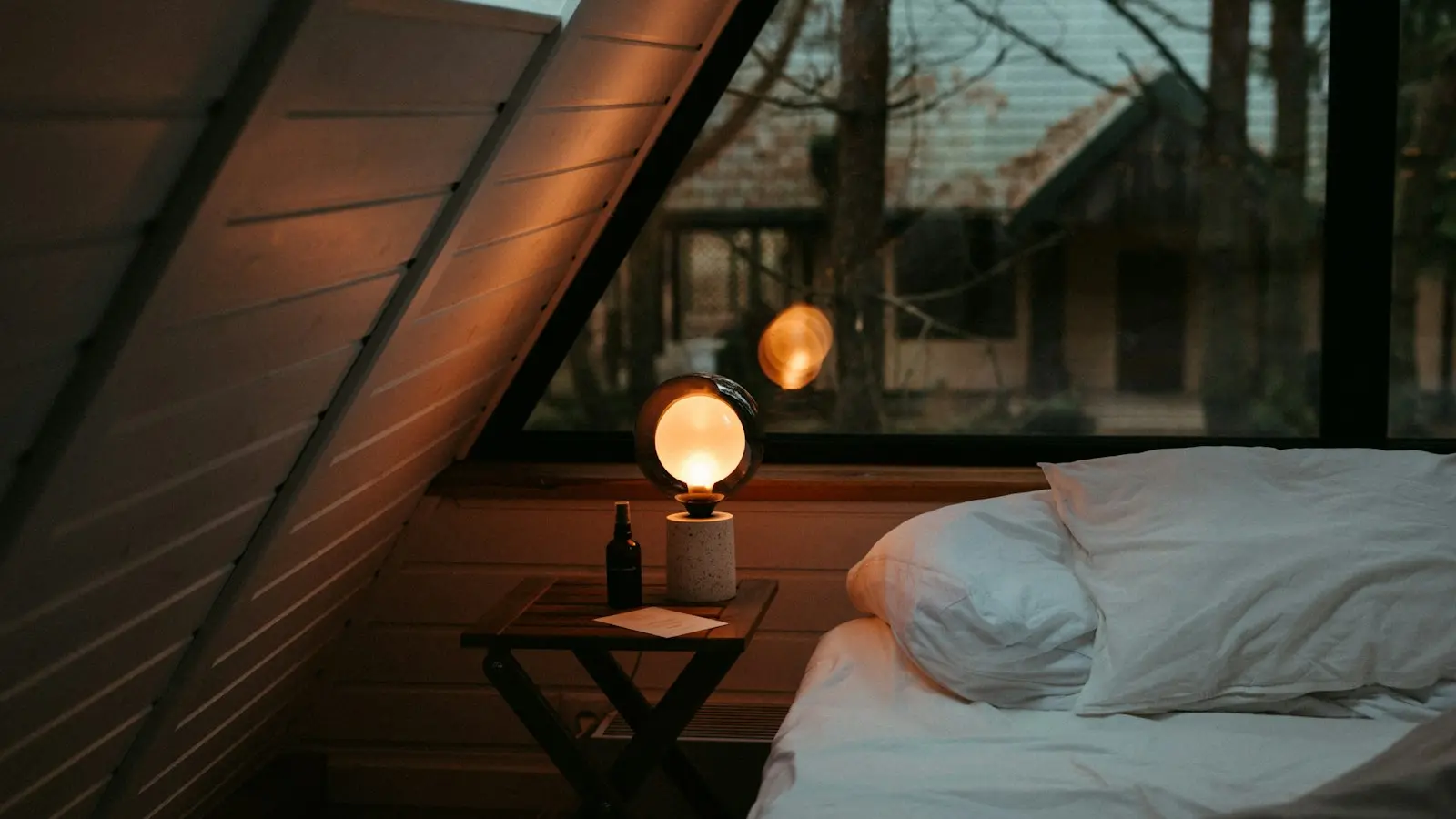
Changing your evening lighting may help some people fall asleep more easily or maintain a steadier body-clock schedule, but it is not a universal sleep treatment. The most useful approach is usually to reduce unnecessary bright light late in the evening while keeping enough illumination for safety and practical tasks.
The details matter. A bright phone held close to your face is not equivalent to a dim lamp across the room, and a warm bulb is not automatically harmless if it is very bright or used for hours. Evening light and sleep are best understood through several interacting factors: brightness, color or wavelength, timing, distance, duration, and the rest of your nighttime routine.
Key Takeaways
- Evening light can influence circadian timing and when melatonin begins to rise, but its effect varies by brightness, wavelength, timing, duration, and personal sensitivity.
- Brightness and proximity often matter as much as color temperature; warm light is not automatically sleep-friendly if it is intense or prolonged.
- Screens can affect sleep through both light exposure and stimulating content, notifications, work, or entertainment.
- Before buying specialized products, try dimming overhead lights, lowering screen brightness, increasing viewing distance, and keeping a consistent wind-down routine.
- Persistent sleep problems, loud snoring, gasping, severe daytime sleepiness, or major impairment deserve professional assessment rather than a lighting-only solution.
How evening light interacts with the body clock and sleep pressure
Light is one of the strongest environmental signals used by the circadian system, the internal timing system that helps coordinate sleep, alertness, body temperature, and hormone rhythms. Specialized cells in the eye detect environmental light and send timing information to the brain’s central body clock.
This signal can influence when the body begins preparing for sleep. In the evening, the body commonly increases production of melatonin, a hormone involved in signaling biological night. Exposure to light at the wrong time may delay or reduce that rise, particularly when the light is bright, reaches the eyes directly, lasts long enough, or occurs during a person’s biological night.
That does not mean every evening lamp or screen will cause meaningful disruption. The response depends on the person, their schedule, the intensity and color of the light, and how long the exposure continues. Someone who is highly light-sensitive or already sleeping at an unusual time may respond differently from someone with a regular daytime schedule.
It also helps to separate two concepts: circadian timing and sleep pressure. Sleep pressure builds the longer you remain awake and generally makes it easier to sleep as the day progresses. The body clock provides a timing signal that can either support or oppose sleepiness. Evening light may shift the clock later without necessarily causing a dramatic problem on a single night.
Likewise, a change in melatonin timing is not proof that sleep quality has improved or worsened. Controlled laboratory studies can use carefully measured light exposure that differs substantially from ordinary household lighting. Real-life sleep is also affected by stress, noise, temperature, caffeine, pain, habits, and the content of what someone is doing on a screen.
Why brightness, timing, color, distance, and duration all matter
Brightness is often more important in practice than the label on a bulb. A strong light source close to the eyes generally delivers more light to the retina than a dim source viewed from farther away. A ceiling fixture can illuminate an entire room, while a shaded bedside lamp may provide enough light for reading without producing the same level of exposure.
Timing changes the likely effect. Light earlier in the evening may influence circadian timing differently from light used immediately before bed or during the middle of a person’s biological night. The same light may be less disruptive when someone is still active and several hours from sleep than when it is used during a late-night awakening.
Color temperature and wavelength also matter, but “blue light” is not the whole story. Shorter-wavelength light can be particularly effective at influencing the circadian system under some conditions. However, a warm light can still be disruptive if it is bright, close, prolonged, or used when the body is especially sensitive.
Distance changes exposure because light spreads as it travels. Holding a bright tablet close to your face is different from watching a television positioned several feet away, even if both devices display similar colors. This is one reason screen size alone does not determine the likely effect.
Duration matters as well. A brief glance at a dim device is not equivalent to several hours of bright, close-up use. Room contrast may also affect comfort: a bright screen in an otherwise dark room can feel more stimulating than a lower-brightness screen in a softly lit environment.
For these reasons, the best evening lighting is usually not defined by one bulb color. It is lighting that is sufficiently dim, comfortable, and low-glare for the task while avoiding unnecessary direct exposure to bright sources during the wind-down period.
Screens versus lamps, overhead lighting, and other nighttime sources
Phones and tablets can affect sleep through light and through what the person is doing. A device may deliver light close to the eyes, while notifications, emotionally activating content, work messages, gaming, social interaction, or problem-solving can increase alertness independently of the display.
This makes it difficult to attribute every screen-related sleep problem to light. Someone may stay awake because a message is stressful or because an engaging video delays bedtime, even if the screen is dimmed. Conversely, a person may use a screen briefly and still notice that bright light close to bedtime makes it harder to feel sleepy.
Computers used for work can combine several factors: a relatively large bright display, close viewing distance, sustained attention, and a schedule that extends later than intended. Televisions are often farther away, but they may remain on for long periods and can still contribute to light exposure or delayed bedtime.
Overhead lighting deserves attention because it is easy to overlook. A brightly lit room may expose the eyes to more total light than a dim bedside device used for a short period. Lamps, bathroom lighting, hallway fixtures, outdoor security lights, and light entering through curtains can all contribute to the nighttime environment.
Night modes, dimming controls, and blue-light filters may reduce some aspects of screen exposure, but they do not guarantee better sleep. They may lower brightness or shift the display toward warmer colors, yet the device can remain stimulating, close to the face, or in use later than planned. Filters are tools, not proof against sleep disruption.
Practical constraints matter. A late-shift worker may need bright light to remain alert and perform safely. A caregiver may need reliable illumination for an infant or family member. Someone sharing a bedroom may not control the other person’s devices or lighting. In these situations, reducing glare, shielding the light, directing it away from the bed, or using a small task light may be more realistic than aiming for complete darkness.
Evening lighting changes worth testing before buying products
Start with a low-cost experiment rather than specialized glasses, bulbs, or screens. During the period before bed, dim bright overhead lights if you can do so safely. Keep stairs, walkways, bathrooms, and caregiving areas adequately illuminated; sleep-friendly lighting should never create a fall or driving hazard.
Next, adjust screens in practical ways. Lower brightness to a comfortable level, move the device farther away, reduce unnecessary notifications, and avoid holding a bright screen close to your face. If possible, keep demanding work, intense entertainment, and emotionally activating conversations outside the wind-down period.
Test one meaningful change at a time for several nights while keeping bedtime and wake time reasonably consistent. Track how long it seems to take to fall asleep, whether you wake during the night, how alert you feel in the morning, and whether caffeine, stress, alcohol, pain, or schedule changes may have influenced the result.
A short trial cannot prove that light was the cause of a sleep problem. Sleep naturally varies, and expecting a dramatic result can make the experiment harder to interpret. The purpose is to identify whether a modest environmental change appears useful in your own routine.
For many households, a warm, shielded, low-glare lamp is more practical than removing all light. A lamp directed toward the floor or wall may be more comfortable than an exposed bulb aimed toward the bed. If one person needs to read or use a device, a focused light can reduce the amount of illumination affecting the other person.
People who work late may need a different strategy. It may be unrealistic to avoid bright light during the work period, but reducing unnecessary brightness after work, keeping a consistent sleep schedule when possible, and making the bedroom darker and quieter may still help. The goal is not to follow a perfect rule; it is to reduce avoidable stimulation without compromising function or safety.
When evening light is unlikely to be the main sleep problem
Lighting changes may have limited benefit when another factor is driving poor sleep. Irregular bedtimes, long naps, late caffeine, alcohol, stress, pain, medication effects, noise, heat, and an uncomfortable mattress can all be more important than the color of a lamp.
Persistent difficulty falling asleep or staying asleep may also reflect chronic insomnia, a breathing-related sleep disorder, restless legs, shift-work-related circadian disruption, or another health concern. Loud snoring, gasping or choking during sleep, unusual nighttime behaviors, severe daytime sleepiness, and significant mood or concentration changes deserve attention rather than a lighting-only solution.
Professional assessment is particularly important when sleep problems continue despite reasonable routine changes, interfere with work or driving, or create concerns about safety. A lighting experiment should complement—not replace—appropriate medical care.
Light-filtering glasses, amber lenses, special bulbs, apps, and screen covers can be treated as optional tools. Evidence for these products is not uniform, and their effects may depend on how they are used and what problem they are intended to address. A product cannot compensate for an irregular schedule, late-night stimulation, untreated sleep apnea, or an environment that is unsafe or uncomfortable.
FAQ
Can using a phone at night affect sleep even when night mode is turned on?
Yes, it can. Night mode may reduce some shorter-wavelength light and lower perceived brightness, but it does not eliminate light exposure or the alerting effects of notifications, work, entertainment, and emotional content. Increasing distance, lowering brightness, silencing alerts, and ending stimulating use earlier may be more useful than relying on the filter alone.
Is warm lighting better than blue light for sleep?
Warm lighting is often a reasonable choice for the evening because it generally contains less shorter-wavelength light than a cool, daylight-like source. However, warm does not mean automatically harmless. Brightness, duration, distance, and timing still matter, so a dim, low-glare warm lamp is more sleep-conscious than a very bright warm fixture used close to bedtime.
How long before bed should I reduce bright light exposure?
There is no single cutoff that works for everyone. The practical approach is to begin reducing unnecessary bright light during your wind-down period and observe whether it changes sleep onset or morning alertness. People with late schedules, high light sensitivity, or circadian timing concerns may need a more individualized plan, while others may notice little difference from ordinary household lighting.
Overall, evening light and sleep are connected, but the relationship is more nuanced than “all screens are bad” or “blue light is the only problem.” Start with reversible changes: soften overhead lighting, limit close bright-screen use, protect necessary nighttime visibility, and keep the broader sleep routine consistent. If poor sleep persists or causes daytime impairment, investigate the wider picture with a qualified health professional rather than assuming the lamp is the main cause.