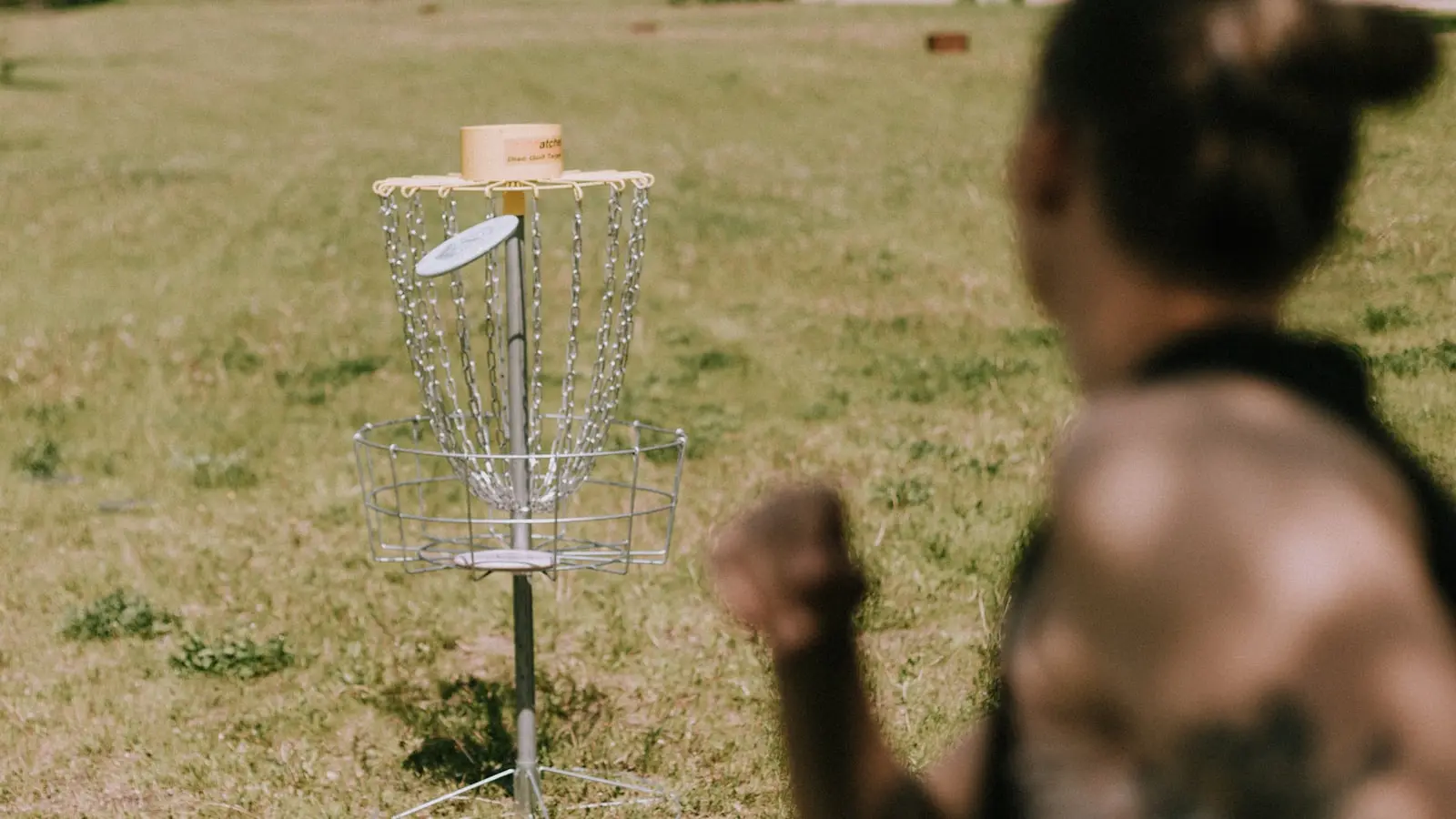
Disc golf elbow pain is not an inevitable cost of gaining distance. The most useful first step is usually to reduce the recent trigger—often repeated hard drives—then rebuild tolerance with smoother whole-body mechanics, a progressive warm-up, and manageable practice volume.
No grip, release, or single form cue can explain or solve every painful throw. Elbow, forearm, shoulder, and back symptoms can have different causes. The practical goal is not to throw through discomfort, but to identify the combination of intensity, volume, and movement your body currently tolerates.
Key Takeaways
- Distance should come from coordinated legs, hips, torso, and arm action—not from trying to yank harder with the elbow or shoulder.
- Short-lived general fatigue after an unfamiliar session differs from sharp, worsening, recurring, or movement-changing pain.
- Warm up from general movement to easy throws, then build toward harder drives instead of making the first tee shot a full-power attempt.
- Track total throws, high-effort throws, throw style, and next-day response to spot workload patterns before they become recurring problems.
- Stop or modify play when pain escalates or changes mechanics; persistent symptoms or warning signs deserve assessment from a qualified clinician.
Start by separating normal training fatigue from disc golf elbow pain
After an unfamiliar round, fieldwork session, or return from time off, muscles may feel generally tired, stiff, or mildly sore. That response can follow a larger or harder workload than usual. It differs from sharp, focal, worsening, or repeatedly triggered pain.
Use more caution when symptoms change your throw, make you guard the arm, persist between sessions, or return with nearly every drive. Pain that spreads, comes with tingling or weakness, or gets worse as a session continues should not be treated as normal training discomfort. Pain is not proof that distance practice is working.
Maximum-distance attempts are easy to overuse because every throw can feel like a test of progress. A player may accumulate many high-effort repetitions while chasing one cleaner release or longer flight. Even when individual throws initially feel manageable, the total load on the elbow, forearm, shoulder, and wrist may exceed current tolerance.
A safer approach is to reduce the recent aggravating load, allow symptoms to settle, and reintroduce throwing gradually. Persistent or recurring symptoms are a reason to seek guidance from a qualified clinician rather than trying to identify the cause from pain location alone.
Understand where backhand and forehand throws can load the arm
Both backhand and forehand throws transfer force from the ground through the legs and torso, then through the shoulder, elbow, forearm, wrist, and hand. When the lower body and trunk contribute less, the arm may be asked to create a larger share of disc speed.
A backhand can become arm-dominant when a player rushes the pull, loses balance in the run-up, rounds the motion, or tries to accelerate the disc mainly with the shoulder and elbow. That may produce occasional power, but it can be difficult to repeat with control and may make symptoms harder to interpret.
Forehand throws can feel efficient at lower effort because the motion is compact. Repeated hard forehands, however, may place substantial demand on the elbow, forearm, wrist, and shoulder—especially when a player relies on a fast arm action or forces extra snap. The actual load depends on mechanics, intensity, throwing history, and prior injury.
Neither style is universally safer. Some players tolerate backhand volume well but react to forehand volume, while others experience the opposite pattern. If one throw reliably reproduces disc golf elbow pain or forearm pain, pause it or modify it substantially rather than trying to power through the same pattern.
Build distance with safer sequencing instead of arm-only effort
Distance is a coordination goal before it is an effort goal. Better timing can help produce disc speed without asking every part of the arm to work harder. For most recreational players, a repeatable throw is more valuable than an occasional maximum-effort throw that breaks down mechanically or causes symptoms.
For safer backhand form, begin with controlled footwork and a balanced finish. Let the hips and torso contribute before the arm accelerates, keep the motion smooth, and avoid forcing a violent pull. The goal is not to lock the elbow into one supposedly correct position; it is to avoid making the elbow and shoulder the only engines of the throw.
Forehand cues follow the same principle. Use a comfortable standstill or run-up, keep the motion compact enough to control, and avoid forcing extra wrist or elbow snap when speed is not arriving naturally. If release consistency declines as effort rises, the session may have moved beyond productive practice for that day.
Standstills can be useful progression tools because they reduce variables. Lower-power throws can also help reveal whether symptoms are linked mostly to intensity or whether they occur during a controlled motion as well. Build from comfortable approaches to smooth fairway shots, then add selectively harder drives rather than jumping directly into full-power fieldwork.
This can temporarily reduce peak distance. The trade-off is useful information: you can observe whether your body tolerates the movement, how your release changes under effort, and whether the next-day response remains manageable. Durable distance is usually built through gradual capacity, not repeated all-out tests.
Use a short disc golf warm up before hard throws
A disc golf warm up should progress from general movement to disc-specific movement. Static stretching alone immediately before maximum-effort drives is not a complete preparation strategy. A practical warm-up gradually increases movement, coordination, and throwing intensity.
Start with a few minutes of easy walking or light jogging. Follow with comfortable, pain-free movements for the shoulders, trunk, hips, wrists, and elbows. The routine does not need to be elaborate; the purpose is to move through ranges you can control without provoking symptoms.
Next, throw several easy putts and approach shots. Progress to controlled throws at gradually longer distances before attempting hard drives. Use this phase to notice stiffness, poor balance, or symptoms that appear as speed increases.
When time is limited, do not make the first tee shot your warm-up. A few minutes of general movement followed by progressively longer, easier throws is a better on-course option than immediately throwing at full power. Allow more gradual buildup in cold weather, after a long drive to the course, after a lengthy break, or when symptoms have occurred before.
No warm-up drill is a cure for disc golf throwing injuries. Stop any movement that provokes symptoms, and modify the day rather than forcing a planned fieldwork session. A warm-up can improve readiness, but it does not erase the effects of excessive workload or unresolved pain.
Progress throwing volume and recovery with a simple workload log
Workload is more than holes played. It includes total throws, high-effort drives, forehand and backhand attempts, fieldwork, rounds, strength training, and the spacing of demanding sessions. It also includes how you feel during play and the following morning.
Use a simple log with these fields:
- Date and session type
- Total throws and estimated high-effort throws
- Backhand, forehand, and other throw styles used
- Symptoms or discomfort during play
- Next-day response
- Recovery actions and the planned change for the next session
The record does not need perfect precision. Consistency matters more because it helps reveal patterns. For example, one casual round may feel fine, while a round followed by hard forehand fieldwork may lead to forearm pain the next day. That does not identify the exact cause, but it identifies a practical workload pattern worth changing.
Change one major variable at a time when possible. You might reduce hard drives while keeping your usual round, shorten fieldwork while keeping the same intensity, or add more time between demanding sessions. Changing everything at once makes it harder to learn what you tolerate.
Increase workload only after sessions and next-day symptoms remain manageable. If symptoms flare, reduce volume or intensity instead of trying to make up for missed distance practice. Easier throwing days, varied intensity, adequate sleep, and avoiding stacked hard sessions are practical parts of throwing volume recovery.
Know when to stop, modify, return gradually, or seek clinical care
Stop play and seek prompt medical evaluation for severe pain, a visible deformity, major swelling, sudden loss of strength or motion, numbness or tingling, or symptoms after a significant fall or direct injury. These signs should not be managed by experimenting with form on the course.
End or substantially modify a session when pain is sharp, escalating, repeatedly returns with each throw, or changes your mechanics. Continuing to throw while compensating can shift stress elsewhere and makes it harder to judge what is happening. Lower-intensity activity may be reasonable only when it remains comfortable during the session and does not worsen symptoms afterward.
Return to harder throws gradually after daily activity and lower-load throwing are comfortable. Begin with a warm-up, controlled throws, and limited exposure to the movement that previously caused symptoms. One pain-free day is not proof that full-power volume is ready.
Persistent or recurring elbow, forearm, or shoulder symptoms warrant assessment by a qualified clinician, ideally one familiar with throwing athletes. Self-management can organize training decisions, but it cannot determine the exact cause of pain.
FAQ
Is disc golf elbow pain more likely from backhand or forehand throws?
Either throw can contribute, depending on technique, intensity, prior injury, and frequency. Forehand and backhand load the arm differently, but neither is automatically harmful or automatically safe. If one style consistently triggers symptoms, reduce or pause it while you assess the pattern.
Should I keep playing disc golf if my forearm hurts only after a round?
Post-round forearm pain is a reason to review recent workload rather than continuing unchanged. Consider reducing hard throws, shortening the next session, and tracking whether symptoms settle or recur. Seek clinical guidance if pain persists, worsens, affects normal activity, or repeatedly returns after throwing.
How many maximum-distance throws should I practice when building distance?
There is no universal safe number because individual tolerance varies. Begin with fewer high-effort throws than you think you can handle, especially after time off or an increase in playing frequency. Add harder drives only when mechanics remain controlled and your during-session and next-day response stays manageable.