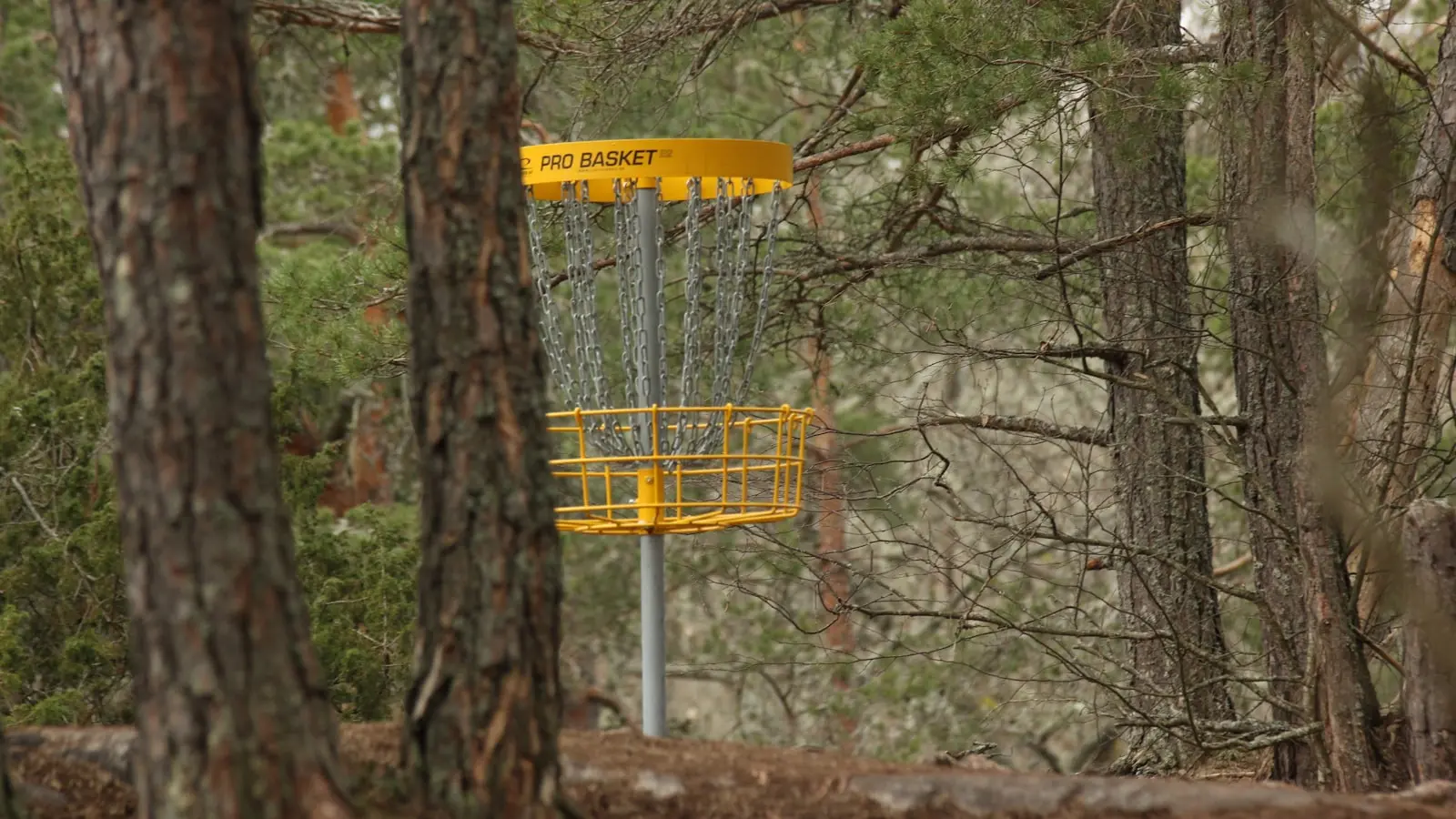
A disc golf ace is a score of one on a hole, completed with the tee throw. But championship-level disc golf hole-in-one odds cannot be inferred from one spectacular make. An elite player can execute a perfect shot under pressure without making that shot repeatable, strategically correct in every situation, or representative of typical players.
The core trade-off is simple: the line that gives a disc a chance to enter the basket may also expose the player to the most damaging miss. Championship competition is decided by total strokes over a round or event, so professionals often favor a controlled landing zone over the most aggressive possible ace run.
Key Takeaways
- A professional disc golf ace is a rare result, not proof that a hole was easy or routinely attackable.
- Listed distance matters, but fairway width, elevation, obstacles, wind, and danger around the basket often matter just as much.
- An ace requires the right speed, release angle, flight shape, height, and approach to the chains at the same time.
- The highest-ace-potential line is not always the best expected-score decision in championship play.
- Reliable ace-rate claims require comparable data across players, holes, conditions, and competitive settings.
An Ace Is a Result, Not a Universal Measure of Difficulty
In everyday disc golf language, an ace means completing a hole in one throw from the teeing area. For a specific sanctioned event, the applicable rules, official scorecard, tee position, and event format should be confirmed before making detailed claims about the shot.
That context matters because a highlight can hide the factors that made the throw difficult. To judge a tournament ace properly, viewers need to know the hole layout, route to the basket, scoring conditions, and consequences of a miss. Without that information, a remarkable result can be mistaken for evidence that the hole was easy or that professionals regularly have the same opportunity.
A single professional disc golf ace shows that one player successfully combined release, flight, and finish on one throw. It does not establish a general ace rate. Meaningful disc golf hole-in-one odds would require a large sample of comparable tee shots, including similar player ability, hole design, weather, and a consistent definition of an ace.
Even then, the result would apply only to that sample. A rate from short, open holes would not transfer cleanly to wooded championship layouts. Nor would casual-round results capture the pressure, strategic restraint, and punishing miss zones common in elite competition.
Why Distance Alone Cannot Explain Disc Golf Ace Difficulty
Distance matters because longer throws generally require more speed, cleaner timing, and greater control during the final part of the flight. But distance is only one item on a hole sign. It does not reveal the usable airspace, the basket’s approach angle, or what happens when the disc misses by a few metres.
A relatively short wooded hole can present a narrower practical target than a longer open hole. A player may need to hit an immediate gap, hold a specific corridor, avoid late branches, and approach the basket from a limited side. The target is not just the basket; it is the full sequence of spaces the disc must travel through.
Championship-oriented PDGA course design often creates these layered demands. Fairway width, mandatory routes, tree cover, blind landings, out-of-bounds areas, and hazard placement all shrink the margin for error. A basket tucked behind guarding trees or near a boundary may be reachable, but it may not be safely attackable.
Elevation changes effective distance as well. A downhill tee shot can help a disc carry with less power, but added glide can make speed control near the basket more difficult. If the disc arrives with too much forward movement or an unfavorable angle, it can skip past the target or slide into a difficult recovery area.
Uphill holes create a different challenge. The player may need more power to reach the target while maintaining the nose angle and flight shape needed to avoid fading early. The throw can be physically demanding without offering a clean route to the chains.
Ground behavior is another hidden variable. Firm turf, hard-packed dirt, roots, rocks, and sloping greens can turn an excellent flight into a poor scoring position after landing. A low shot may use a controlled skip as part of its intended line, but that same skip becomes a liability if the disc lands slightly too fast, too steep, or too wide.
To judge a hole from coverage, use a practical checklist:
- Compare the listed distance with the visible fairway width, not distance alone.
- Identify forced gaps, low ceilings, tree branches, and routes that prevent a direct line.
- Examine the basket area for slopes, water, out-of-bounds, hazards, or sharp drop-offs.
- Note whether the basket is elevated, guarded, blind from the tee, or positioned to punish long misses.
- Watch where well-thrown discs finish when they do not go in; those outcomes often reveal more than the ace itself.
A hole that appears aceable on a map can look very different once the landing zone and recovery terrain are visible.
Wind, Shot Shape, and the Narrow Window for a Make
A basket is a small target at the end of a long, changing flight. An ace line must combine speed, release angle, height, timing, and directional shape. Maximum power is rarely enough, and it can be counterproductive if it leaves the disc arriving too quickly to stay near the target.
Wind narrows that window further. A headwind can alter how a disc holds or turns during flight, while a tailwind can change carry and descent. Crosswinds can push a disc off its intended line, particularly as it slows near the green, and gusts can make a reliable-looking plan less predictable.
The challenge is not just reaching basket height. The disc also needs a plausible entry line. A shot approaching from the wrong side, too high, too low, or with too much lateral movement may have little chance of catching chains even if it passes close to the target.
Obstacles compound the problem. A gentle turning line may offer a better approach to the basket but leave almost no tolerance for an early release into trees. A wider hyzer route may be more repeatable from the tee but approach the basket at an angle that creates fewer realistic makes. The best-looking flight on a replay may therefore be the least forgiving option over repeated attempts.
Disc golf wind strategy is fundamentally a control decision. A player may choose a disc and flight that reduce the chance of a dramatic make but improve the likelihood of a routine birdie look or stress-free par. That is not a lack of ambition; it reflects the way tournament scoring rewards controlled outcomes more consistently than isolated highlights.
Why the Best Ace Attempt May Be the Wrong Tournament Shot
Expected-score thinking sounds technical, but the practical meaning is straightforward: choose the shot most likely to produce the best result across many comparable situations. On a forgiving hole, a direct bid at the basket may have limited downside. On a dangerous green, the same intent can turn a near-miss into an out-of-bounds penalty, difficult scramble, or multi-stroke swing.
Consider two tee-shot plans. The aggressive line reaches the basket directly and retains a small chance of an ace, but a long miss can skip into trouble. The placement line targets a wider landing zone, removes much of that long-miss risk, and leaves a manageable putt or approach.
Which shot is better depends on the player, the hole, and the competition state. If the conservative line still produces birdie opportunities while sharply limiting bogeys, it may be the superior championship play even though it nearly eliminates ace potential.
Severe greens raise the price of missing. A basket on a slope can send an overthrown disc far beyond the target. Water, out-of-bounds, thick rough, and difficult recovery angles create a similar effect: the miss is not simply farther from the basket; it may add uncertainty and strokes.
Tournament position also changes the calculation. A player protecting a lead may value predictable placement more than a volatile attempt. A player needing to gain ground, or facing a hole where conservative play offers little advantage, may reasonably accept more risk. Format, hole par, and score separation all matter, which is why strategy should not be judged from a single throw alone.
Championship disc golf scoring rewards the complete round. An ace counts for one stroke on one hole, but a poor decision on a punishing hole can cost several throws. The value of aggression is therefore situational rather than fixed.
How to Interpret Disc Golf Hole-in-One Odds Without Inventing a Number
There is no responsible universal percentage for disc golf hole-in-one odds without credible, comparable data. A useful estimate would need a clearly defined player group, a known number of tee shots, and consistent documentation of the holes being played.
It would also need to separate hole categories. Distance, fairway shape, elevation, basket position, hazards, and tee-pad configuration all influence the opportunity. Environmental conditions matter as well, particularly wind and surface conditions, while player choices determine how often they actually use an ace-oriented line.
A defensible estimate should specify whether it covers sanctioned competition or casual play, elite professionals or a broader player population, and championship layouts or shorter recreational courses. It should also identify whether all tee shots are counted or only deliberate runs at the basket. Without those distinctions, a precise-looking number can be more misleading than useful.
This is why a televised ace should be appreciated as a low-frequency outcome without becoming a benchmark. Elite players have the power, touch, and pattern recognition to create opportunities that most players do not. Yet difficult layouts, changing wind, and the consequences of a miss often make the most rational shot something other than a full attack on the chains.
For viewers, the useful question is not simply, “How far was it?” Ask what route the disc had to fly, where it could safely land, what happened if it missed, and whether the score situation rewarded risk. Those details explain disc golf ace difficulty far better than the highlight alone.
FAQ: Championship Disc Golf Aces
What counts as an ace in sanctioned disc golf?
An ace is a score of one on a hole: the player completes the hole with the tee throw. For a specific sanctioned event, the applicable current rules and official scorecard should be checked before making detailed claims about terminology or administration.
Are longer disc golf holes always less likely to produce an ace?
No. Longer distance usually increases technical demand, but it is not the whole equation. An open downhill hole may offer a more realistic flight to the basket than a shorter hole with tight gaps, a guarded green, wind exposure, or severe penalties around the target.
Why would a professional player avoid aiming directly at the basket?
The direct line may create too much downside if it misses. A professional may prefer a controlled landing zone when an aggressive throw can bring out-of-bounds, a rollaway, thick rough, or a difficult next shot into play. The best decision is the one that serves the expected score for that hole and that moment in the tournament.