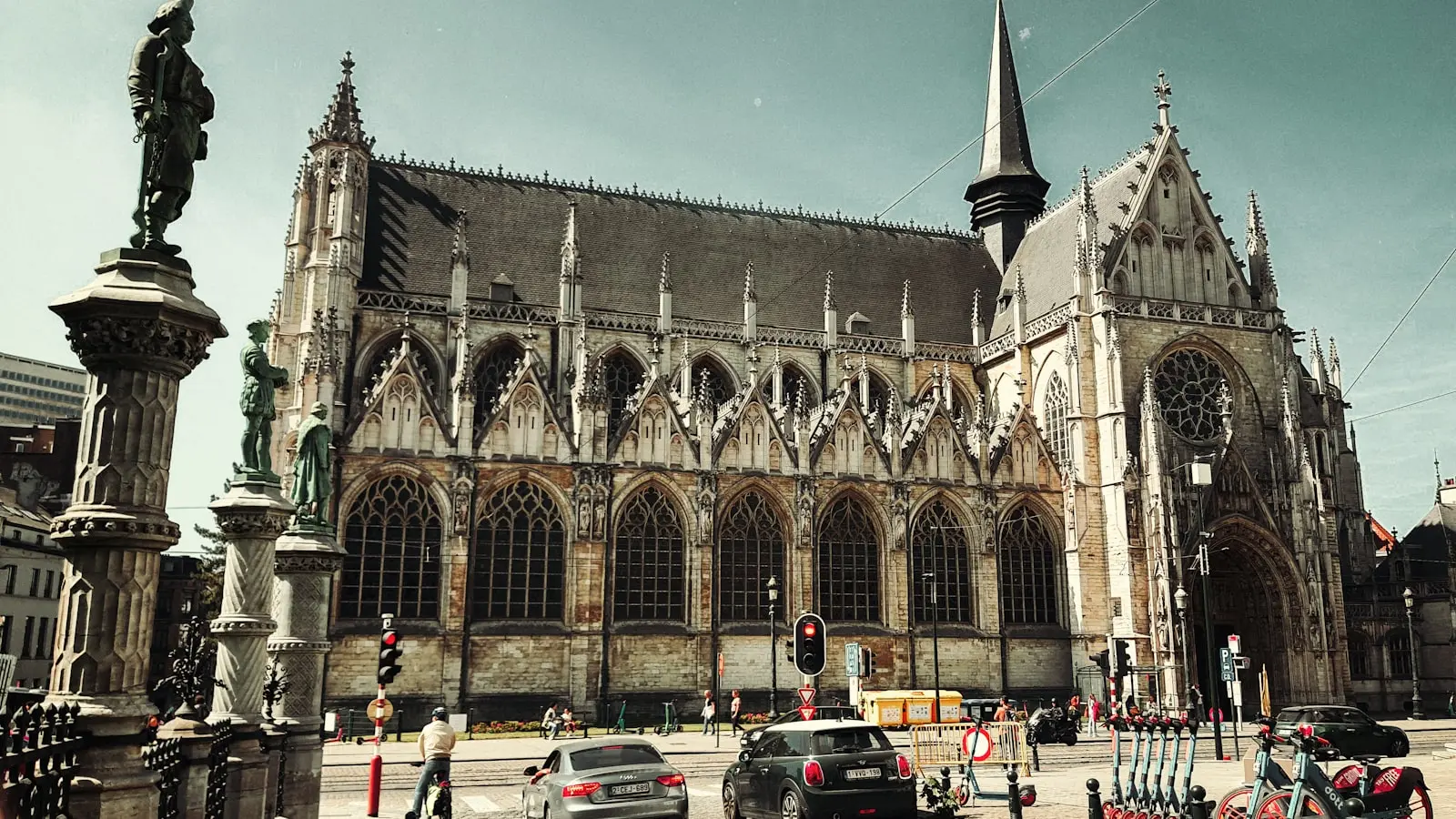

Travel forums routinely process a highly specific piece of conventional wisdom regarding European itineraries. The digital consensus insists that international arrivals should treat the Belgian capital purely as a transit hub, boarding the first departing train toward the preserved medieval geometries of Bruges or Ghent. Millions execute this maneuver annually. Backpackers and vacation planners cite chaotic infrastructure surrounding Brussels Midi station, visible urban friction, and a suffocating bureaucratic atmosphere emanating from the European Union headquarters. Visitors arrive expecting the immediate romantic cohesion of Paris or the curated canal density of Amsterdam. They receive a decentralized, working metropolis. When expectations clash with urban reality, the immediate reaction is retreat.
Tourism boards report that Brussels serves as a massive international flight hub, anchoring global routes into Western Europe. This logistical dominance creates an inherent liability. Transients judge a living, breathing administrative center against the metric of a holiday resort. When passengers drag rolling luggage across the uneven, stained pavement outside major transit corridors, the sensory input overwhelms the under-prepared. Concrete shadows stretch over transit lanes. Commuter frustration intersects with aggressive panhandling in the immediate vicinity of the train stations. The architectural environment dictates immediate departure. Yet, urban planners understand that transit hubs rarely represent the cultural heartbeat of a municipality. (Transit nodes serve efficiency, not aesthetics).
The Anatomy of Arrival Friction
Bruges functions flawlessly as a preserved medieval diorama. Canal boats slide past impeccably maintained brick facades. Local authorities navigate a sanitized environment optimized entirely for external consumption. Ghent offers slightly more collegiate friction, balancing university life with historical preservation. However, both municipalities represent a closed loop of historical reflection. They exist in the past tense. Brussels operates differently. The capital tears down, rebuilds, and layers glass over stone in a constant state of structural negotiation. It never rests.
The European Quarter casts a heavy psychological shadow over the city’s reputation. Steel and glass monoliths house diplomats, administrators, and lobbyists. This infrastructure projects power and bureaucratic function, stripping the immediate surrounding blocks of spontaneous neighborhood culture. Critics label this district sterile. They miss the structural counterweight entirely. Beyond the institutional perimeter, the true spatial dynamics of Brussels unfold through distinct, highly localized communes. The sterile veneer of the EU district acts merely as a localized containment zone, leaving the rest of the city free to fracture into distinct cultural ecosystems.
Structural Art and Spatial Identity
To dismiss Brussels requires ignoring one of the most significant architectural movements in modern European history. Art Nouveau does not exist solely behind velvet ropes here; it holds up the roofs. Victor Horta and Paul Hankar embedded organic, iron-forged botanical motifs into the very residential fabric of the Ixelles and Saint-Gilles neighborhoods. Curved glass bends light into narrow domestic spaces, actively rejecting the rigid industrialization of the late nineteenth century. The city forces observers to look upward. Facades ripple with asymmetric wrought iron and intricate sgraffito. To walk through Schaerbeek is to witness a masterclass in residential design, where form and function merge into a continuous visual argument against the mundane.
Where other European capitals mandate uniformity, Brussels embraces visual fracture. Massive comic strip murals cover exposed party walls, turning urban demolition scars into public galleries. Tintin, Astérix, and Corto Maltese do not exist as mere nostalgia. They function as spatial anchors, guiding pedestrian flow through working-class districts and commercial arteries alike. Local authorities did not commission these massive frescoes to appease tourists; they weaponized art to reclaim dead space. (Public art thrives where urban planning fails).
The Canvas of Brick and Yeast
This tension between grit and craft extends heavily into local consumption. Brussels sustains a beverage culture rooted deeply in local microbiology, rejecting the sanitized production lines of global conglomerates. At Brasserie Cantillon, airborne yeast ferments lambic beers in open wooden vats, utilizing the specific atmospheric conditions of the Senne valley. This is not a polished visitor experience. Dust coats the barrels. Spiders control the insect population. The brewers refuse to sweep the cobwebs, understanding that the micro-ecosystem directly impacts the fermentation cycle. The result offers a complex, acidic profile that defies mass-market standardization. True craft requires dirt.
The culinary topography mirrors this dedication to specialized mechanics. The city structures its food identity through deliberate contradiction. Friteries anchor neighborhood street corners, serving paper cones of twice-fried potatoes under harsh fluorescent lights. Minutes away, unmarked doors open into neo-bistro dining rooms where chefs deconstruct traditional Flemish stews using hyper-local foraging. The mass-market chocolate shops lining the Grand Place serve the transit crowds efficiently. However, true craftsmanship hides in the residential communes. Independent chocolatiers in Uccle and Ixelles treat cocoa sourcing with the exact scrutiny applied to fine wine appellations, carefully mapping the terroir of their ingredients.
Linguistic Layers and Cultural Friction
Space in Brussels fractures along linguistic lines. French and Dutch intersect abruptly, often within the same intersection. Street signs carry dual nomenclature, reflecting deep historical and bureaucratic compromises. This duality prevents the city from ever feeling entirely settled. (Comfort breeds stagnation). The municipality requires constant translation, forcing its inhabitants to navigate dual realities daily.
Immigrant communities layer their own spatial dynamics over the European framework. The Matongé neighborhood transforms traditional Belgian street grids into a vibrant corridor of Congolese textile merchants, spice vendors, and barbershops. North African influences dominate the markets around Gare du Midi on Sunday mornings, where the scent of fresh mint and roasting meats overrides the exhaust fumes of nearby trains. This friction generates a cosmopolitan authenticity that the polished cobblestones of smaller provincial towns simply cannot replicate. The city absorbs external cultures and immediately weaves them into its chaotic fabric.
The Geography of Time
The discrepancy in traveler reviews ultimately hinges on temporal investment. Day-trippers rush from the Grand Place to the Manneken Pis, absorb the dense crowds, glance at a waffle stand, and depart dissatisfied. They consume the city as a checklist. They demand immediate returns on their visual investment. Conversely, travelers who commit to a three-night residency unlock the localized rhythms. They sit in dark, wood-paneled estaminets long enough to understand the service pacing. They navigate the antique markets of the Marolles district before noon. They recognize that the beauty of the city lies in its resistance to easy consumption.
A curated historical park provides frictionless comfort. A living capital demands navigation. Brussels does not curate itself for the casual observer. It hides its world-class institutions behind unassuming facades and wraps its architectural triumphs in the grime of a working metropolis. To skip Brussels entirely in favor of a purely medieval backdrop is to prioritize the sanitized simulation of Europe over its complex, breathing reality. Design shapes behavior, and the design of Brussels demands patience. Those unwilling to provide it will always find themselves on the first train to Bruges.