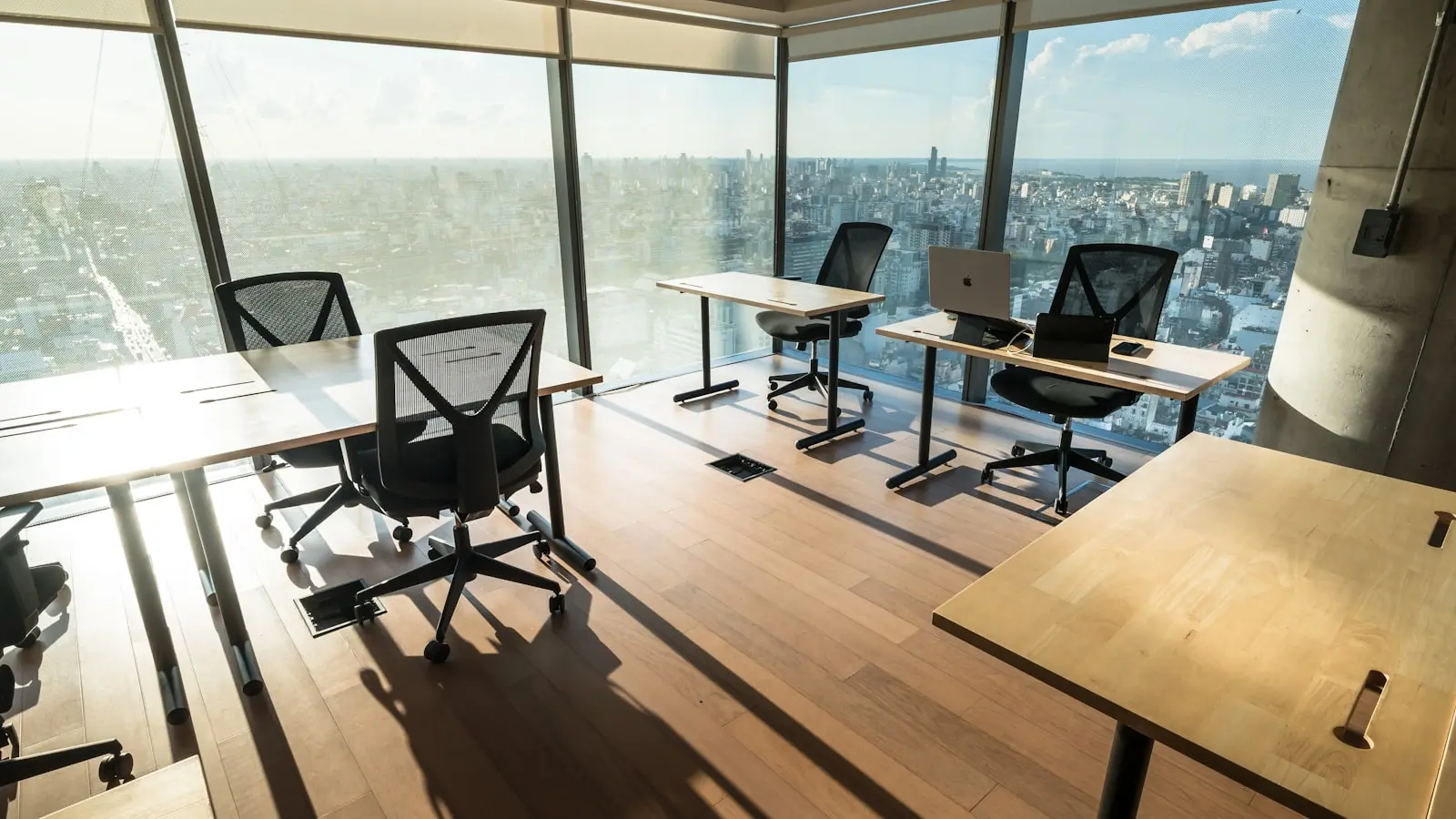
Corporate architects dismantled interior walls over the past two decades to maximize headcount per square foot. Management teams justified this spatial compression by claiming it would break down silos and accelerate innovation. The physical reality presents a stark contrast. Employees now sit shoulder-to-shoulder under fluorescent grids, actively ignoring each other to maintain baseline concentration. The promised synergy never materialized. It evaporated into ambient noise.
Data published in the Journal of Environmental Psychology tracks a massive behavioral shift when physical boundaries vanish. Rather than engaging in spontaneous brainstorming, workers defensively withdraw from their surroundings. Removing walls decreases physical, face-to-face collaboration by up to 70 percent. Employees replace physical conversation with digital isolation.
To survive the constant visual motion and overlapping conversations, knowledge workers build artificial barriers. They deploy active noise-canceling headphones and route all communication through asynchronous channels like Slack or Microsoft Teams, even when the recipient sits three feet away. (The irony of messaging a colleague at the adjacent desk remains a quiet corporate tragedy).
The Economics of Spatial Compression
Follow the capital incentives driving corporate real estate decisions. The open plan layout was rarely designed by workflow optimization experts. It was engineered by finance departments executing cost arbitrage.
When lease costs climb in prime urban centers, executives face a binary choice. They must reduce total footprint, or they must increase the density of human capital within the existing footprint. The open office executes the latter under the disguise of an egalitarian corporate culture. By stripping away cubicles and private offices, a company can compress 150 employees into floor space originally zoned for 90.
The math looks brilliant on a quarterly balance sheet. Real estate overhead drops sharply. Facilities management costs fall. Energy expenditures per headcount decrease. Yet, the ledger fails to account for the catastrophic drag on individual output. Focus operates as a finite resource. When the physical environment constantly drains cognitive reserves through visual distraction and acoustic interference, net productivity plummets. Capital saved on office leases bleeds out through degraded labor efficiency.
Defensive Withdrawal and Cognitive Overhead
Human cognition relies on focused attention to execute high-value labor. Deep work requires sustained concentration devoid of unpredictable stimuli. The open plan office guarantees unpredictable stimuli.
When engineers watch colleagues pacing the aisles or hear sales teams ringing bells on the other side of the floor, the brain inevitably processes these environmental changes. Every disruption triggers a context switch. Neurological studies consistently demonstrate that recovering from a single task interruption demands significant cognitive energy and requires up to twenty-three minutes to re-establish deep focus. In an environment stripped of acoustic dampening and visual blocks, these interruptions compound relentlessly throughout the day. The loss of output scales linearly with the density of the floor plan.
Employees exhibit classic defensive withdrawal mechanisms to cope with this structural deficit. They narrow their field of vision. They avoid eye contact in the corridors. They construct psychological fortresses because physical fortresses no longer exist. The very architecture intended to force interaction generates acute social avoidance.
Consider the operational paradox. A software developer requires long, uninterrupted blocks of logic formulation. The enterprise pays a premium for this specialized cognitive labor. The enterprise then places this highly compensated asset into an acoustic wind tunnel, surrounded by cross-departmental chatter. The investment yields diminishing returns. Management has successfully optimized the real estate while simultaneously depreciating the core asset.
The Shadow Economy of Corporate Real Estate
Corporate workers adapt to hostile environments through resourcefulness. A shadow economy of workspace utilization emerges in nearly every high-density office layout. The floor plan fails, so the workforce invents workarounds.
Workers increasingly hoard the scarce resource of silence. Analysis of digital calendar systems reveals widespread booking of phantom meetings. Employees reserve glass-walled conference rooms under the guise of strategy sessions or client calls. The room remains occupied by a single individual seeking the isolation required to execute complex tasks. They monopolize collaborative spaces to escape the collaborative floor. (Is this efficient resource allocation?)
Others migrate entirely. Cafeterias, unused stairwells, and obscure corners become temporary havens for focused labor. Employees carry laptops away from their designated, cost-optimized workstations just to secure fifty minutes of unbroken thought. The physical environment forces the workforce to subvert the official floor plan simply to deliver the labor they are contracted to provide.
The Tax of Digital Asynchrony
The retreat from physical collaboration triggers a secondary operational tax. Because employees actively block out their physical environment with headphones, verbal communication drops. To compensate, organizations adopt massive enterprise messaging platforms.
This shift moves interaction from synchronous physical space into asynchronous digital space. A simple clarification that previously required leaning over a partition now requires a multi-threaded Slack exchange. This creates an endless stream of digital notifications. The workforce trades auditory distraction for visual digital distraction. The screen flashes with unread indicators. Focus breaks again.
The reliance on instant messaging builds massive digital archives of fragmented communication. Critical directives vanish into endless chat threads. The enterprise operates slower, weighed down by the friction of managing constant text-based micro-interactions.
Quantifying the Unseen Capital Drain
The financial penalty of the open office remains difficult to quantify on a standard profit and loss statement, but it materializes across several operational friction points. Consider the metrics:
- Elevated Stress Indicators: Constant surveillance and lack of privacy trigger baseline cortisol spikes. Workers never fully relax when spatial boundaries are eliminated, leading to higher burnout rates and increased healthcare premiums.
- Task Interruption Penalties: A single visual distraction forces a cognitive reset, delaying project milestones and introducing higher error rates in complex logic tasks. Time-to-market increases.
- Hardware Remediation: Corporations attempt to patch architectural failures by purchasing premium noise-canceling hardware for the entire workforce. This offsets a fraction of the initial real estate savings.
- Turnover Friction: Highly skilled workers eventually leave environments that prevent them from executing their duties efficiently. The cost of recruiting and training replacements eclipses the rent savings of an open desk.
The Failure of Corporate Vocabulary
Executive leadership frequently relies on specialized vocabulary designed to mask structural cost-cutting. Terms like “agile workspaces,” “hot-desking,” and “collision spaces” represent public relations terminology layered over raw density optimization.
An “agile workspace” generally means an employee lacks a permanent desk, forcing them to waste time daily establishing a temporary operational base. “Collision spaces” imply that forcing workers to cross paths near coffee machines generates profitable ideas. In reality, these forced collisions generate brief social friction before employees return to their active attempts at isolation.
The architectural paradigm fails because it fundamentally misunderstands human behavioral economics. Humans do not brainstorm constantly. They require long periods of isolation to process information, execute tasks, and generate value. The layout attempts to force a permanent state of collaboration. The biology rejects it.
Markets eventually punish capital misallocation. Forcing knowledge workers into environments that actively degrade their ability to produce knowledge is a fundamentally flawed strategy. The savings captured in commercial real estate leases pale in comparison to the value destroyed through systemic cognitive disruption.
Companies must evaluate workspace not by the cost per square foot, but by the yield per employee. When walls are dismantled, productivity flows out the open door. The modern enterprise must recognize that isolation is not the enemy of innovation. It is often the prerequisite. Until architectural layouts align with the biological realities of human focus, the open office will remain a masterclass in false economy. The market demands output. The floor plan demands distraction.