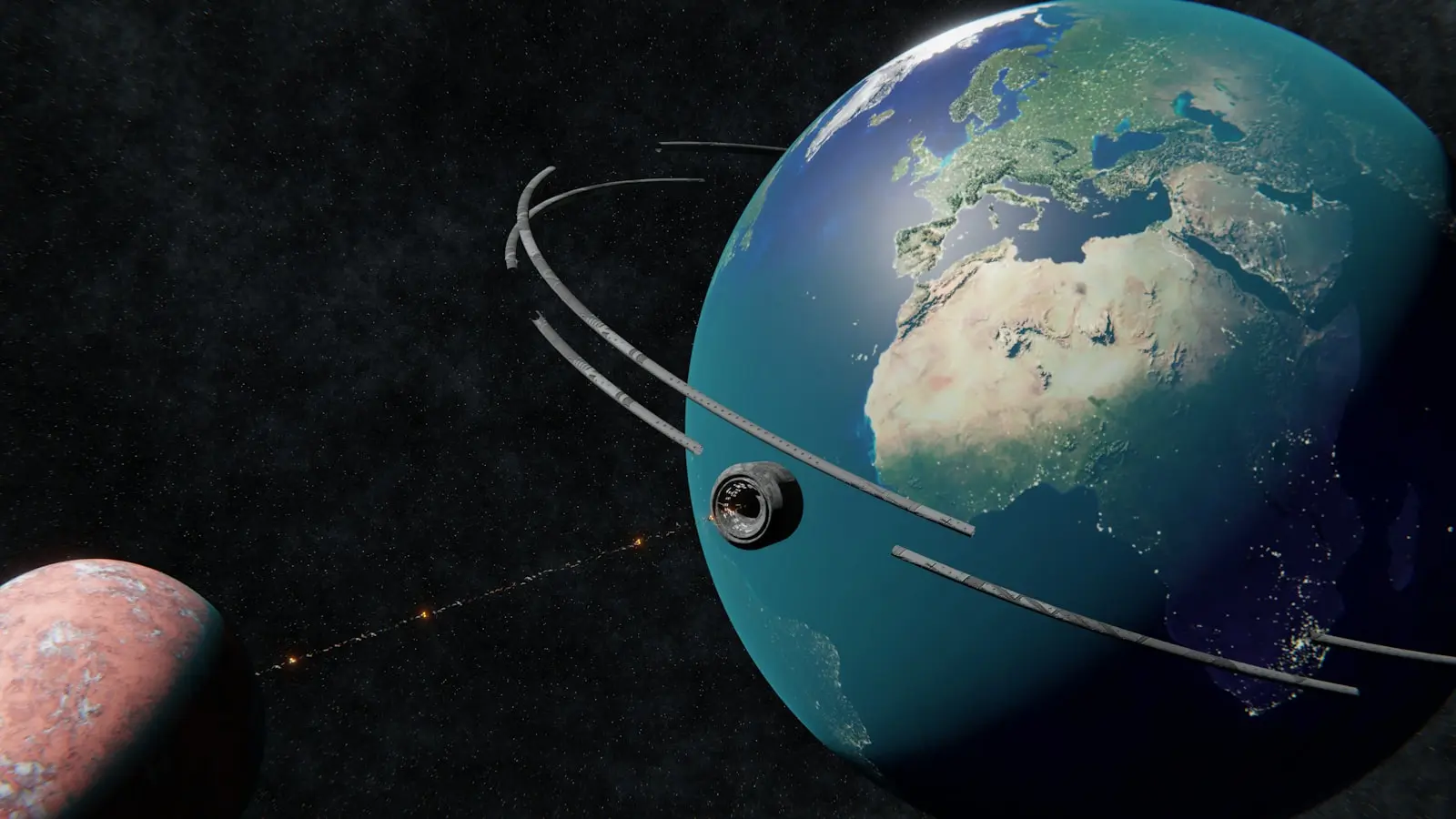

Low Earth Orbit (LEO) is no longer the pristine vacuum explorers once envisioned. It has transformed into a high-speed shooting gallery. With over 30,000 trackable fragments moving at speeds exceeding 17,000 mph, the orbital environment is reaching a saturation point that threatens the very infrastructure underpinning modern global connectivity. (The silence of space is deceptive.)
Data provided by the European Space Agency in 2024 clarifies the scale of the crisis. These objects, ranging from defunct rocket bodies to flecks of paint, possess enough kinetic energy to vaporize operational assets upon impact. Each collision does not merely destroy a satellite; it generates a cloud of shrapnel that cascades into further potential impacts. This is the mechanism behind the Kessler Syndrome—a theoretical tipping point where the density of debris becomes self-sustaining, effectively locking humanity out of the orbits necessary for telecommunications, navigation, and climate monitoring.
The Cost of the Mega-Constellation Era
The orbital landscape shifted dramatically over the past decade. Driven by the deployment of mega-constellations like Starlink, the total number of active satellites has tripled. This rapid industrialization of space (a race for market dominance) has outpaced international efforts to regulate traffic. Where once individual missions were carefully tracked, we now face a chaotic stream of automated maneuvers. Engineers, once tasked only with orbital injection, are now essentially operating air traffic control systems for orbital shells, juggling the constant threat of close encounters.
Understanding the Kessler Syndrome
To understand the threat, one must view the orbital plane as a finite resource. When two objects collide at hypersonic speeds, they create a debris field. If the rate of creation outpaces the rate of natural orbital decay, the environment suffers from a feedback loop. This is not a distant sci-fi threat. It is a mathematical certainty if debris production is not curtailed. Currently, the orbital density in LEO is approaching a threshold where passive avoidance is becoming statistically insufficient.
Current Technological Interventions
Industry analysts and space safety agencies are currently investigating three primary methods to mitigate the crisis:
- Active Debris Removal (ADR): Utilizing robotic harpoons, nets, or magnetic grapples to de-orbit dead satellites.
- Design for Demise: Mandating that new satellites be constructed from materials that fully vaporize during atmospheric re-entry.
- Mandatory De-orbiting: Integrating secondary propulsion systems into all new satellite designs to ensure they can steer themselves into the atmosphere at the end of their mission life.
The Regulatory Vacuum
Despite the technical solutions available, policy remains the primary bottleneck. Compliance with debris mitigation guidelines is largely voluntary for private space corporations. While some entities have adopted responsible disposal protocols (thankfully), others prioritize cost-cutting measures that omit robust end-of-life disposal systems. International law, largely written during the Cold War, lacks the enforcement teeth to hold private actors accountable for the long-term integrity of the orbital commons. (Is an international treaty even possible in the current geopolitical climate?)
Future Outlook
If the industry continues its current trajectory without a standardized, mandatory debris removal framework, the loss of LEO access is a likely outcome within the century. The economic impact would be catastrophic, resulting in the loss of global GPS synchronization, high-speed internet, and real-time atmospheric modeling. Scientific progress hinges on the stability of our orbital platform. We are currently testing the limits of that stability. The question remains whether innovation in debris removal will arrive before the first domino falls in a catastrophic, self-sustaining collision cascade.