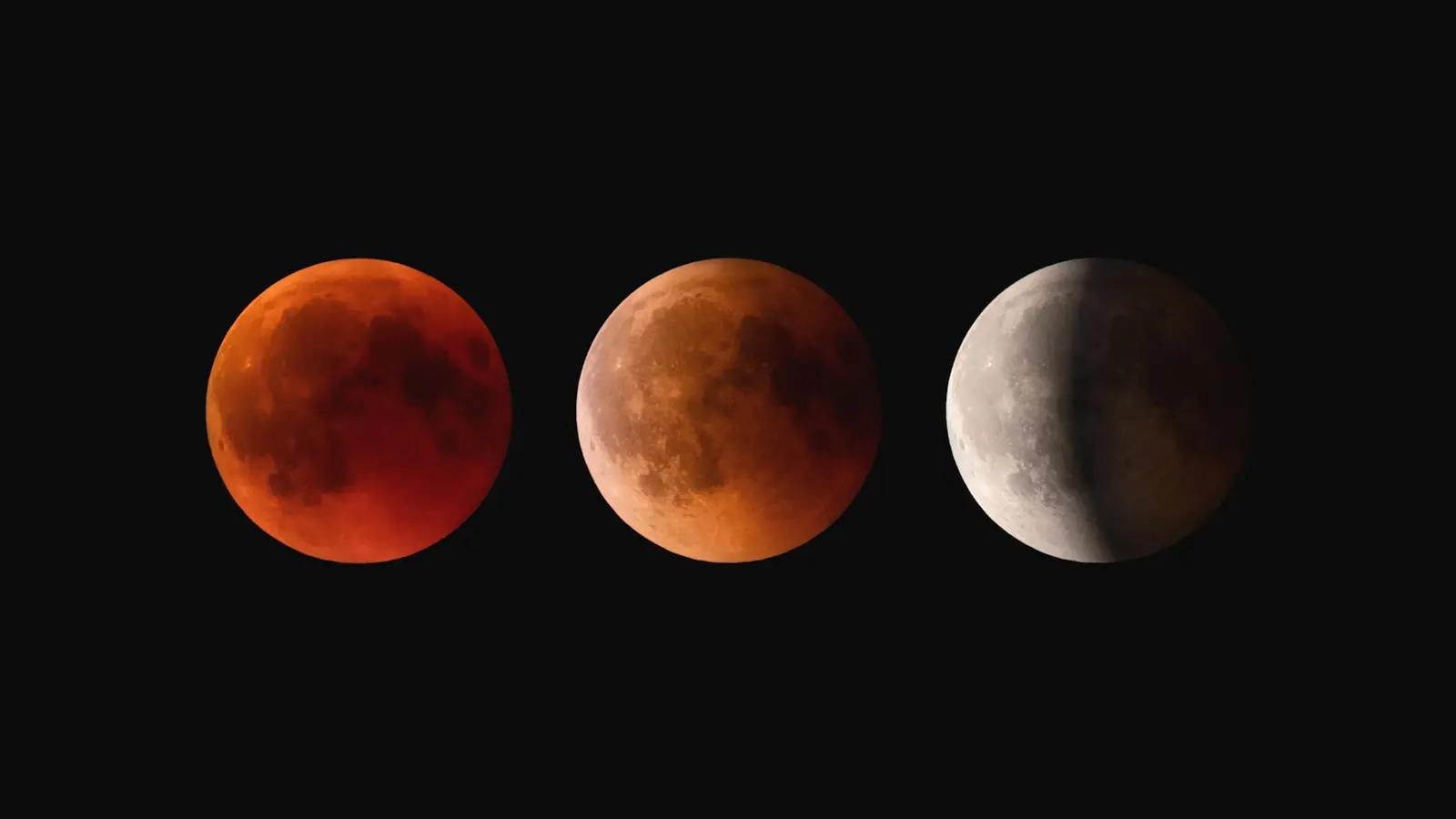

Earth intercepts solar radiation this Tuesday. The resulting shadow will cross space and swallow the moon. Viewers stationed across North America, Central America, and western South America catch the event just before dawn. Observers located in Australia and eastern Asia track the progression Tuesday night. The orbital mechanics leave Africa and Europe facing the opposite direction. (Geography rarely negotiates.) The timeline stretches over several hours. The totality phase dominates the sky for roughly sixty minutes. After Tuesday passes, the orbital calendar enters a prolonged dry spell. The next total lunar eclipse refuses to materialize until late 2028. That impending drought elevates the significance of the current observation window.
The Mechanics of Syzygy
Celestial bodies operate on ruthless mathematical schedules. Solar and lunar eclipses require syzygy. The sun, Earth, and moon must lock into a precise linear formation. The moon traverses an orbit that tilts roughly five degrees relative to Earth’s orbital plane around the sun. That slight incline ensures the moon usually passes above or below Earth’s shadow during its monthly cycle. The orbital paths intersect at two distinct locations called nodes. When a full moon strikes a node precisely, the shadow connects. Eclipses hunt in pairs. Two weeks ago, the moon passed between Earth and the sun, throwing a localized shadow over Antarctica. Penguins and isolated research teams witnessed a ring of fire. Now, the orbital pendulum swings back. Earth blocks the sun. The moon receives the shadow. Physics demands equilibrium.
The Scale of the Shadow
Physical dimensions govern the timeline. The moon travels roughly three times the speed of sound along its orbital track. Earth’s umbral shadow stretches nearly 900,000 miles into the void—more than triple the distance between the planet and its satellite. At the specific distance of the lunar orbit, that shadow measures roughly 5,700 miles across. The moon measures roughly the width of the continental United States. Geometry dictates the duration of the event. The entire lunar sphere fits easily within the umbral core. It requires significant time for a mass to cross a shadow nearly three times its own width. Astronomers tracking the event acknowledge the slower progression. A total solar eclipse races across the landscape, offering observers perhaps three or four minutes of totality before the light returns. The lunar version crawls. The deepest phase stretches for a full hour. (Patience yields the best data.)
The Physics of the Red Shift
Public discourse widely refers to the event as a blood moon. The term drives engagement, but the actual mechanism relies entirely on atmospheric chemistry. Earth blocks all direct sunlight from reaching the lunar surface. The shadow splits into distinct zones. The penumbra offers a faint outer shading. The umbra delivers the deep, dark core. When the moon plunges into the umbra, intuition suggests it should vanish entirely into the blackness of space. It does not. Light finds an alternate path. Solar radiation strikes Earth’s atmosphere. Nitrogen and oxygen molecules scatter the shorter, bluer wavelengths of light out into space. The longer, redder wavelengths push through the atmospheric density. This process defines Rayleigh scattering. The atmosphere acts as a lens, bending that filtered red light inward and projecting it onto the darkened lunar surface. The sky strips the blue and leaves the red.
Earths Atmospheric Mirror
The exact hue of the eclipsed moon provides a live diagnostic scan of terrestrial conditions. Every sunset and sunrise happening simultaneously around the globe projects onto the lunar surface at that exact moment. Researchers utilize the Danjon Scale to quantify the visual phenomenon. French astronomer André-Louis Danjon created the five-point system to categorize lunar eclipse luminosity. A zero on the scale represents a virtually invisible moon at mid-totality. A four indicates a bright copper-red or orange orb featuring a bluish outer rim. A dust-filled atmosphere resulting from recent volcanic eruptions or widespread wildfires yields a darker, brick-red measurement. A clear global atmosphere produces a bright orange glow. When Mount Pinatubo erupted in 1991, the subsequent lunar eclipses registered extremely dark. Volcanic ash effectively blocked the red wavelengths. Tuesday’s eclipse will serve as a proxy atmospheric reading. Observers looking up effectively see the ground.
The Democratic Observation
Solar eclipses demand specialized protective glasses and frequently trigger frantic travel arrangements to narrow corridors of totality. Lunar eclipses operate on a strictly democratic model. Anyone positioned on the night side of the planet with a clear view of the sky holds a ticket. No special equipment alters the baseline experience. Telescopes provide sharper crater definition, but the naked eye captures the primary color shift perfectly. Astronomical models emphasize that constant vigilance remains unnecessary. Viewers venture outside, check the shadow’s progress, retreat indoors to escape the weather, and return an hour later to observe the next phase. The shadows move regardless of who watches. (A rare astronomical convenience.) The sequence allows for uninterrupted observation without the frantic urgency associated with chasing solar totality.
The Eclipse Season Window
The pairing of the recent Antarctic solar eclipse and Tuesday’s lunar event highlights the rigid mechanics of the eclipse season. The orbital nodes align with the sun twice a year. The window stays open for roughly 34 days. The moon completes a full orbit in 27.3 days. Therefore, every single eclipse season guarantees at least two eclipses. Occasionally, the geometry forces three. The alignment dictates a rapid sequence. A solar eclipse must precede or follow a lunar eclipse. Celestial mechanics allow no isolated events. Institutional tracking confirms between four and seven total eclipses occur annually across the solar system. The distribution between solar and lunar varies, but the underlying mathematical framework remains inflexible.
The Ancient Saros Cycle
The Saros cycle governs the repetition of these eclipses. Every 18 years, 11 days, and 8 hours, the relative positions of the sun, Earth, and moon return to nearly identical geometrical configurations. If an eclipse occurs today, a nearly identical eclipse will happen one Saros period later. The extra eight hours dictate that Earth rotates an additional third of a turn before the next event. The geographic viewing zone shifts westward. This endless celestial clockwork allowed ancient civilizations to predict alignments without understanding the underlying gravitational physics. They simply tracked the patterns over decades. Today, aerospace engineers utilize the exact same mathematical constants to calculate orbital trajectories for satellites. The physics that turns the moon red on Tuesday also dictates the fuel requirements for modern orbital insertion. The principles never change.
The Urban Observation Factor
Urban observers face unique environmental realities. When engineers step out of heated facilities into the pre-dawn chill of downtown Chicago, the contrast between illuminated skyscrapers and the dimming satellite above frames the event. Terrestrial light pollution obliterates faint stars and galaxies. It severely hampers meteor shower data collection. Yet, a lunar eclipse pushes through the artificial glare. The moon possesses enough inherent brightness to overcome municipal streetlights. During the totality phase, as the moon darkens and shifts into the red spectrum, the surrounding sky temporarily regains its depth. Stars that were previously washed out by the full moon suddenly materialize. The shadow effectively turns down the brightest lamp in the night sky. (A temporary reprieve for urban stargazers.) Once the moon begins exiting the umbra, the glare returns. The stars vanish. The mechanics of the solar system assert their dominance over local lighting grids.
The Impending Drought
Tuesday closes an era of frequent lunar totality. The orbital dynamics will soon shift the alignment away from the exact intersection of the nodes. Partial eclipses will continue to occur over the next few years. August brings a minor event visible across the Americas, Europe, Africa, and western Asia. Small, dark sections will vanish from the lunar disk as it grazes the edge of the umbra. But the deep red totality goes dormant. Mathematical models confirm the next full immersion waits until late 2028. Nearly five years of waiting stand between Tuesday and the next occurrence. (Predictability does not diminish the spectacle.) Mathematical models define exactly when the shadows will fall. Tuesday represents the final opportunity to observe the atmospheric projection before the geometry shifts entirely.