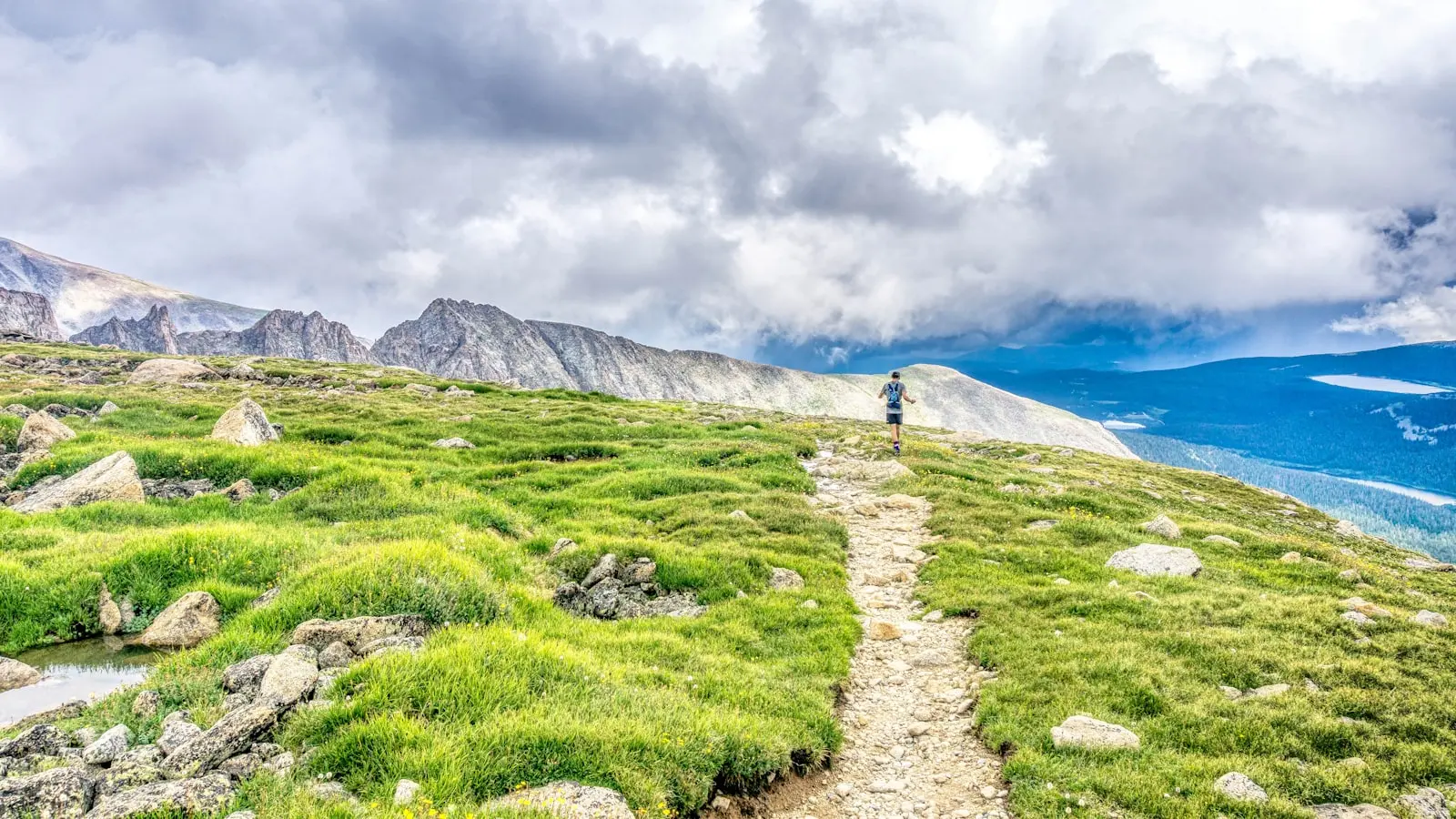
A common complaint on hiking forums, echoed in a recent Reddit post about the Seceda hike in the Dolomites, is knee pain during steep descents. The user noted that despite the beauty, their “knees scream” at the thought of steep hikes. This visceral reaction captures a widespread problem. Descending places forces on the knee joint that can reach four to six times body weight, depending on slope angle and step length. For older or less fit individuals, the cumulative strain transforms a rewarding summit into a painful ordeal. The Reddit community agreed that proper gear like poles and knee braces, plus technique such as backwards descent, can mitigate pain. But what does the evidence actually say?
The Biomechanics of Descending
The knee joint experiences its highest loads during eccentric contraction of the quadriceps — that is, the muscle lengthening while under tension as you lower your body weight down the slope. Impact forces spike with each foot strike. A 2016 study in the Journal of Biomechanics measured peak tibial acceleration during downhill walking at over 6 g, compared to roughly 2 g on level ground. The patellofemoral joint, where the kneecap glides over the femur, is especially vulnerable. Repetitive high loads can irritate the cartilage or the surrounding ligaments. (Frankly, many hikers underestimate this mechanical stress entirely.) The result: pain along the front of the knee, often described as a burning or grinding sensation.
Risk Factors: Age, Fitness, and Form
Research consistently shows that older adults and those with weaker quadriceps are at higher risk for anterior knee pain during descent. A 2018 systematic review in Sports Medicine found that reduced eccentric quad strength predicted patellofemoral pain in recreational hikers. Additionally, individuals with a history of knee injury — such as ACL reconstruction or meniscus tears — have altered gait patterns that amplify joint loads. Body weight also plays a role; a 2022 study in Gait & Posture reported that each 1 kg increase in body mass raised patellofemoral joint stress by approximately 2% during downhill walking. Steep gradients (greater than 25 degrees) accelerate the problem. (Is it any wonder that the Seceda trail, with its steep rocky sections, triggers complaints?)
Evidence-Based Prevention: Quadriceps Strengthening
The most robust intervention is progressive eccentric quadriceps strengthening. A 2020 randomized controlled trial in the Clinical Journal of Sport Medicine assigned participants to a 6-week program of step-downs, wall sits, and split squats. The intervention group showed a 40% reduction in knee pain during downhill hiking compared to controls. Step-downs are particularly effective because they mimic the lowering phase of a descent. Start with a 15 cm step, lower the opposite foot slowly to the floor, and press back up. Perform 3 sets of 10 repetitions on each leg, three times per week. (No gym membership required — just a sturdy step.)
Evidence-Based Prevention: Trekking Poles
Trekking poles reduce the load on the lower extremities by transferring some weight to the upper body. A 2015 meta-analysis in the European Journal of Applied Physiology concluded that poles decrease ground reaction forces at the knee by 20–30% during downhill walking. To maximize benefit, plant the poles slightly ahead of your body and use a light push as you step down. Adjust pole height so your elbow forms a 90-degree angle when the tip is on the ground below you. (Thankfully, poles are inexpensive relative to the cost of knee surgery.) The Reddit anecdote about backwards descent also has merit: walking backwards down steep sections shifts the demand from the quadriceps to the glutes and hamstrings, altering the angle of knee flexion. However, caution is warranted on uneven terrain due to tripping risk.
Evidence-Based Prevention: Knee Braces and Taping
Evidence for knee braces is mixed. A 2017 review in the American Journal of Sports Medicine found that patellar stabilising braces reduce pain in patients with patellofemoral pain syndrome but do not alter joint loads in healthy individuals. For the general hiker, a simple neoprene sleeve may provide proprioceptive feedback (improved awareness of knee position) but does not offer mechanical unloading. Kinesiology taping has similarly limited evidence; a 2019 meta-analysis in the British Journal of Sports Medicine found no clinically meaningful benefit for knee pain during exercise. (Frankly, recording setups like this belong in the past.) The best approach remains muscle conditioning and load management.
Practical On-Trail Strategies
In addition to preparation, technique adjustments while hiking can reduce pain. Shorten your stride — smaller steps lower the peak force per step. Keep your knees slightly bent at all times to engage the quadriceps as shock absorbers. Lower your center of gravity by bending at the hips. Use frequent rest breaks, especially on long descents. A 2021 field study in the Journal of Outdoor Recreation and Tourism showed that hikers who took two-minute standing rest breaks every 15 minutes reported 50% less knee pain than those who descended continuously. (The psychology of pacing matters just as much as the physiology.)
Pre-Hike Conditioning Timeline
Start a quad-strengthening program at least four weeks before a steep hike. Focus on eccentric exercises (slow lowering phases) three times per week. Pair with glute activation exercises such as bridges and clamshells to balance hip stability. A 2004 study in the Journal of Orthopaedic & Sports Physical Therapy found that hip weakness correlated with patellofemoral pain in female runners; similar principles apply to hikers. If you already have knee pain, consult a physical therapist for a tailored program. (No cookie-cutter routine works for everyone.)
The Role of Nutrition and Recovery
While not a direct mechanic, adequate protein intake supports muscle repair after eccentric exercise. A 2013 paper in the Journal of the International Society of Sports Nutrition suggested that 20–30 grams of protein post-activity enhances muscle recovery. Anti-inflammatory foods, such as those rich in omega-3 fatty acids, may reduce joint discomfort but do not replace strength training. Recovery includes sufficient sleep and active recovery such as walking on flat ground the day after a steep descent.
When Pain Becomes Pathology
Acute knee pain during descent should not be ignored. If pain persists for more than two weeks after hiking, or is accompanied by swelling, clicking, or locking, seek medical evaluation. Conditions such as patellofemoral osteoarthritis, meniscal tears, or patellar tendinopathy require specific diagnoses. Imaging (X-ray or MRI) may be warranted. The evidence supports early intervention; a 2018 cohort study in the Arthritis Care & Research journal found that untreated patellofemoral pain often progresses to osteoarthritis within 10 years.
Summary of Evidence-Based Recommendations
- Strengthen quadriceps eccentrically with step-downs and wall sits beginning 4 weeks before a hike.
- Use trekking poles properly to offload 20–30% of knee stress.
- Shorten strides and keep knees flexed during descents.
- Consider backwards descent on very steep, non-technical sections with caution.
- Take short rest breaks every 15 minutes on long descents.
- Address persistent pain with a medical professional.
The Reddit post about Seceda is not an anomaly. Knee pain during steep descents is a predictable consequence of biomechanical overload. But it is equally predictable that with targeted strengthening, appropriate gear, and deliberate technique, the risk can be substantially reduced. The body adapts to imposed demand — but only if that demand is progressive and prepared for. No miracle cure exists. The evidence points to a simple, unglamorous truth: prepare the muscles, manage the load, and respect the descent.