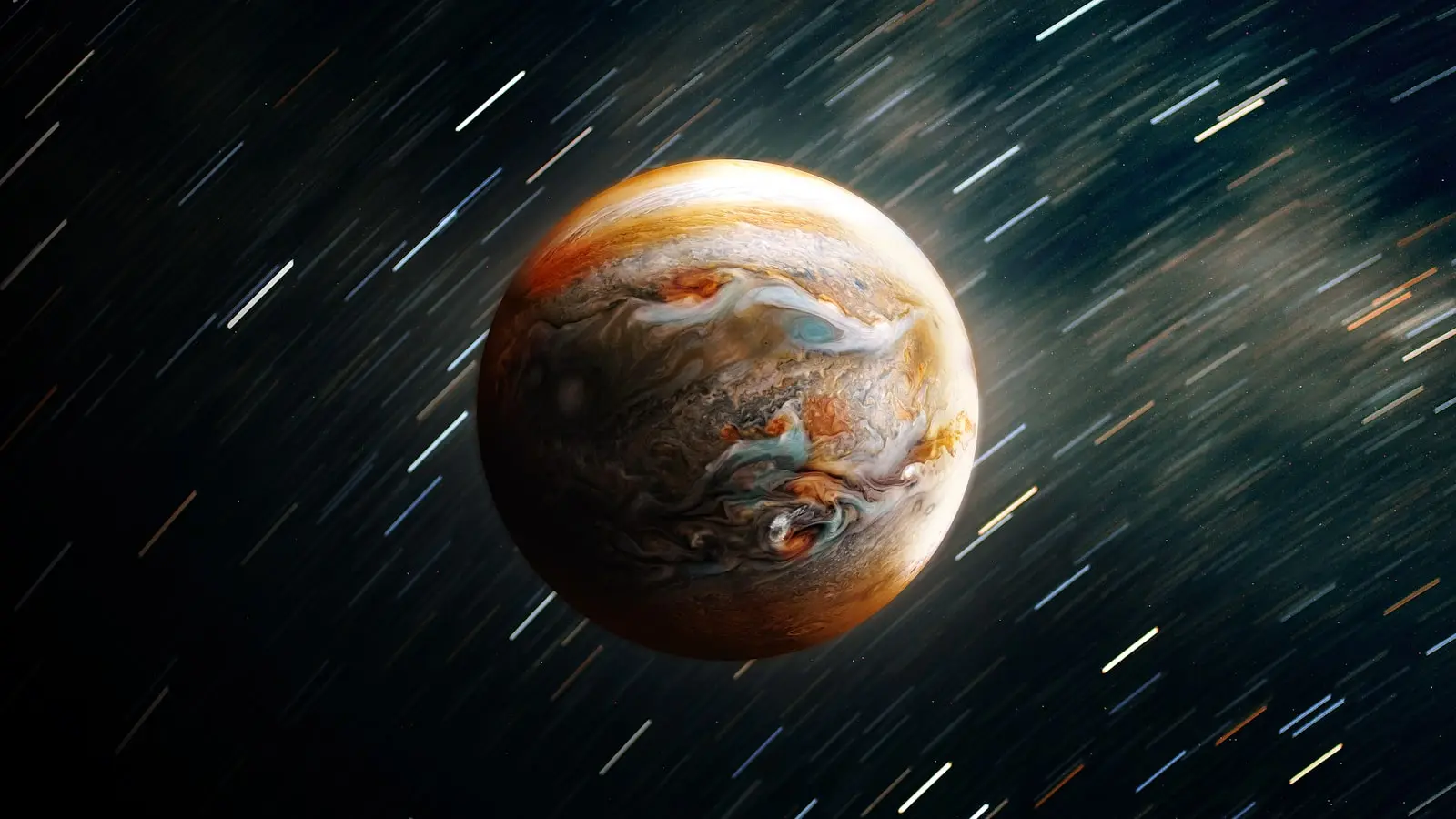

The narrative of extraterrestrial life often hinges on a lucky strike. A sterile world forms, cools, and then waits for a comet to crash into its surface, delivering the volatile organics required to spark biology. New data from the Southwest Research Institute (SwRI) suggests this delivery model is outdated. The massive Galilean moons of Jupiter—Europa, Ganymede, Callisto, and Io—did not wait for a chemical injection. They likely accreted the building blocks of life at the very moment of their birth.
Researchers from SwRI, collaborating with Aix-Marseille University, have demonstrated that complex organic molecules (COMs) formed efficiently in the protoplanetary disk surrounding our young Sun. These molecules were not merely floating in the void; they were systematically transported and integrated into the growing Jovian system. The findings shift the probability equations for habitability. If the ingredients for life are standard equipment rather than aftermarket add-ons, the subsurface oceans of the outer solar system may be far more chemically active than previously estimated.
The Logistical Chain of Cosmic Chemistry
The research centers on a specific class of matter: complex organic molecules. These carbon-rich compounds, containing oxygen and nitrogen, act as the precursors to amino acids and nucleotides. In the chaos of the early solar system, creating them required a precise assembly line. Icy grains containing methanol, carbon dioxide, and ammonia had to undergo specific environmental stresses to transform into COMs.
The study utilized advanced hydrodynamic simulations to reconstruct this assembly line. (Chemistry is often just physics acting on a smaller scale). The model tracked the movement of dust grains through the protosolar nebula—the gas cloud that birthed the Sun—and into the circumplanetary disk swirling around a forming Jupiter.
As these icy grains migrated, they faced a barrage of ultraviolet radiation and thermal fluctuations. It was a precarious journey. Too much heat destroys the molecules; too little prevents the reaction. The simulation revealed a surprisingly resilient transport network. Nearly half of the simulated grains successfully delivered newly formed COMs from the larger solar nebula into the Jovian disk without suffering major chemical degradation. The moons did not form as sterile balls of ice. They coalesced from material already saturated with prebiotic potential.
Manufacturing in the Dark
The transport mechanism is only half the story. The study indicates that the Jovian system was capable of its own local production. The circumplanetary disk surrounding the gas giant possessed regions with sufficient thermal energy to trigger organic synthesis independently of the Sun.
Dr. Olivier Mousis of SwRI’s solar system science and exploration division led the modeling effort. By coupling disk evolution with particle transport modules, the team quantified the exact radiation doses experienced by the grains.
“We directly compared our simulations with other laboratory experiments that produce COMs under realistic astrophysical conditions,” Mousis states. “The results showed that COM formation is possible in both the protosolar nebula environment and Jupiter’s circumplanetary disk.”
This duality matters. It means the Galilean moons inherited organic wealth from two distinct sources: the primordial solar cloud and the local Jovian factory. (Redundancy is a comforting feature in engineering, and apparently in planetary formation too).
Implications for the Hidden Oceans
This data fundamentally alters how we view the subsurface oceans of Europa, Ganymede, and Callisto. These worlds hide vast bodies of liquid water beneath thick crusts of ice. Water alone, however, does not equal life. Without a supply of carbon, nitrogen, and complex structures, a water world is just a wet rock.
If these moons accreted COMs during their formation, the organic inventory is likely distributed throughout their interiors. As the moons differentiated and their cores warmed, these organics would have interacted with liquid water from the start.
“Our findings suggest that Jupiter’s moons did not form as chemically pristine worlds,” Mousis notes. “Instead, they may have accreted, or accumulated, a significant inventory of COMs at birth.”
This changes the mission parameters for upcoming exploration. NASA’s Europa Clipper and the European Space Agency’s Juice mission are currently in transit to the Jovian system. They are hunting for habitability. The confirmation that COMs were baked into the crust means these probes are not looking for a needle in a haystack. They are analyzing a system that was primed for complexity billions of years ago.
The separation between geology and biology blurs when you view planetary formation this way. The physics that built the moon also cooked the chemistry. The Galilean satellites are not just containers for water. They are chemical reactors that have been running for 4.5 billion years.