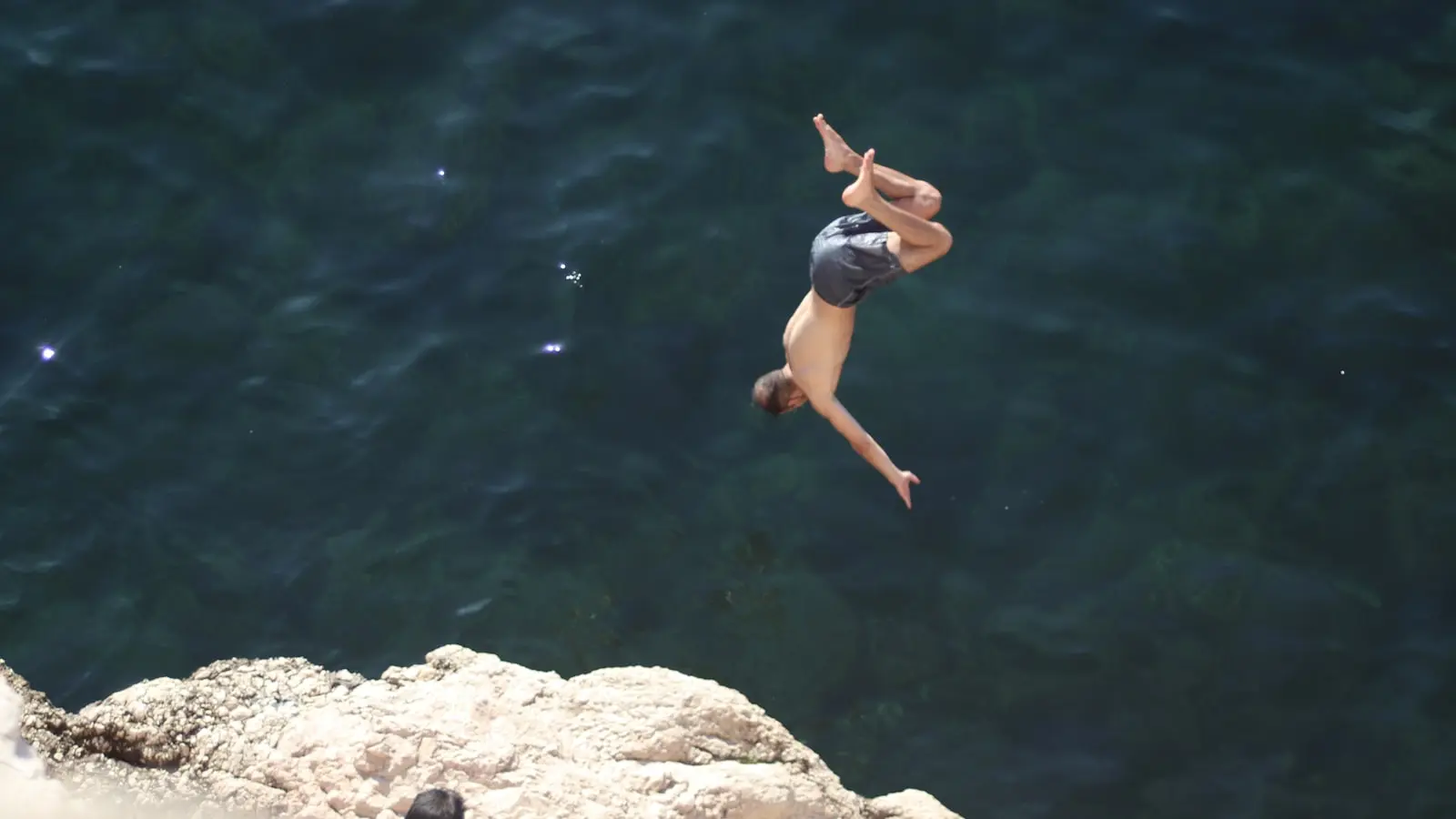

The physics of professional cliff diving is an exercise in managed catastrophe. When a diver leaves a platform 27 meters above the surface, they are not merely performing a sport; they are initiating a freefall that culminates in an entry speed of approximately 50 mph. At this velocity, water does not act as a soft landing zone. It acts as a solid, unforgiving barrier. (The margin for error is effectively zero.)
Data from the Red Bull Cliff Diving World Series highlights that impact forces reach levels of 3-G upon the diver hitting the surface. To survive this, athletes like Molly Carlson do not rely on brute strength alone. They rely on a hyper-disciplined commitment to the “pencil” entry. The objective is to minimize the surface area at the precise moment of contact, forcing the water to displace rapidly rather than transferring kinetic energy directly into the skeletal frame. The core and quadriceps function as the primary shock absorbers. If these muscle groups fail to lock in the micro-second before contact, the consequences are immediate: muscle tearing, joint dislocation, or, in extreme cases, internal trauma.
The Biomechanics of Survival
Training for this intensity requires a specific, data-backed approach to conditioning. Divers are not lifting for hypertrophy; they are training for reactivity and structural integrity. Plyometric routines form the backbone of their preparation, focusing on explosive contraction and rapid stabilization. The goal is to train the nervous system to brace the body instantly. This conditioning allows the athlete to maintain a rigid posture throughout the descent, ensuring the center of mass remains perfectly aligned with the entry vector. (If the torso deviates by even a few degrees, the water becomes a sledgehammer.)
Professional regimens typically involve 15 to 20 jumps per week during the peak season. This volume is not solely for practice of rotation mechanics or acrobatic flair. It is a calibration cycle for spatial awareness. The brain must learn to process the horizon, the cliff face, and the approaching water as a single, shifting data set. Over time, this repetition creates a cognitive baseline that allows the diver to make minute, instinctual adjustments to their rotation mechanics in mid-air.
Beyond Physicality
Sports biomechanists like Sarah Jenkins emphasize that physical strength is only half of the equation. The mental conditioning required to override the human survival instinct—which naturally screams to spread limbs during a fall—is the true differentiator. Maintaining a straight, compressed form while plummeting at terminal velocity requires a psychological detachment that most professional athletes never encounter in their careers.
Consider the physiological demand of the exit. After absorbing the shock, the diver must immediately transition from a brace to a swim, navigating the turbulent water to reach the surface. This is a complex chain of movements:
- Pre-Impact: Full core activation and alignment of the extremities into a vertical pencil position.
- The 3-G Event: Passive shock absorption through the legs and torso, converting vertical momentum into displacement.
- Post-Impact: Immediate transition to swimming mechanics to stabilize and signal for recovery.
Frankly, the standard of training exemplified by athletes like Carlson is less about sport and more about precision engineering of the human form. Aspiring divers looking to enter the professional circuit often underestimate the volume of repetitive, high-stress impact training required to build this level of resilience. It is a grueling, non-linear progression. (There are no shortcuts here.)
Ultimately, the scoreboard at a cliff diving event reflects the execution of a maneuver, but the real victory occurs in the weeks of dry-land plyometrics and the thousands of hours spent refining the entry. In a sport where the environment is the opponent, the athlete’s body must be prepared to act as both the projectile and the armor.