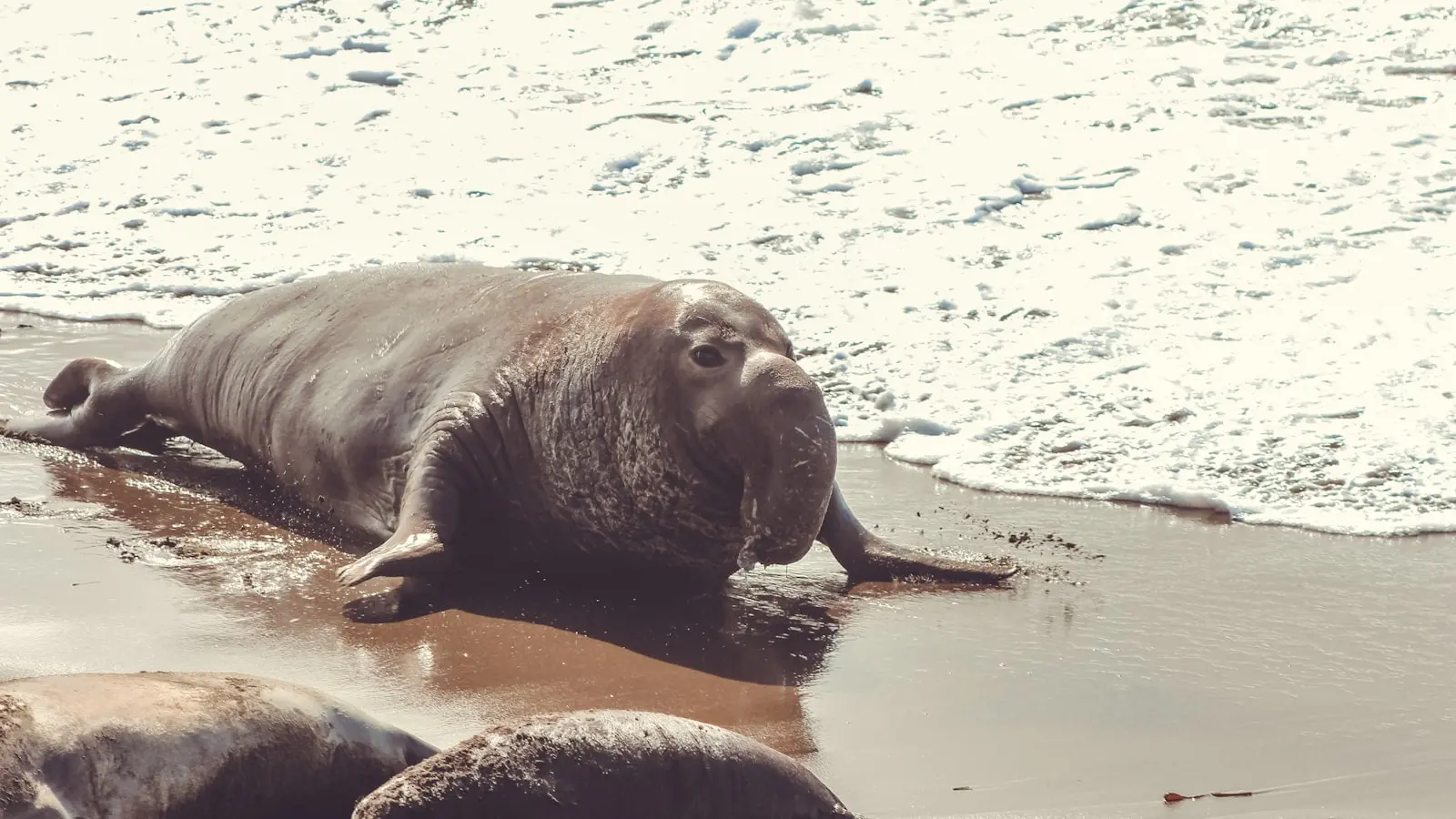

The pathogen has officially crossed a new biological border. At Año Nuevo State Park, a research stronghold for marine biology, scientists have confirmed the presence of the H5N1 virus in northern elephant seals for the first time. Seven pups have tested positive, and thirty animals—mostly weaned pups—have died since late last week. This is not a random fluctuation in wildlife mortality.
While the park usually hosts a chaotic, vibrant breeding ground for 5,000 seals, operations have shifted from tourism to containment. Public viewing areas are closed. Biologists are tracking neurological symptoms rather than growth charts. The virus is no longer theoretical in this population; it is clinical reality.
The Clinical Picture
The physiological impact of Highly Pathogenic Avian Influenza (HPAI) on mammals is distinct and aggressive. Postmortem examinations conducted by veterinary pathologists at the University of California, Santa Cruz, revealed significant tissue damage in the brain and lungs of infected pups. Unlike typical respiratory presentations in waterfowl, the virus in mammals frequently crosses the blood-brain barrier.
Researchers on the ground report specific neurological deficits: tremors, seizures, and erratic behavior. (This aligns with the neurotropism seen in feline H5N1 cases). The virus infiltrates neurons, leading to rapid systemic failure. Dr. Roxanne Beltran, leading the monitoring project, noted that while the majority of the colony remains asymptomatic, roughly five new sick or dead pups are appearing daily. The infection is clustered at the southern tip of the beach.
Data from the Southern Hemisphere
To understand the prognosis for the California colony, analysts look to the Southern Ocean. The northern seals are genetically distinct but biologically similar to the southern elephant seals, which suffered catastrophic losses recently. In late 2023, H5N1 infiltrated colonies on Argentina’s Valdés Peninsula.
The resulting mortality data was staggering. An estimated 17,400 pups died in Argentina alone. On the sub-Antarctic island of South Georgia, roughly 50,000 adult females succumbed to the virus. The critical concern in these outbreaks was the mode of transmission. Evidence suggested the virus mutated to allow seal-to-seal transmission, rather than relying solely on bird-to-seal contact. If the California strain acquires similar mammalian adaptations, the containment measures currently in place may prove insufficient.
Preparedness and Pharmaceutical Gaps
The crossover of H5N1 into mammals—including dairy cattle, foxes, and now northern seals—raises questions about human biosecurity. While the current risk to the general public remains low, the biological gap between a seal and a human is narrower than the gap between a bird and a human. Since 2024, the CDC has received reports of 70 human infections, including one fatality in an older adult.
Despite this shifting viral landscape, federal preparedness strategies have recently contracted. Reports indicate that the administration canceled a contract with Moderna to develop an mRNA vaccine for bird flu. (This decision prioritizes budget over speed). mRNA technology, validated during the Covid-19 pandemic, is widely regarded by immunologists as the fastest platform for targeting rapidly mutating pathogens. Instead, the national stockpile relies on millions of doses of vaccines based on older technologies. The efficacy of these older formulations against a potentially mutated H5N1 strain remains clinically uncertain.
Furthermore, the antiviral strategy relies heavily on oseltamivir (Tamiflu). However, emerging clinical data suggests that baloxavir may offer superior viral suppression against influenza strains. We are fighting a modern virus with a legacy toolkit.
Surveillance as a Defense Mechanism
The Año Nuevo colony is among the most heavily monitored marine populations on Earth. Researchers have tagged and tracked these animals for six decades. This long-term baseline data is crucial. It allows scientists to distinguish between normal mortality rates and the exponential uptick characteristic of an epizootic event.
Dr. Christine Johnson, a veterinary epidemiologist at U.C. Davis, emphasized that early detection was facilitated by stepped-up surveillance initiated in 2024. Because many seals carry individual trackers, researchers plan to reconstruct the transmission web. They aim to determine if the virus is jumping from bird to seal or if it has achieved the feared seal-to-seal transmission capability. (The data will tell the story).
For now, the outbreak is in its early stages. Most adult females had already weaned their pups and departed for the sea before the virus took hold, leaving a population of about 1,350 vulnerable seals on the beach. The coming weeks will determine if this is a contained spillover or a population-level crash.