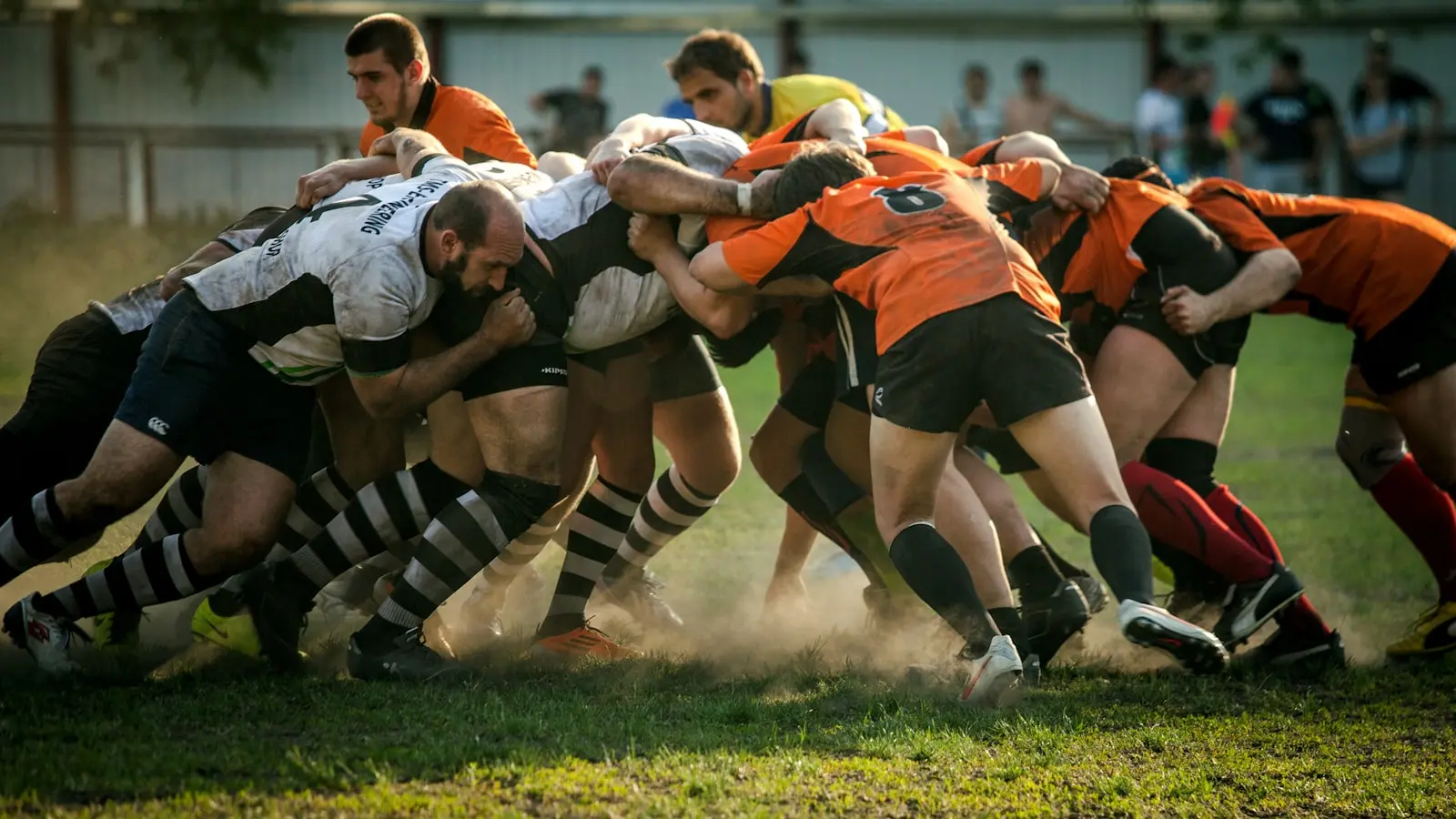
A team can defend rugby offloads without trying to prevent every pass at contact. The real objective is to complete tackles safely, keep defenders connected around the next receiver, and rebuild the line before an offload becomes a line break.
Fast line speed can reduce an attacker’s decision time, but only if the defensive line advances together. A lone defender rushing ahead, an incomplete tackle, or too many players committing to one collision can create the space an offloading attack is designed to exploit.
Key Takeaways
- Offloads hurt defenses when contact draws extra defenders and leaves the next receiver unmarked.
- The first tackler must make safe, controlled contact; the second defender must decide whether to assist or cover the pass.
- Line speed works when it is connected. A single defender shooting up usually creates a gap.
- Guards and folding defenders restore numbers around the ruck and protect the next phase.
- Amateur teams benefit most from simple calls, legal technique, disciplined spacing, and quick realignment.
Why fast offloads make organized defenses look disconnected
An offload is a pass made in, or immediately before, contact that keeps the ball moving without requiring a conventional ruck. It allows the attack to use the attention drawn by the ball-carrier to release a teammate into newly available space.
The attacking pattern is often straightforward. The carrier runs square enough to hold a defender, attracts a second defender or keeps the first occupied, stays alive through contact, then passes to a nearby support runner. The receiver is dangerous because the defense is often still reacting to the original collision.
That is why a defensive line can appear to collapse even when the first tackle looks as though it has been made. If the carrier stays upright, turns in contact, or can free an arm, defenders near the tackle may all focus on the ball. The offload then reaches a player facing a line with unclear inside and outside connections.
The aim of rugby offload defense is not to eliminate every possible offload at any cost. Overcommitting players to contact can create a larger problem one pass later. A well-organized defense makes the pass difficult while ensuring the receiver is met by a defender rather than open space.
The contact battle and the roles around it
The first tackler closes space under control and completes a legal, safe tackle. Speed into contact matters only when the defender can stay balanced, make effective contact, and avoid being beaten by a late step or pass. A missed or incomplete tackle gives the carrier time to turn toward support.
The assist tackler, often the second defender in this situation, has a different decision. If the first defender needs help to control the carrier, the assist tackler should arrive connected and help finish the tackle. If contact is already under control, that player may be more valuable protecting the likely passing lane or support runner.
This is the central trade-off when teams defend rugby offloads. Two defenders can reduce the carrier’s time and freedom in contact. A needless second or third defender, however, can empty the next channel, especially when attackers have runners on both sides of the ball.
The nearby guard should not simply chase the ball. This defender protects the space beside the contact area, particularly on the side closest to the ruck. If an offload is released behind the first collision, the guard’s ability to identify the receiver and protect the inside channel can stop a modest gain becoming a clean break.
For amateur players, the most useful cues are simple: call who has the tackle, identify the nearest support runner, and decide who covers the pass option. Confusion produces the familiar sight of several defenders converging on one carrier while nobody marks the player receiving the offload.
Tackle-height requirements and enforcement can vary by competition and may change. Players and coaches should follow current governing-body guidance and qualified coaching instruction for contact technique. No tactical advantage justifies unsafe or illegal contact.
Line speed versus connection
Line speed means defenders moving forward together to reduce the attacker’s time and space. Against an offloading side, connected line speed can be useful because it limits the carrier’s opportunity to square up defenders, draw them cleanly, and choose a passing lane without pressure.
The important word is connected. When the line rises together, the first tackler meets the carrier with nearby support already in position. The attack may still offload, but it is more likely to do so under pressure and into a channel covered by another defender.
An all-out rush becomes risky when defenders arrive at different times. A player who shoots up alone can leave an inside hole for a support line or force a teammate to cover two attackers. If that isolated defender then fails to complete the tackle, the carrier may offload while the rest of the line is stretched behind the play.
Defenses commonly use two broad spacing approaches. Inside-out control protects the space closest to the ruck first, then works outward as the ball moves. It is particularly useful when an attack threatens short carries, close support runners, and quick passes around the breakdown.
A drift defense moves laterally with the attack and tries to guide it toward the touchline while preserving outside cover. It can reduce the usable width of the field, but it requires discipline. If inside defenders drift too early or too far, an offload back inside can find a runner cutting into open space.
Direct pressure is generally more viable when the line is set, defenders are communicating, and support is close behind the first tackle. When defenders are retreating, tired, or outnumbered, preserving rugby defensive spacing may matter more than trying to win the collision with one dramatic rush.
Keeping coverage after contact
Fold defense is the process of defenders involved near a tackle or ruck moving back into the defensive line. In practical terms, they rebuild from the inside outward so the defense does not repeatedly lose numbers beside the breakdown.
This matters against an offloading attack because extended contact can delay defenders. A player who helps make a tackle and then follows the ball without a clear role may leave the next phase short of inside protection. The attack needs only one unsupported defender and a quick pass to create momentum.
Around the ruck, guards and the next defenders should communicate about immediate threats: a short carry, a close support runner, or an offload released behind the first collision. Roles must remain distinct. One player cannot reliably contest every contact and also cover the next receiver.
After an offload or partial line break, the first priority is the current ball-carrier. The next is protecting the middle of the field and directing play toward available cover. If every defender chases the same runner from behind, the attack can pass again into a wider gap.
Near the touchline, the sideline can help the defense by reducing the attack’s available width. That advantage only works if inside defenders remain connected. An attacker near the edge may offload back toward the middle, switch with a support runner, or pass inside to exploit defenders who assumed the touchline had solved the problem.
A useful reset rule after every contact is: find the ball, find the nearest receiver, then identify the next space that needs protecting. It is simple, but it prevents defenders from staying mentally attached to a tackle after the ball has already moved.
A practical offload-defense checklist
Before contact, ask whether the line is advancing together and whether the inside space beside the ruck is protected. A fast defensive line with a central gap is not truly organized.
At contact, establish whether one player is completing the tackle and whether another is either assisting or covering the likely pass. The second defender role is not automatically to join the tackle; it is to make the next attacking action less dangerous.
After contact, check whether enough defenders remain for the next receiver and whether players near the breakdown are folding back into the line. A defense that wins one collision but cannot defend the next phase has not solved the offload problem.
Several recurring failures are easy to spot:
- High or incomplete contact leaves the carrier upright and able to pass.
- A late assist tackler allows the carrier to turn and find support.
- Too many defenders at one tackle empty the next channel.
- Folding defenders trail the ball instead of restoring inside numbers.
- One fast-rushing defender breaks the shape of the line.
For community teams, the answer is rarely a complex professional system with detailed calls for every scenario. Better rugby offload defense usually begins with connected spacing, clear communication, legal contact technique, and rapid realignment. Those habits are trainable without asking players to reproduce elite defensive structures.
FAQ
How do you stop a rugby player from offloading in the tackle?
You cannot reliably stop every offload, and trying to do so at all costs can unbalance the defense. Focus on controlled, legal contact, timely support when needed, and coverage of the nearest receiver if the pass gets away.
Is line speed rugby defense the best answer to an offloading team?
Line speed helps when defenders advance together with connected support inside and outside. It is less effective when one player rushes alone, the line is retreating, or the contact area lacks nearby cover. The right level of pressure depends on field position, available numbers, and how settled the defense is.
What is the second defender role when defending an offload?
The second defender decides whether to help complete the tackle or protect the likely offload option. That decision depends on whether the first tackler has genuine control of the carrier and where the attacker’s closest support runner is positioned.