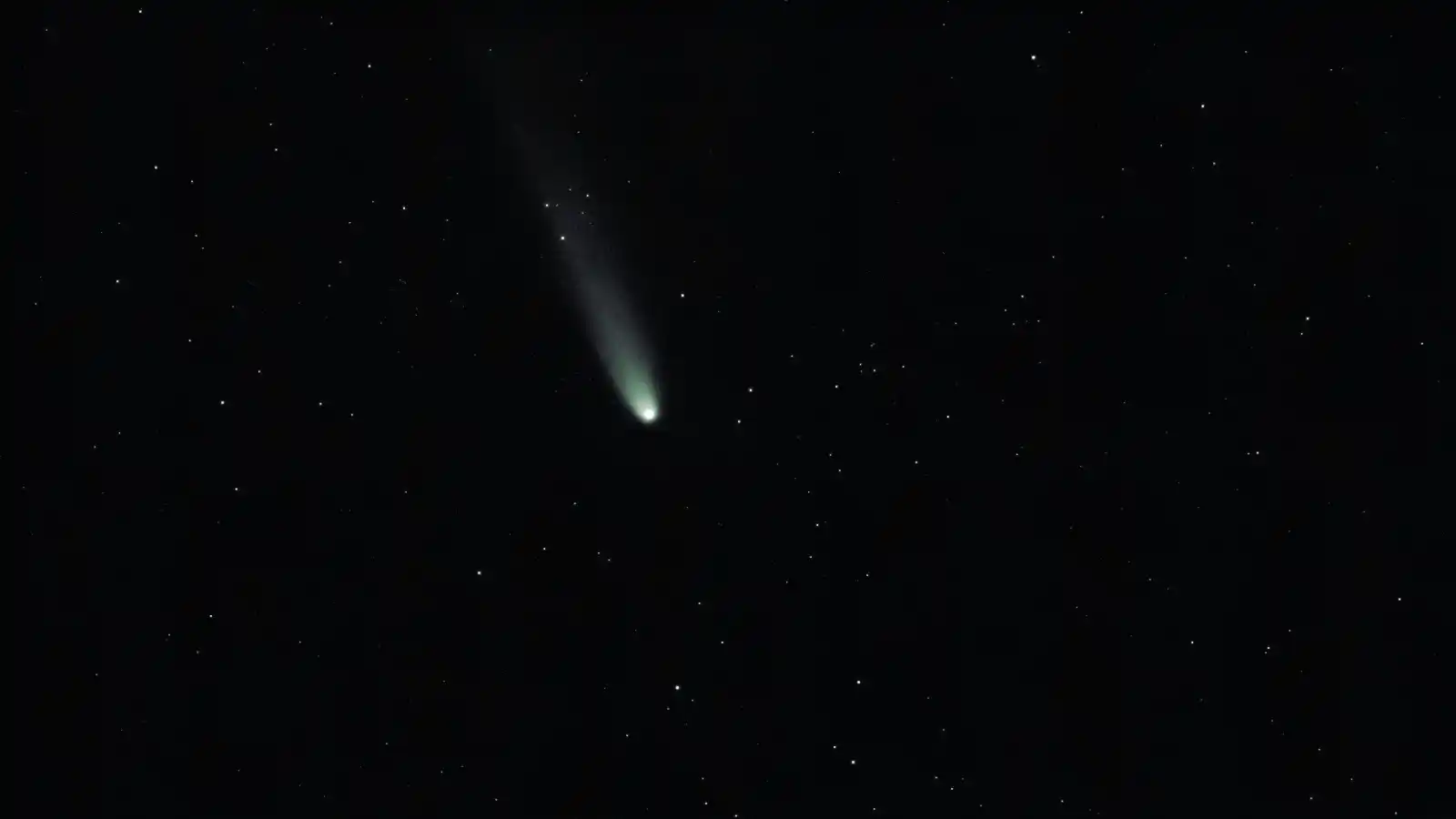

If you were standing on the surface of Comet 41P/Tuttle-Giacobini-Kresák nine years ago, you would have experienced a scene straight out of a sci-fi nightmare.
As the comet hurtled toward the sun, your “day” would have stretched longer and longer—from 20 hours to 46 hours—until the sun simply refused to set. The ground beneath you would have shuddered to a halt, motionless. And then, slowly at first, the world would have started turning again… but in the opposite direction.
This cosmic U-turn isn’t theoretical physics. It’s exactly what astronomers believe happened to Comet 41P, based on a new analysis of Hubble Space Telescope data.
The “Garden Hose” Effect
David Jewitt, an astronomer at UCLA, published findings this week detailing this unprecedented event. While we know comets aren’t static rocks—they are volatile chunks of ice and dust—we’ve never seen one hit the brakes this hard.
The culprit? Jets.
As a comet approaches the inner solar system, the sun’s heat sublimates its ice, turning it instantly from solid to gas. This gas doesn’t just drift away; it erupts from the surface in powerful jets.
“Think of it like a garden hose left running on the lawn,” explains Dennis Bodewits, an astronomer at Auburn University. If the nozzle is pointed the right way, the force of the water (or in this case, gas) generates thrust.
On Comet 41P, these jets acted like thrusters firing against the rotation.
A Violent Ballet
The timeline of this event, pieced together from NASA’s Swift telescope and Hubble images, is staggering:
- March 2017: The comet is spinning with a period of about 20 hours.
- May 2017: The spin slows dramatically to 46 hours as it nears Earth’s orbit.
- The Gap: The comet passes too close to the sun to be observed.
- December 2017: Hubble picks it up again. It is now spinning once every 14 hours—in the reverse direction.
“The only way this made sense is if, at some point between May and December, it had slowed down to zero, and then kept going in the opposite direction,” Dr. Jewitt noted.
Why Comets Die Young
This discovery solves a long-standing puzzle in planetary science. Astronomers have long noted that there are fewer small comets in the solar system than our models predict. Where do they go?
The fate of 41P offers a grim answer: Rotational self-destruction.
If these jets can stop a comet and spin it backward, they can also spin it up—faster and faster until the centrifugal force overcomes the weak gravity holding the “dirty snowball” together.
“The evidence is that comets just don’t live that long,” Jewitt says. “There’s some other process that destroys the comets, and I think it’s rotation.” essentially, they are blown to bits by their own spin.
Comet 41P survived its chaotic 2017 encounter and is scheduled to swing past the sun again in early 2028. With new heavy-hitters like the Vera C. Rubin Observatory coming online, we’ll soon have a front-row seat to see if it survives the next round of this violent celestial dance.