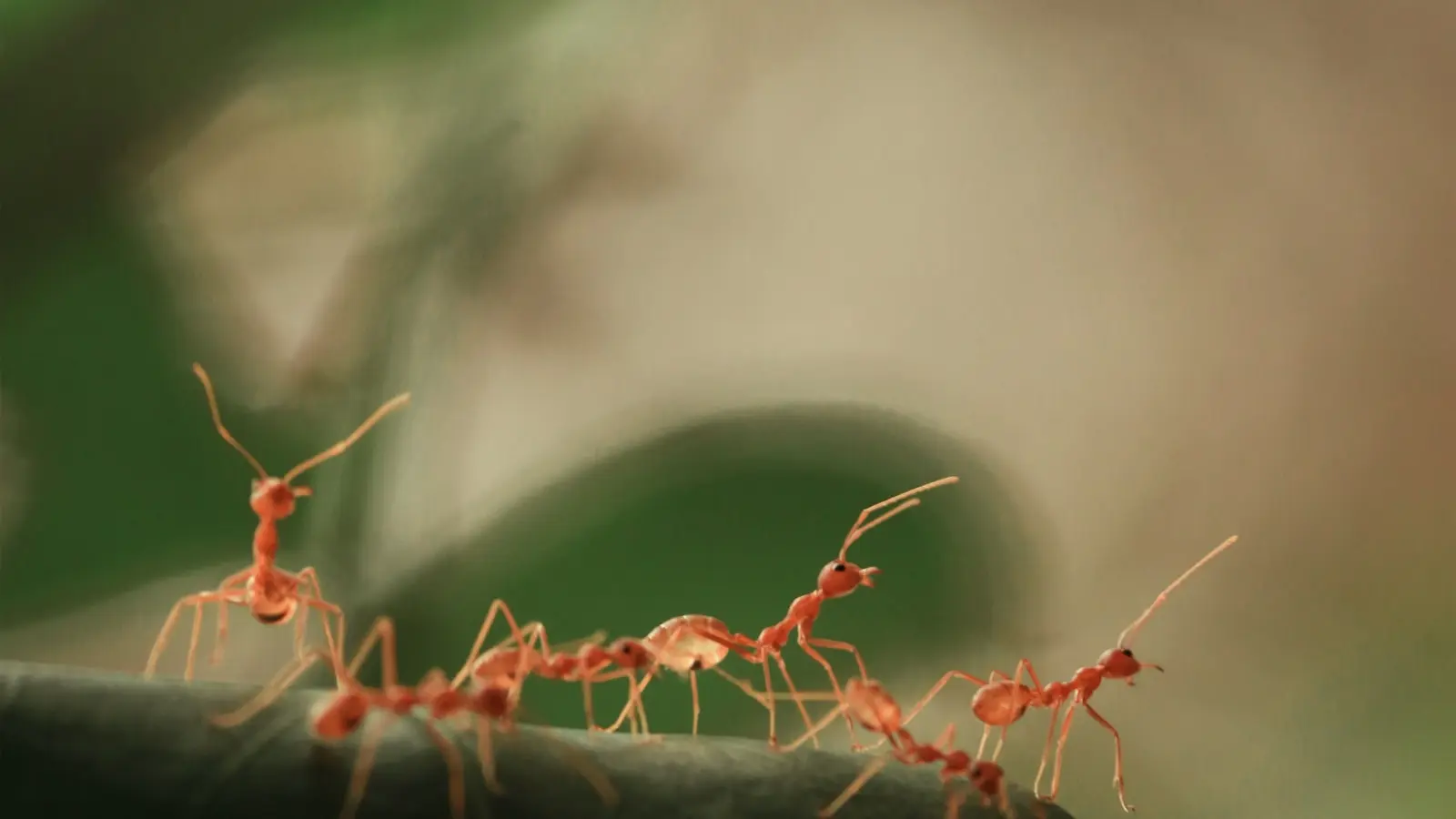

The security protocols of an ant colony are ruthless. Chemical sensors patrol the perimeter, and intruders are usually dismantled on sight. Yet, deep inside these biological fortresses, a pink caterpillar sleeps safely among the brood. It is not a prisoner. It is a guest of honor.
This is the Lycaenidae butterfly, a species that has evolved to hack the most secure operating system in the insect world. A study published in the Annals of the New York Academy of Sciences reveals that these caterpillars do not merely disguise themselves; they perform. By mimicking the complex acoustic rhythms of the colony, they trick ants into carrying them home. Once inside, they feast on the ants’ own resources. The ants, deceived by the code, protect the parasite as if it were royalty.
Evolution favors the grifter.
The Acoustic Trojan Horse
The premise of the heist is simple. An ant colony is a concentration of resources—food, shelter, and humidity—in a hostile environment. Dr. Rachelle Adams, an evolutionary biologist at Ohio State University, describes them as “well-defended fortresses.” For a soft-bodied caterpillar, access to this fortress ensures survival. The problem is the guard at the door.
For centuries, entomologists understood that Lycaenidae caterpillars used chemical secretions to appease ants. They produce sugary droplets (a bribe) and mimic pheromones (a disguise). But chemistry alone often fails to explain the depth of the integration. The new data suggests the final key is sonic.
Researchers at the University of Turin and the University of Warwick placed tiny, hypersensitive microphones into the dirt. They recorded tens of thousands of pulses exchanged between ants and butterflies. The analysis revealed that the caterpillars are not just making noise; they are keeping time.
Rhythm as a Password
Previous research focused on the pitch or tone of insect signals. The new findings indicate that rhythm is the true authenticator. The caterpillars produce a complex series of beats that mirror the tempo of the host ants. It is a biological shibboleth. If the rhythm syncs, the door opens.
Dr. Chiara De Gregorio, the ecologist leading the study, notes that this mimics human communication. It is not just what is said, but the cadence of the delivery. The recordings show that caterpillars fully dependent on ants for survival—obligate parasites—have evolved rhythms that are nearly indistinguishable from their hosts. Those species that can survive alone are sloppy beat-keepers.
(Survival demands perfection.)
The stakes are absolute. If the caterpillar fails the acoustic test, it is eaten. If it succeeds, it is carried into the nest. There, the deception darkens. Some caterpillars are fed by the ants directly; others proceed to devour the ants’ larvae while the adults stand by, paralyzed by the acoustic and chemical spell.
The Evolutionary Arms Race
This interaction represents a sophisticated evolutionary arms race. As ants evolve more complex recognition codes to identify intruders, the butterflies evolve better mimicry to crack them. Dr. Adams notes that the ants are constantly trying to keep the parasites out, while the parasites are constantly refining their entry codes.
What makes this discovery significant is the complexity of the rhythm. Complex acoustic patterns are rare in the insect world, usually reserved for primates or birds. Finding such sophisticated modulation in a caterpillar challenges our understanding of insect intelligence and adaptation. Konrad Fiedler, an entomologist at the University of Vienna, calls the code-breaking capability of these insects “demanding.”
The caterpillar does not just hide. It lies. It speaks the language of the colony fluently enough to rob it blind, proving that in nature, the most dangerous weapon is often a convincing voice.